What Is the Difference Between a Substation Protection Panel and a Control and Monitoring Panel?
1. Key Difference
- Protection panels and control and monitoring panels are both essential components of a substation secondary system, but they perform different functions:
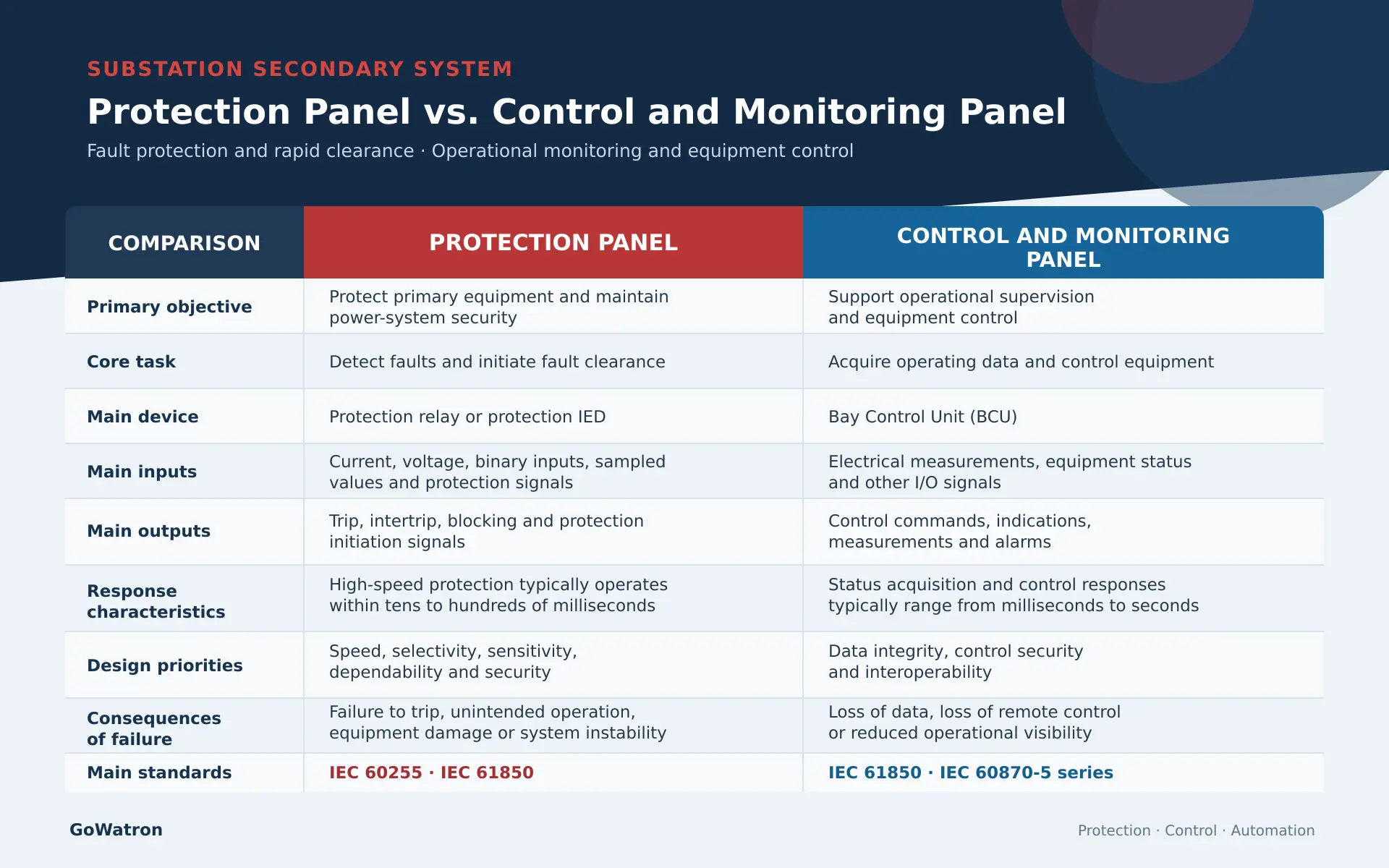
- A protection panel detects electrical faults and initiates fault clearance, while a control and monitoring panel acquires operating data and controls primary equipment.
- In simple terms, the protection panel safeguards primary equipment and power-system stability, while the control and monitoring panel supports operational supervision and control.
2. What Is a Protection Panel?
- A protection panel houses protection relays or intelligent electronic devices (IEDs) used for power-system protection.
- When a short circuit, earth fault, overload or other abnormal condition occurs on a transmission line, transformer, busbar or other primary equipment, the protection IED evaluates current, voltage and status signals. If the configured operating criteria are met, it issues a trip command to the appropriate circuit breaker to isolate the faulted element.
2.1 Main Functions
- Fault detection and evaluation;
- Circuit-breaker tripping;
- Differential, distance, overcurrent and earth-fault protection;
- Automatic reclosing and circuit-breaker failure protection;
- Intertripping and protection blocking;
- Fault recording and event logging;
- Transmission of protection status, alarms and trip indications.
2.2 Common Types
- Line protection panel;
- Transformer protection panel;
- Busbar protection panel;
- Generator protection panel;
- Motor protection panel;
- Bus-coupler or bus-section protection panel.
Protection systems are designed with particular emphasis on operating speed, selectivity, sensitivity, dependability, security and functional independence.
High-speed main protection typically issues a trip command within tens to hundreds of milliseconds. Time-delayed and backup protection operates according to the configured settings and protection coordination requirements.
3. What Is a Control and Monitoring Panel?
- A control and monitoring panel houses bay control units, measurement and control IEDs, and associated input/output equipment.
- The principal device used for a line, transformer, bus coupler or other bay is commonly called a Bay Control Unit (BCU).
- The BCU acquires the positions of circuit breakers, disconnectors and earthing switches, as well as current, voltage, active power, reactive power, frequency and other operating data. It also executes authorized local or remote control commands.
3.1 Main Functions
- Acquisition of circuit-breaker, disconnector and earthing-switch positions;
- Acquisition of equipment operating status;
- Measurement of current, voltage, active power, reactive power and frequency;
- Opening and closing control of circuit breakers and other switching devices;
- Control-authority verification and interlocking checks;
- Sequence-of-events (SOE) recording and status-change logging;
- Transmission of indications, measurements, events and alarms to the Supervisory Control and Data Acquisition (SCADA) system;
- Data exchange with the remote control centre through a telecontrol gateway or Remote Terminal Unit (RTU).
Common configurations include line bay control panels, transformer bay control panels, bus-coupler control panels and common control and monitoring panels.
4. Protection Panel vs. Control and Monitoring Panel
5. How Do the Two Panels Work Together?
- During normal operation, the control and monitoring panel continuously acquires equipment status and electrical measurements and sends them to the substation SCADA system. Operators can monitor primary equipment and issue commands such as circuit-breaker opening and closing through the control system.
- When a fault occurs, the protection panel evaluates the electrical quantities and operating conditions. If the protection criteria are satisfied, it sends a trip command to the appropriate circuit breaker. Protection operations, fault information and related alarms are then transmitted to the SCADA or fault information system for analysis.
Their respective roles can be summarized as follows:
- The control and monitoring panel provides operational visibility, measurement and control;
- The protection panel provides accurate fault detection and rapid fault clearance.
Where protection and control are implemented independently, a failure of the control and monitoring system should not prevent the protection system from detecting a fault and tripping the required circuit breaker.
6. Can Protection and Control Functions Be Integrated?
Yes.
- In many medium- and low-voltage applications, protection, measurement, control, communication and event-recording functions can be integrated into a single IED. This type of equipment is commonly called an:
Integrated Protection and Control Device
or:
Protection and Control IED
- Integrated devices can reduce the number of panels, simplify secondary wiring and improve system integration. They are widely used in many applications at 35 kV and below. Some utilities also apply integrated solutions at higher voltage levels.
- Their use depends on local grid codes, utility practices, reliability requirements and project specifications. Voltage level alone should therefore not be treated as the sole criterion for determining whether protection and control functions may be integrated.
- In many high-voltage and extra-high-voltage substations, protection and control functions continue to be implemented using separate devices, DC auxiliary power circuits or communication arrangements to reduce the risk of common-cause failures.
- It is also important to distinguish between protection-system redundancy and physical panel arrangement:
- Two independent protection systems do not necessarily require two separate protection panels.
- The two systems may be installed in separate panels or arranged in independent sections of the same panel, depending on the project design and applicable utility requirements.
7. Applicable International Standards
- The IEC 60255 series specifies requirements for measuring relays and protection equipment.
- IEC 61850 covers communication networks and systems for power utility automation, including standardized data models, communication services and system configuration.
- The IEC 60870-5 series applies to telecontrol equipment and systems used for data exchange between substations and remote control centres.
- The IEC 62271 series primarily applies to high-voltage switchgear and controlgear. It should therefore not be presented as the principal product standard for a substation protection panel or control and monitoring panel.
- The applicable standards, grid codes, utility requirements and technical specifications should be confirmed for each project and country.
8. Conclusion
- Although protection panels and control and monitoring panels may have a similar appearance, they perform fundamentally different tasks:
- A protection panel detects faults and initiates rapid fault clearance to protect primary equipment and the power system. A control and monitoring panel acquires operating data, monitors equipment status and executes control commands.
- The two systems complement each other and together form an essential part of a complete substation secondary system.


