What Are the Advantages of Wall-Mounted DC Power Supply Systems?
Document Type: Technical Articles
Document Published: 2026-11-06
Last Updated: 2026-11-06
- The main advantage of a wall-mounted DC power supply system is its ability to integrate rectification and battery charging, battery-backed supply, DC distribution and intelligent monitoring within a compact installation. It provides a space-saving, manageable DC auxiliary power solution for applications with relatively low DC loads.
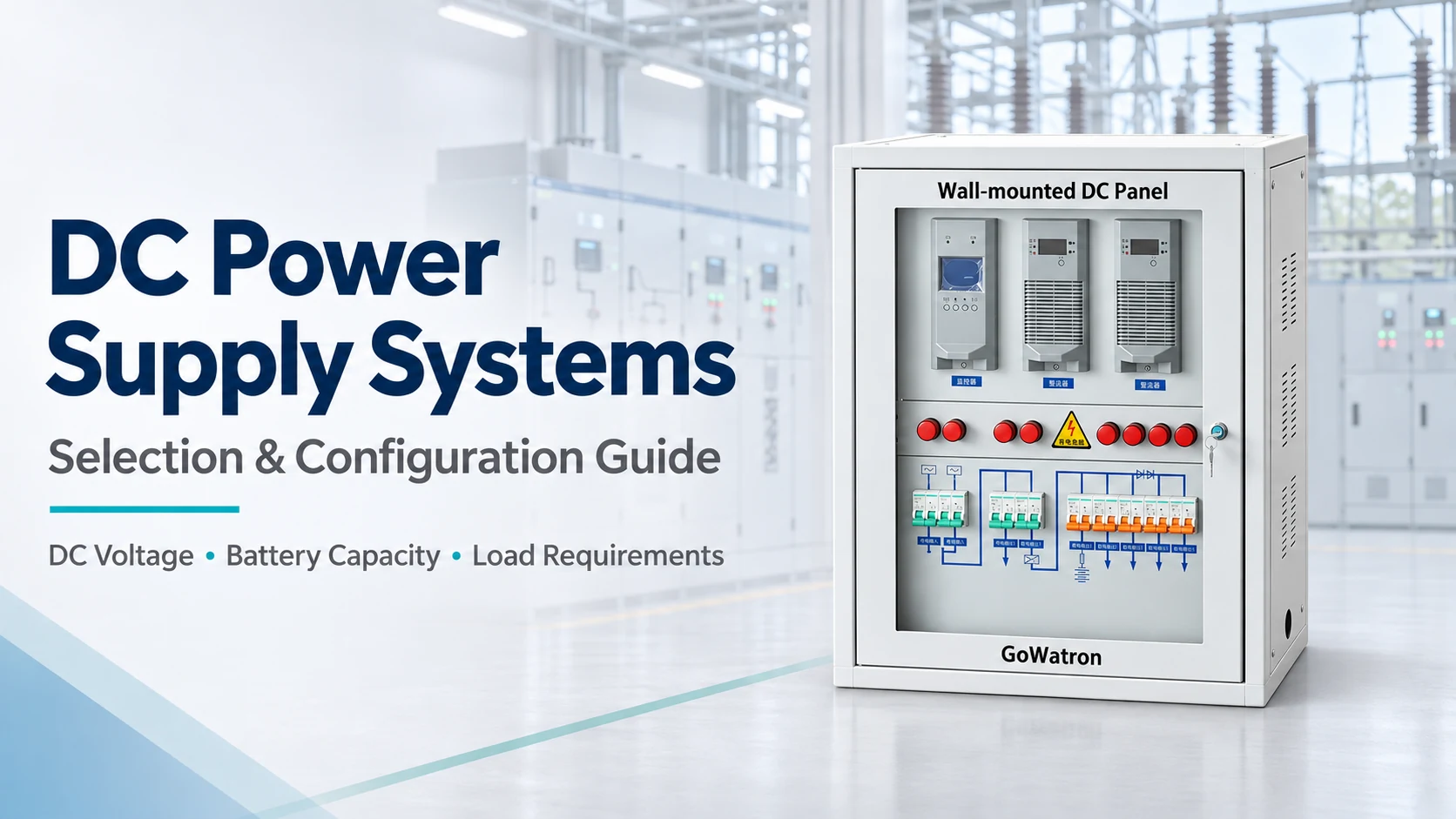
- Wall-mounted DC power supply systems are well suited to small substations, switching stations and distribution rooms with limited installation space and a small number of outgoing DC feeders. The GoWatron GWPS-DCW series offers five battery capacity options: 12 Ah, 20 Ah, 24 Ah, 30 Ah and 40 Ah, allowing selection according to the load requirements and required backup duration.
1. Space and Construction Advantages: Compact Layout and Convenient Installation
1.1 Wall-Mounted Installation Reduces Floor Space Requirements
- Wall-mounted DC power supply systems are installed on a wall, reducing the floor space required compared with floor-standing DC panels. This arrangement is suitable for compact distribution rooms and retrofit projects at existing sites.
- Before installation, the wall’s load-bearing capacity, the total equipment weight and the mounting method must be verified. Adequate clearance must be provided for door opening, cable connections, heat dissipation and maintenance. Where batteries are included, access for battery inspection and replacement must also be considered.
1.2 Integrated Design Simplifies Site Wiring
- By bringing several functional units together, a wall-mounted DC power supply system reduces interconnections between separate devices and simplifies installation, wiring and commissioning.
- For example, the 24 Ah configuration of the GoWatron GWPS-DCW series integrates rectification and charging, battery management, silicon-diode voltage reduction, DC distribution, insulation monitoring and alarm functions to form a complete DC auxiliary power system. The components and battery arrangement of other capacity versions should be confirmed against the relevant configuration.
1.3 Modular Construction Facilitates Maintenance
- A modular rectifier arrangement allows charging capacity to be selected according to the DC load and battery charging requirements. It also facilitates maintenance and spare-parts management.
- Configurations using naturally cooled rectifier modules can reduce maintenance requirements by eliminating cooling fans. However, natural cooling still requires adequate heat dissipation. Suitability for dusty environments depends on the enclosure’s ingress protection rating and the installation conditions.
2. Power Supply Advantages: Supporting Normal Operation and Battery Backup
2.1 Stable DC Supply for Protection and Control Equipment
- Wall-mounted DC power supply systems can supply protection relays, automation equipment, control circuits, signalling circuits and circuit-breaker operating mechanisms.
- A stable auxiliary power supply is essential for the correct operation of protection and control equipment. In addition to rated output voltage, selection should consider voltage regulation accuracy, output ripple voltage, dynamic response and the permissible supply-voltage range of the connected loads. Specific performance values must be taken from the technical documentation for the selected configuration.
2.2 Continued Battery Supply Following AC Failure
- During normal operation, the rectifier modules supply the DC loads and charge the battery bank. If the AC supply fails, the battery bank supplies the DC bus, maintaining power to essential protection, control and operating circuits. The GoWatron GWPS-DCW 24 Ah configuration uses this supply arrangement.
- Backup capability depends on battery capacity, continuous load, the number and duty of switching operations, battery condition and circuit voltage drop. It must therefore be assessed against the actual operating requirements.
2.3 Rectifier Capacity Can Be Matched to the Load
- Rectifier capacity must meet both the continuous DC load and the battery charging requirement. Appropriate sizing helps prevent sustained overload and avoids unnecessary capacity.
- If rectifier redundancy is required, the capacity of the remaining modules must be checked to confirm that they can supply the specified load with one module out of service. Parallel operation of multiple modules does not, by itself, establish redundancy.
3. Battery Management Advantages: Less Manual Adjustment and Better Status Visibility
3.1 Automatic Charging Management
- Systems equipped with intelligent charging management can provide float charging, boost charging and charge-current limiting according to preset conditions, reducing the need for manual intervention.
- The GoWatron GWPS-DCW 24 Ah configuration supports float charging, boost charging and charge-current limiting, together with battery-voltage and charge/discharge-current monitoring.
- Appropriate charging management helps reduce the effects of unsuitable charging conditions on battery performance. Periodic inspection of connections, operating conditions and battery condition remains necessary.
3.2 Multiple Battery Capacities for Different Applications
- The GoWatron GWPS-DCW series offers the following battery capacity options:
- GWPS-DCW Wall-Mounted DC Power Supply System
Available Rated Battery Capacities:12 Ah, 20 Ah, 24 Ah, 30 Ah and 40 Ah - These options allow battery capacity to be matched to the load and required backup duration. Final selection must account for battery discharge characteristics, ambient temperature, ageing allowance and the permissible end-of-discharge voltage.
- Battery capacity does not correspond to a fixed backup duration and cannot, on its own, determine the number of switchgear panels that the system can supply.
4. Monitoring and Communication Advantages: Convenient Local and Remote Supervision
4.1 Centralised Display of Operating Data
- A system monitoring unit allows operating personnel to view system voltages, currents, equipment status and alarms from a central interface, facilitating local inspection and parameter management.
- The display language, operating interface, adjustable parameters and access permissions should be confirmed according to the monitoring unit supplied and the project requirements.
4.2 Early Identification of Abnormal Conditions
- AC supply failure, abnormal DC bus voltage, battery abnormalities and reduced insulation resistance can affect DC system reliability. Monitoring and alarms help operating personnel identify these conditions and arrange corrective action.
- Insulation monitoring detects abnormal insulation resistance between the DC system and earth. Identification of the specific faulty feeder requires suitable feeder-level insulation monitoring or earth-fault location functionality.
4.3 Integration with Automation or SCADA Systems
- Communication facilities allow measurements, operating status and alarms to be transmitted to a supervisory system, supporting centralised monitoring and reduced on-site staffing.
- The published GoWatron GWPS-DCW 24 Ah configuration provides one RS-485 interface with Modbus RTU as standard. An RS-232 interface and other communication options can be provided according to project requirements. For other capacity versions, the interface, protocol and communication point list should be specified when ordering.
- Remote control and remote parameter adjustment depend on the implemented functions and configured access permissions. The presence of a communication interface alone does not establish support for all remote monitoring and control functions.
5. Economic Advantages: Suitable for Small DC Power Applications
- For projects with relatively low DC loads, a limited number of outgoing feeders and restricted installation space, a wall-mounted DC power supply system can reduce installation work and help match the equipment scope to the actual requirements.
- Project costs should be assessed against the complete supply scope, including batteries, mounting brackets, distribution circuits, communication options, installation and subsequent maintenance. Where larger battery capacities, numerous outgoing feeders or more complex redundancy arrangements are required, the overall suitability of wall-mounted and floor-standing solutions should be compared.
6. Typical Applications and Selection Considerations
Wall-mounted DC power supply systems are suitable for small switching stations, customer substations, distribution rooms, ring main unit installations and compact substations, provided that a DC load assessment confirms their suitability.
Typical loads include:
- Protection relays, measurement devices and control equipment;
- Automation and communication equipment;
- Circuit-breaker opening and closing circuits and associated operating circuits;
- Signalling and alarm circuits;
- Other DC loads, subject to capacity assessment and project requirements.
The following items should be checked during selection:
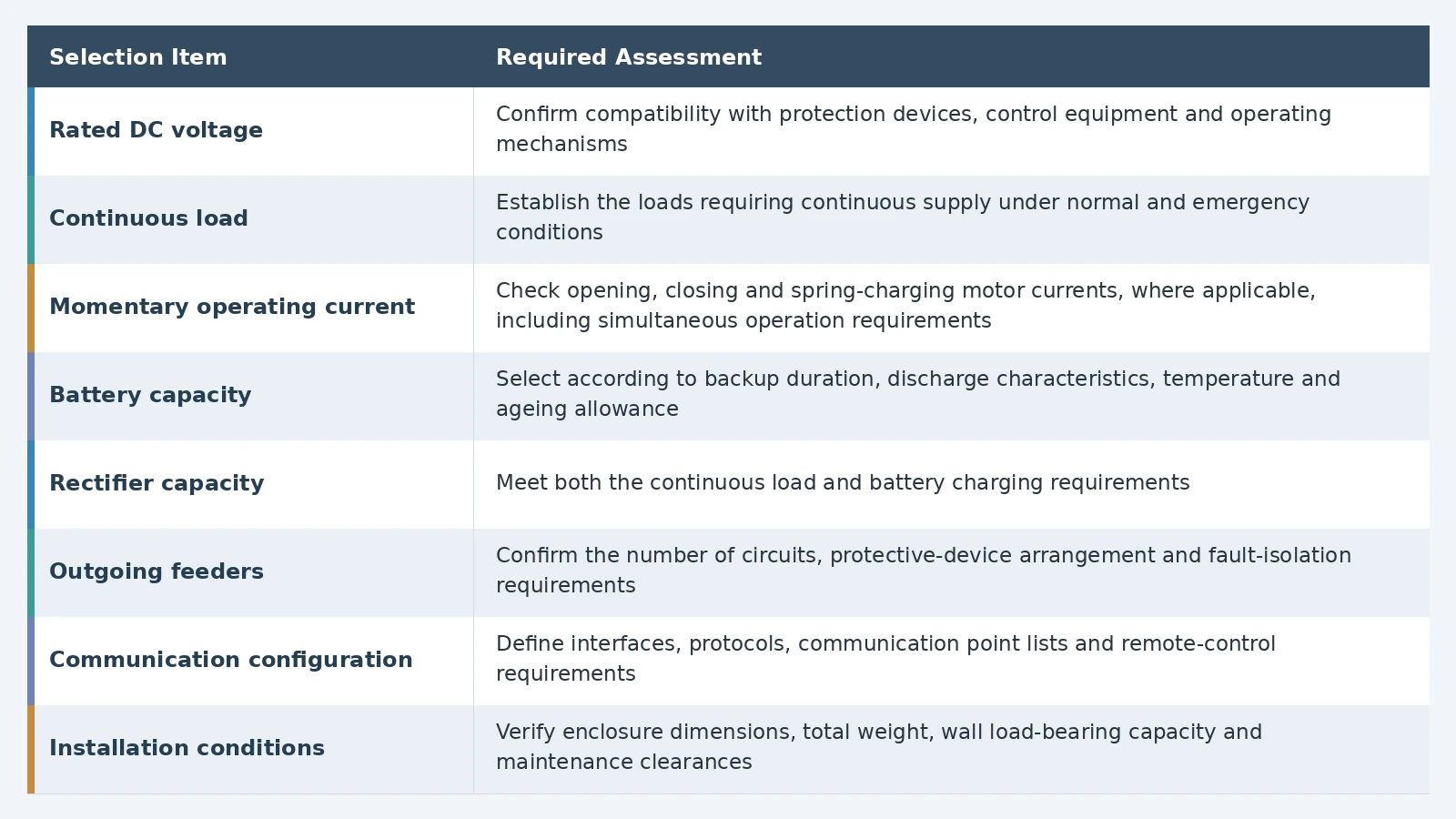
The GoWatron GWPS-DCW series provides 12 Ah, 20 Ah, 24 Ah, 30 Ah and 40 Ah configurations for selection against these requirements. Enclosure dimensions, weight, rectifier module quantity and charging current must be confirmed separately for each capacity version; a single set of specifications should not be applied to all configurations.


