Which Generators Need Generator Protection Relays?
- Generators can experience stator winding faults, earth faults, overloads, loss of excitation, reverse power, and abnormal voltage or frequency conditions. Hydro, steam turbine, diesel and gas generators all require protection suited to their operating conditions.
- Every generator needs appropriate protection, but not every generator requires a separate generator protection relay. On smaller units, the required functions may be provided by a generator controller, a circuit breaker and individual protection devices. Larger, grid-connected or operationally critical units generally require a more comprehensive dedicated protection scheme.
- This article uses British English and IEC-oriented terminology. The term earth fault is equivalent to ground fault in US usage. ANSI device numbers are included to identify common protection functions.
- The protection scheme should be selected according to the generator rating, voltage, earthing arrangement, operating mode, current transformer (CT) and voltage transformer (VT) configuration, and the requirements of the generator manufacturer and grid operator.
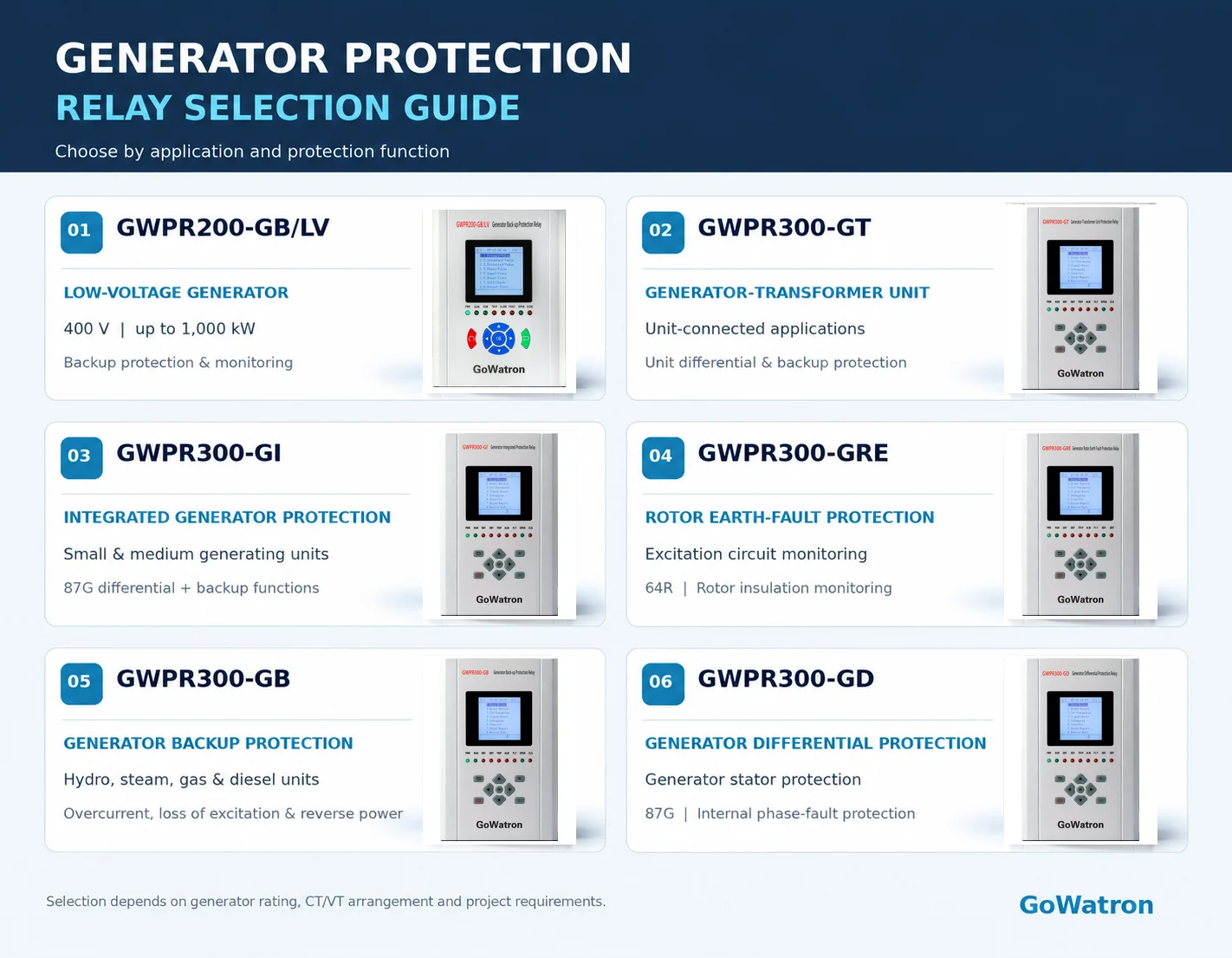
1. Which Types of Generator Need Dedicated Protection?
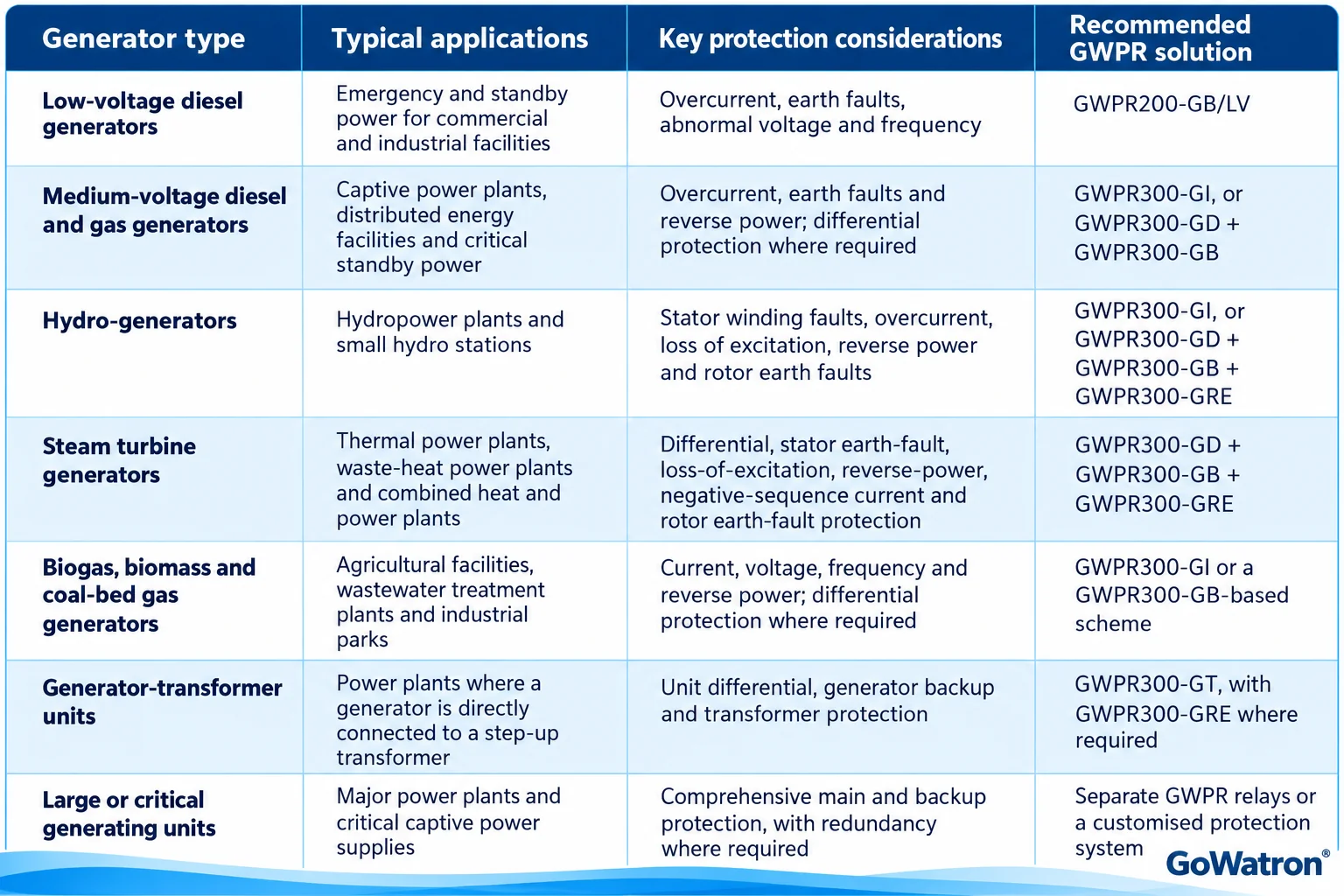
Grid-interface protection at the grid connection point and generator protection should be considered separately. Grid-interface protection, such as voltage, frequency and anti-islanding protection, does not automatically replace generator differential, loss-of-excitation or rotor earth-fault protection.
Anti-islanding protection is a grid-interface function and does not necessarily correspond to a single ANSI device number. The protection boundary should be defined in the project scheme.
2. Protection Requirements and Product Recommendations by Generator Type
2.1 Low-Voltage Diesel Generators
Low-voltage diesel generators are commonly used in hospitals, hotels, commercial buildings, factories and communication facilities.
Depending on the application, the protection scheme may include:
- Overcurrent protection (ANSI 50/51): Detects abnormal currents associated with short circuits or overloads.
- Earth-fault overcurrent protection (ANSI 50N/51N): Detects earth-fault current where the earthing arrangement and measurement method permit.
- Overvoltage and undervoltage protection (ANSI 59/27).
- Overfrequency and underfrequency protection (ANSI 81O/81U): Coordinated with the generator controller.
For diesel generators operating in parallel with other units or connected to the grid, reverse-power protection (ANSI 32, often designated 32R) should also be considered according to the prime mover and operating arrangement.
The exact earth-fault function and its designation depend on the relay configuration and neutral earthing arrangement.
Recommended product: GWPR200-GB/LV Low-Voltage Generator Backup Protection Relay
The GWPR200-GB/LV is intended for 400 V generators rated up to 1,000 kW, including standby, emergency and small distributed-generation applications.
The functions already provided by the generator controller and circuit breaker should be reviewed to determine the required relay configuration and protection coordination.
Typical application:
A 400 V diesel generator set requiring protection against abnormal output current, voltage and earth faults, with protection status connected to a power plant monitoring system.
2.2 Hydro-Generators
Hydro-generators may be exposed to stator winding faults, stator earth faults, overloads, excitation failures and unbalanced currents.
Depending on the unit rating, connections and project requirements, the protection scheme may include:
- Generator differential protection (ANSI 87G): Detects phase-to-phase faults within the protected zone.
- Stator earth-fault protection (ANSI 64G, depending on the protection method): Detects stator earth faults according to the generator earthing arrangement and measurement circuits.
- Negative-sequence current protection (ANSI 46): Helps protect the rotor against heating caused by unbalanced operation.
- Loss-of-excitation protection (ANSI 40).
- Reverse-power protection (32R).
- Rotor earth-fault protection (ANSI 64R): Monitors the excitation circuit where rotor earth-fault monitoring is required and configured.
Stator earth-fault protection may use different measuring principles, such as residual overvoltage (59N), depending on the scheme. A particular ANSI designation does not by itself establish the percentage of winding coverage.
Option A: Small hydro-generators
Recommended product: GWPR300-GI Generator Integrated Protection Relay
The GWPR300-GI combines generator differential and backup protection functions in one device. It is suitable for projects seeking to reduce the number of relays, panel space and secondary wiring.
Its typical hydro-generator application range is up to 3 MW.
Recommended combination: GWPR300-GI + GWPR300-GRE
Add the GWPR300-GRE where separate rotor earth-fault monitoring is required for the excitation circuit.
Option B: Hydro-generators requiring separate protection devices
Recommended combination: GWPR300-GD + GWPR300-GB + GWPR300-GRE
- GWPR300-GD;Generator differential protection (87G)
- GWPR300-GB;Generator backup and abnormal-operating-condition protection functions
- GWPR300-GRE;Generator rotor earth-fault protection
The GWPR300-GB includes functions such as overcurrent, loss-of-excitation and reverse-power protection. Some functions provide backup protection for faults, while others respond to abnormal generator operating conditions.
This combination is suitable for projects requiring differential, backup and rotor earth-fault protection to be provided by separate devices. GoWatron also offers the GWPC300-GP Generator Protection Panel, which incorporates these relays.
2.3 Steam Turbine Generators
- Steam turbine generators are widely used in thermal power plants, industrial waste-heat recovery and combined heat and power projects.
- Since a unit shutdown may affect the entire plant, a comprehensive protection scheme is generally selected according to the generator rating and operational importance.
Key functions may include:
- Generator differential protection (ANSI 87G): Provides fast protection against stator phase-to-phase faults within the protected zone.
- Stator earth-fault protection (ANSI 64G, depending on the protection method): Selected according to the earthing arrangement and required coverage.
- Loss-of-excitation protection (ANSI 40): Detects abnormal excitation conditions.
- Reverse-power protection (32R): Detects power flowing from the system into the generator when prime-mover input is insufficient or lost.
- Negative-sequence current protection (ANSI 46): Helps limit rotor heating caused by unbalanced currents.
- Rotor earth-fault protection (ANSI 64R): Monitors the excitation circuit where rotor earth-fault monitoring is required and configured.
- Overvoltage and undervoltage protection (ANSI 59/27).
- Overfrequency and underfrequency protection (ANSI 81O/81U).
Recommended products
- Small steam turbine generators: GWPR300-GI. Its typical steam turbine generator application range is up to 10 MW.
- Units requiring separate protection devices: GWPR300-GD + GWPR300-GB + GWPR300-GRE.
- Projects requiring a complete panel: GWPC300-GP Generator Protection Panel.
The GWPR300-GD and GWPR300-GB product descriptions list applications for steam turbine generators rated up to 100 MW. The relay version, protection functions and generator connections should be verified for each project.
2.4 Gas, Biogas, Biomass and Coal-Bed Gas Generators
These generators are commonly used in gas-fired power plants, wastewater treatment plants, livestock farms, landfill sites and industrial parks. They may operate in island mode or in parallel with the grid.
The protection scheme should address both generator protection and grid-interface protection at the grid connection point.
- Generator Overcurrent;earth fault, negative-sequence current, loss of excitation, reverse power, and abnormal voltage or frequency
- Generator windings;Differential protection, depending on unit rating, importance and CT configuration
- Grid interface;Voltage, frequency, anti-islanding and other interface protection required by the grid operator
Recommended product: GWPR300-GI Generator Integrated Protection Relay
The GWPR300-GI is an option for small and medium-sized units requiring generator differential and backup protection in one device.
Its listed applications include diesel generator sets, biogas plants, coal-bed gas power plants and gas-fired power plants.
Where separate devices are required, consider:
GWPR300-GD + GWPR300-GB, with GWPR300-GRE added according to the excitation system and project requirements.
The final grid-interface protection scheme should be selected according to the applicable grid connection requirements.
2.5 Medium-Voltage and Large Diesel Generator Sets
Medium-voltage diesel generators are used in large industrial facilities, mines, data centres and independent power plants. They may operate continuously, run in parallel with other units or supply critical loads.
In addition to overcurrent, earth-fault and voltage/frequency protection, the project should consider:
- Generator differential protection (ANSI 87G);
- Reverse-power protection (32R);
- Negative-sequence current protection (ANSI 46);
- Loss-of-excitation protection (ANSI 40);
- Circuit-breaker failure protection (ANSI 50BF) and other system-level protection, where required;
- Coordination between the generator relay, generator controller and switchgear protection.
Circuit-breaker failure protection is a project-level protection consideration. Its inclusion in a particular relay or panel configuration should be confirmed separately.
Recommended solutions
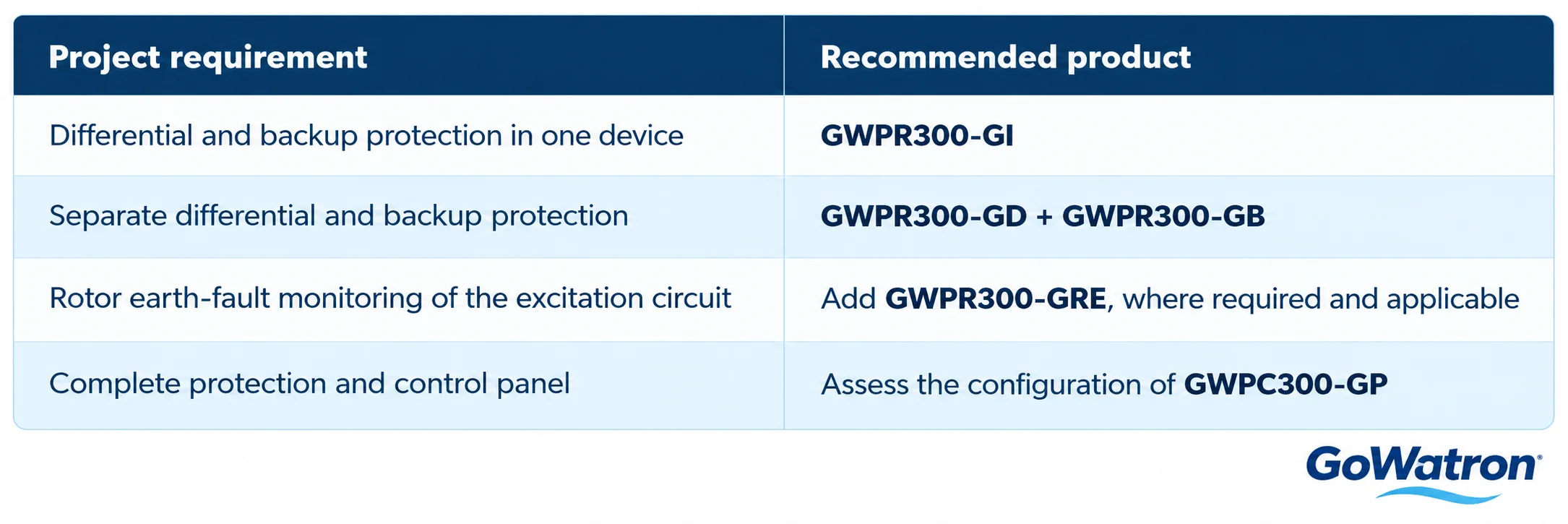
Generator differential protection requires suitable CTs and secondary connections at both ends of the protected zone. The generator neutral arrangement, CT ratios, accuracy classes and installation positions should be checked before selecting the relay.
2.6 Generator-Transformer Units
Where a generator is directly connected to a step-up transformer as a generator-transformer unit, the protection scheme should be designed around the primary connections and the required protection zone.
The scheme may need to consider:
- Protection of the conductors between the generator and transformer;
- Generator-transformer unit differential protection;
- Transformer magnetising inrush and CT configuration;
- Generator backup and abnormal-operating-condition protection;
- Transformer Buchholz, pressure, temperature and other non-electrical protection;
- Generator rotor earth-fault protection.
Recommended product: GWPR300-GT Generator-Transformer Unit Protection Relay
The GWPR300-GT is intended for generator-transformer unit protection, including generator-transformer unit differential protection. The boundaries of the differential protection zone depend on the primary connections and CT locations.
Recommended combination: GWPR300-GT + GWPR300-GRE
Suitable for projects requiring generator-transformer unit protection and rotor earth-fault protection.
The final scheme should also be coordinated with any separate transformer protection, unit controls and circuit-breaker trip circuits.
2.7 Large or Operationally Critical Generators
Large generating units, important captive power plants and projects with high-reliability requirements may need:
- Separate generator main and backup protection;
- Duplicated (redundant) protection where required by the project;
- Separate CT cores;
- Separate DC auxiliary supplies and trip circuits;
- Separate VT circuits and circuit-breaker trip coils, where required;
- Rotor earth-fault and other dedicated protection;
- Coordination with excitation, turbine control and power plant SCADA systems.
Recommended solution: Customised Generator Protection System
GWPR series devices can be selected according to the generator and project requirements, with a duplicated protection scheme assessed where required.
Duplicated protection involves more than adding a second relay. Independence should also be considered from measurement inputs and auxiliary supplies through to the final trip circuits.
3. How to Select a GWPR Series Generator Protection Relay
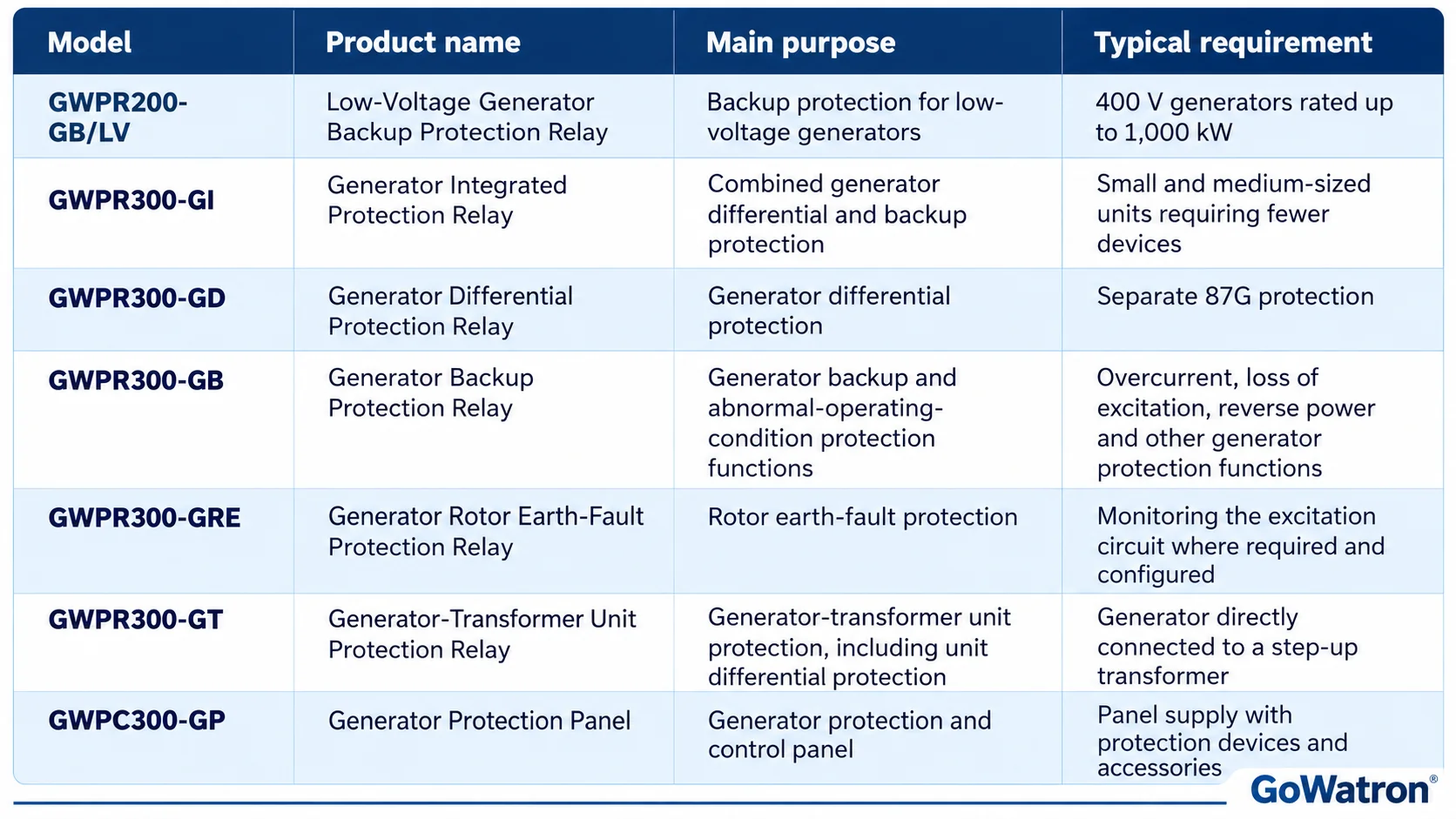
Quick selection guide
- Small 400 V low-voltage generator: Consider the GWPR200-GB/LV.
- Differential and backup protection in one device: Consider the GWPR300-GI.
- Separate differential and backup protection: Consider the GWPR300-GD + GWPR300-GB.
- Rotor earth-fault protection required: Assess whether to add the GWPR300-GRE.
- Generator directly connected to a step-up transformer: Assess the GWPR300-GT.
- Complete protection and control panel required: Assess the GWPC300-GP configuration.
4. Information Required to Select a Generator Protection Relay
The following information helps determine the appropriate relay and protection scheme:
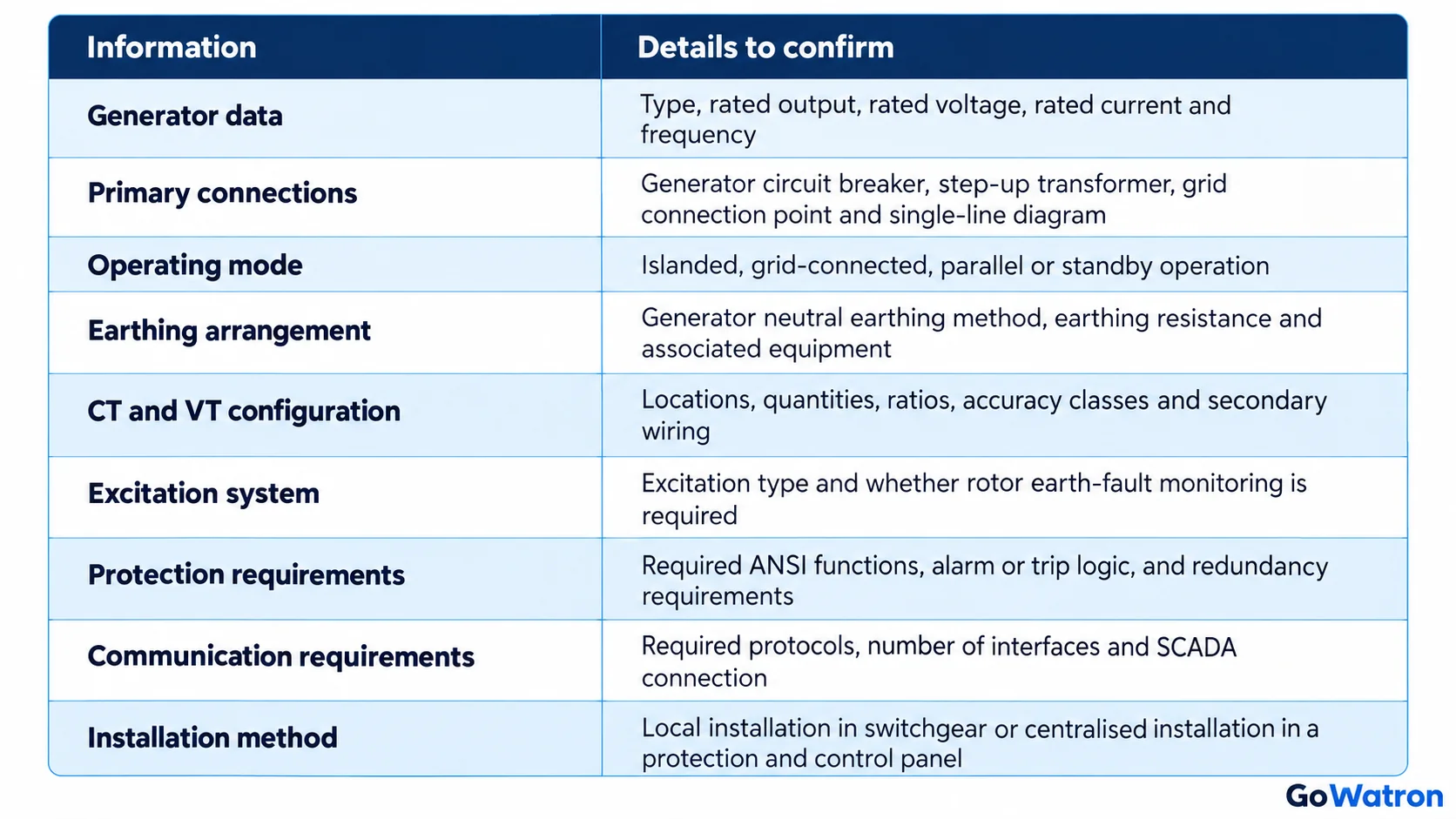
Generator differential, stator earth-fault and rotor earth-fault protection depend on the actual connections and measurement arrangements. They should not be selected on generator capacity alone. The final scheme should be confirmed against the generator manufacturer’s documentation, project specifications and protection settings.


