Technical Principles
Electrical Encyclopedia
Industry Solutions
Technical Knowledge Sharing
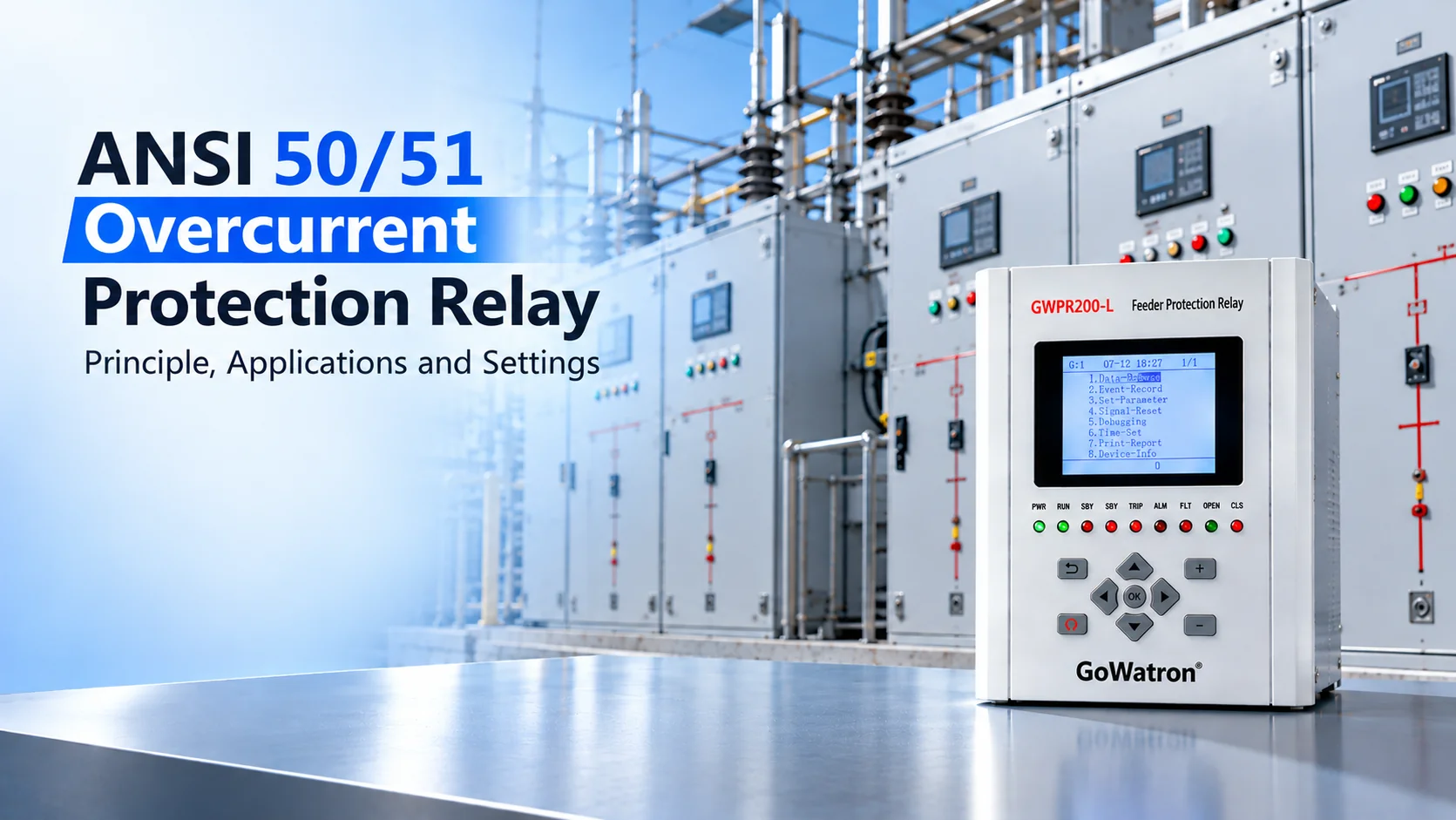
Where Are ANSI 50/51 Overcurrent Protection Relays Used?
1. What Is ANSI 50/51 Overcurrent Protection? An overcurrent protection relay continuously measures the current flowing through a power circuit. When the measured current exceeds the configured pickup value and the applicable operating criteria are satisfied, the relay issues a trip command to the circuit breaker. This isolates the faulty equipment or circuit section and […]
2026-09-09
Read more →
What Is the Difference Between a Substation Protection Panel and a Control and Monitoring Panel?
1. Key Difference Protection panels and control and monitoring panels are both essential components of a substation secondary system, but they perform different functions: A protection panel detects electrical faults and initiates fault clearance, while a control and monitoring panel acquires operating data and controls primary equipment. In simple terms, the protection panel safeguards primary […]
2026-09-09
Read more →
Line Differential Protection (87L) Setting Calculations
Line current differential protection (ANSI 87L) settings should be based on the relay algorithm, line charging current, CT performance and power-system short-circuit calculation results. The following settings are expressed in per-unit values based on the relay rated current\( I_{\mathrm{n}} \)and apply to protection relays with a rated current input of 1 A or 5 A. […]
2026-09-01
Read more →
Line Current Differential Protection (ANSI 87L): Functions, Protection Zone and Applications
The ANSI/IEEE device function number for line current differential protection is 87L. Its operating principle is based on comparing the currents measured at all line terminals and determining whether a fault is internal by calculating the difference between the currents entering and leaving the protected zone. Hereinafter, it is referred to as “line current differential […]
2026-08-31
Read more →
Line Current Differential Protection (ANSI 87L): Operating Principle and Restraint Characteristic
Line current differential protection (ANSI 87L) is a communications-assisted unit protection scheme that compares the currents measured at all terminals of the protected line. It is normally applied as the main protection for the line. The protection operates according to Kirchhoff’s current law. Current transformers (CTs) are installed at both ends, or at all terminals, […]
2026-08-31
Read more →
Motor Thermal Overload Protection (ANSI 49): Operating Principle and Setting Calculations
1. What Is ANSI 49 Protection? ANSI 49 is a protection function designed to prevent motor damage caused by excessive temperature and accumulated thermal stress. It is commonly referred to as: Motor Thermal Overload Protection Motor Thermal Model Protection Motor Thermal Replica Protection The function uses motor current, operating time, current unbalance, cooling conditions, and […]
2026-08-29
Read more →
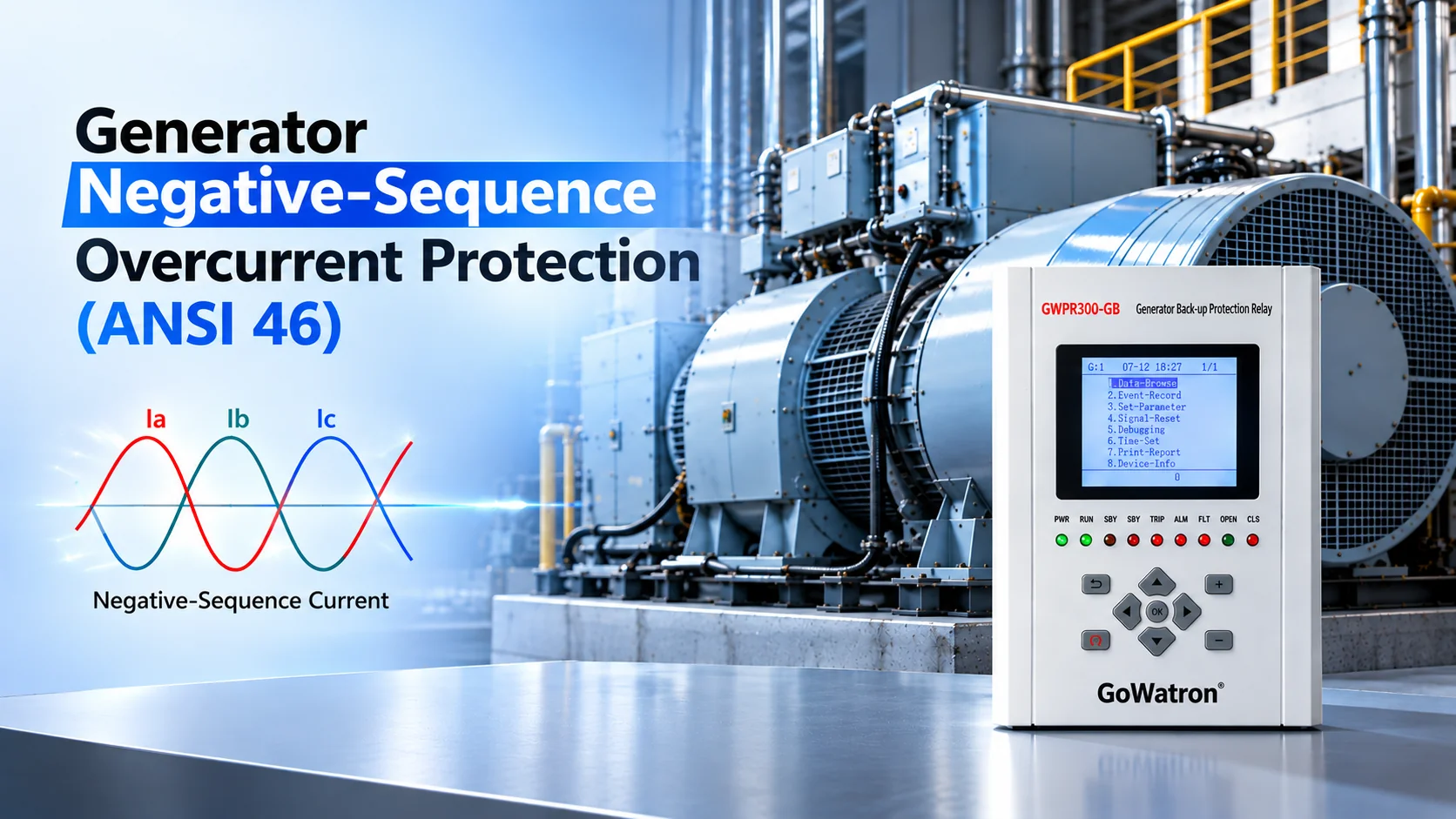
Generator Negative-Sequence Overcurrent Protection (ANSI 46): Principles, Functions and Setting Calculations
1. Protection Configuration Overview Generator negative-sequence overcurrent protection (ANSI 46) detects stator negative-sequence current arising from power-system unbalance and protects the rotor against the resulting thermal damage. It responds primarily to phase-to-phase faults, phase-to-phase-to-ground faults, open-conductor conditions, incomplete-pole operation of circuit breakers, and prolonged severe load unbalance. A single-phase-to-ground fault may also produce negative-sequence current, […]
2026-08-29
Read more →
Generator Protection System Selection Guide
1. General Overview GoWatron provides generator protection solutions for low-voltage generators, small and medium-sized generating units, unit-connected generator-transformer applications, and complete generator protection and control systems. The appropriate solution should be selected according to: Rated generator voltage and output Generator and step-up transformer connection arrangement Required protection functions Requirement for rotor earth-fault protection Integrated or […]
2026-08-29
Read more →


