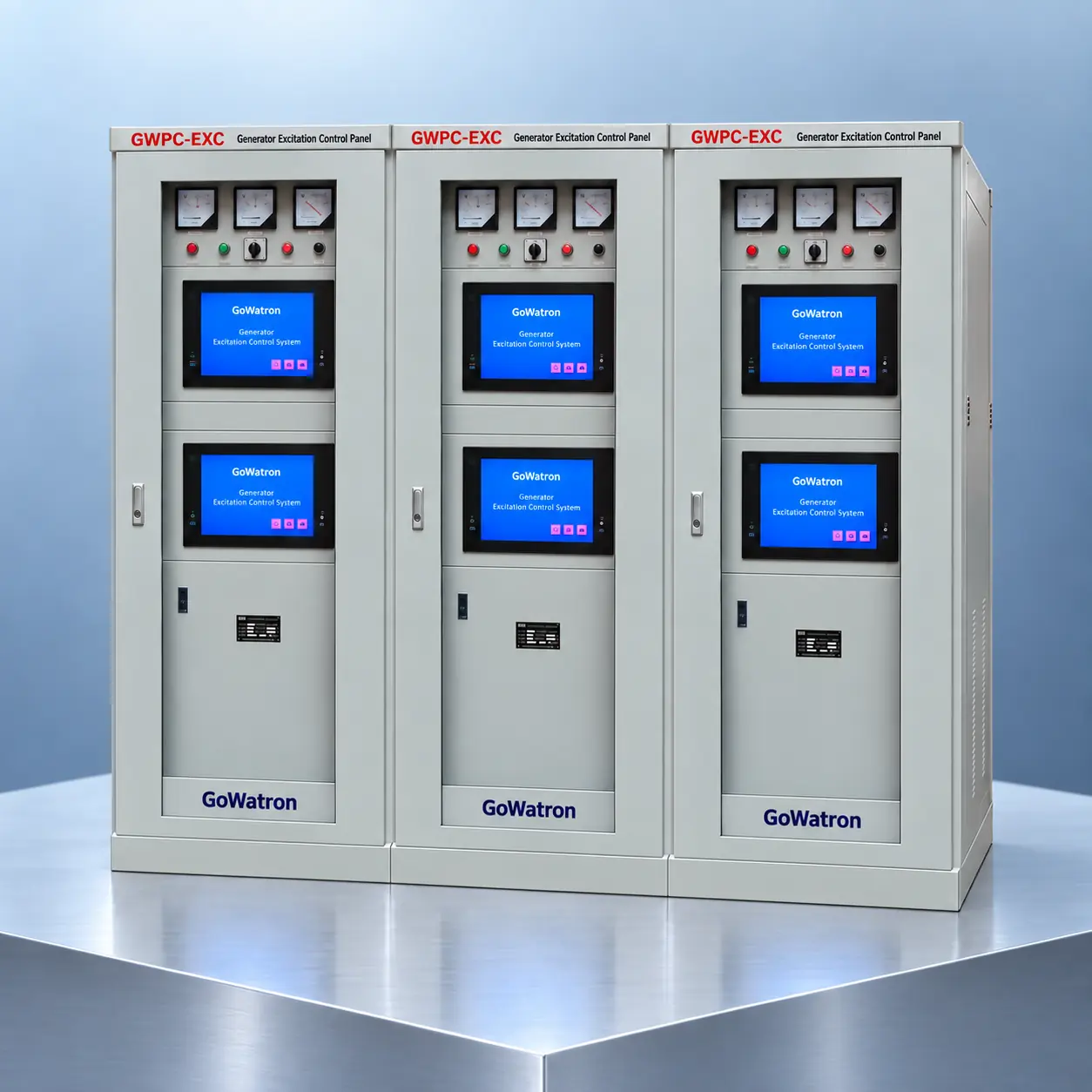
GWPC-EXC Generator Excitation Control Panel
- The GWPC-EXC Generator Excitation Control Panel is an essential control component of excitation systems for synchronous generators with ratings up to 300 MW. It continuously measures generator-terminal voltage, stator current, frequency, reactive power, power factor, and other operating quantities, and regulates the DC output of the thyristor rectifier accordingly. The controlled excitation output maintains the generator-terminal voltage at the required level and enables the generating unit to meet its reactive power control requirements during grid-connected operation.
- The GWPC-EXC provides automatic voltage regulation, manual field current control, operating limiters, logic control, fault monitoring, HMI, and communication functions. Depending on the generator rating, excitation method, and project requirements, the power rectifier, field-flashing unit, de-excitation unit, and excitation transformer may be supplied as integrated assemblies or as separate panels and equipment.
- The panel is widely used in hydropower plants, thermal power plants, industrial captive power plants, biomass power plants, waste-heat power generation facilities, and other facilities that operate synchronous generators. It plays an important role in ensuring the safe, stable, and efficient operation of the generator.




1. Product Description
- The GWPC-EXC Generator Excitation Control Panel provides automatic voltage regulation, field current control, operating limiter functions, logic control, condition monitoring, and communications with plant automation systems for synchronous generators.
- Under normal operating conditions, the excitation control panel regulates the excitation output based on the generator-terminal voltage and other measured quantities, maintaining the voltage within the specified range. During grid-connected operation, it can also regulate the generator’s reactive power and power factor to meet power-system operating requirements.
- When a power-system fault or significant voltage disturbance depresses the generator-terminal voltage, the excitation system can increase its output within the permissible operating limits, thereby improving the generator’s transient voltage-support capability.
- Modern excitation control panels typically use a dedicated digital automatic voltage regulator based on a high-performance microprocessor or industrial controller. Together with a thyristor rectifier, the digital AVR provides fast and precise control of the generator excitation. If required, a PLC may be used for auxiliary logic, sequential control, equipment interlocking, and system communication.
- Depending on the project configuration, the system can be equipped with automatic and manual control channels, channel tracking, fault-initiated changeover, residual-voltage build-up, external DC field flashing, field forcing, inverter de-excitation, rotor overvoltage protection, and operating limiters to meet the excitation control requirements of different synchronous generating units.
2. Main Functions
- Automatic voltage regulation: The excitation controller continuously measures the generator-terminal voltage and regulates the excitation output to maintain the voltage close to its setpoint. The typical steady-state voltage regulation accuracy is within ±0.5%, subject to the project specification and actual system configuration.
- Manual field current control: The excitation controller provides manual regulation of the generator field current as a backup to the automatic voltage control channel. The automatic and manual channels can track each other’s setpoints and provide a smooth transfer when the specified changeover conditions are satisfied.
- Supplementary control modes: Reactive power control and power factor control can be provided as required by the project to support reactive power management during grid-connected operation.
- Voltage build-up and field-flashing control: Depending on the generating unit and excitation system configuration, the generator can build up voltage from residual magnetism. If the residual voltage is insufficient, field flashing from an external DC supply is applied.
- Field-forcing control: If a power-system fault or significant reduction in generator-terminal voltage occurs, the excitation system can temporarily increase the field voltage and field current within its specified capability, thereby improving transient voltage support. The ceiling voltage, maximum field current, and permissible field-forcing duration are determined by the generator parameters, the thermal capability of the excitation system, and the project requirements.
- Operating limiters: Depending on the system configuration, the excitation controller can provide an overexcitation limiter (OEL), underexcitation limiter (UEL), field current limiter, V/Hz limiter, and stator current limiter to keep the generator within its permissible operating limits.
- De-excitation control: The excitation system performs de-excitation during normal shutdown or under fault conditions. Depending on the system design, this can be achieved by inverter de-excitation or by using a field breaker to connect the rotor field circuit to linear or nonlinear de-excitation resistors.
- Fault monitoring and protection: Depending on the selected configuration, available functions can include rotor overvoltage protection, generator-terminal voltage transformer (VT) circuit failure detection, rectifier AC supply phase-loss monitoring, rectifier branch fault monitoring, thyristor firing-circuit supervision, high-speed fuse status monitoring, and cooling-system failure alarms.
- Dual-channel and redundant control: Dual automatic control channels or an automatic/manual dual-channel configuration can be provided if required. Channel tracking, fault alarms, and transfer to the standby channel improve the operational availability of the excitation system.
- Human-machine interface: A touchscreen or operating panel displays generator-terminal voltage, field voltage, field current, operating mode, limiter status, and alarm information. It also supports parameter setting, operating commands, and the review of alarms and fault records.
- Event recording and fault analysis: Depending on the configuration, the system can record operating events, alarms, and fault conditions to support commissioning, fault analysis, operation, and maintenance.
- Communication and automation: RS-485 and Ethernet communication interfaces can be provided. Communication protocols are selected according to project-specific communication, data-exchange, and interoperability requirements. These protocols support integration with the plant control system, unit control system, or supervisory control and data acquisition (SCADA) system.
- Power system stabilizer: For generating units subject to system-stability requirements, an optional power system stabilizer (PSS) can provide supplementary excitation control to improve the damping of low-frequency power-system oscillations.
3. System Components
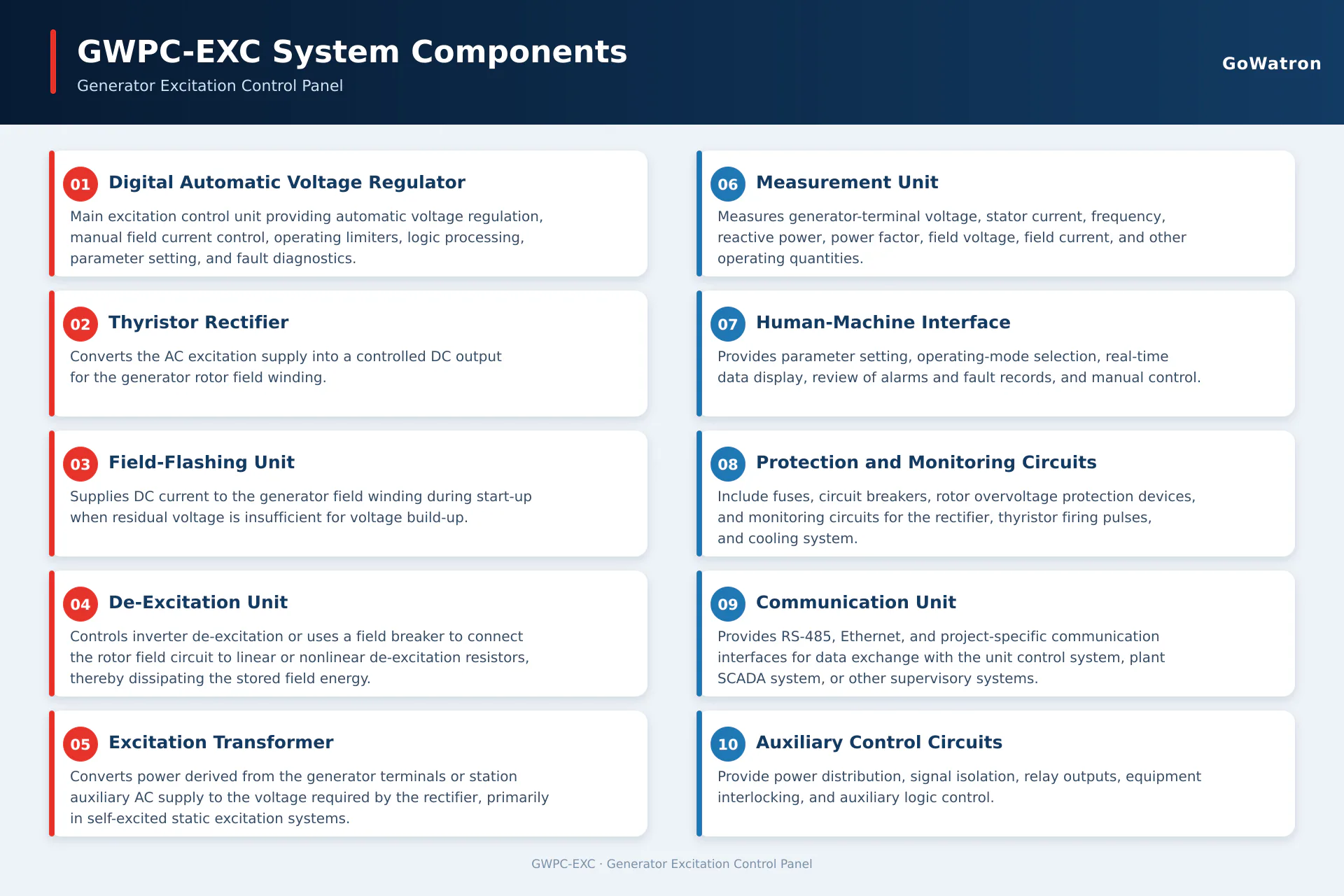
The GWPC-EXC uses a standard floor-mounted enclosure. Depending on the generator rating, excitation method, and project configuration, the excitation system may include the following components:
For smaller generating units, the regulator, rectifier, field-flashing, and de-excitation components may be integrated into a single enclosure where technically appropriate. For larger units or systems requiring greater redundancy, the excitation regulator panel, power rectifier cabinet, de-excitation cabinet, and excitation transformer may be installed separately.
Typical panel dimensions include:
- 2260 × 800 × 800 mm (H × W × D)
- 2260 × 800 × 600 mm (H × W × D)
The number of panels, enclosure dimensions, degree of protection, cooling method, and cable-entry arrangement are determined by the rectifier rating, installed equipment, and project requirements.
4. Technical Specifications
The following values represent typical configurations. Final specifications are determined by the generator data, excitation method, and project technical agreement.
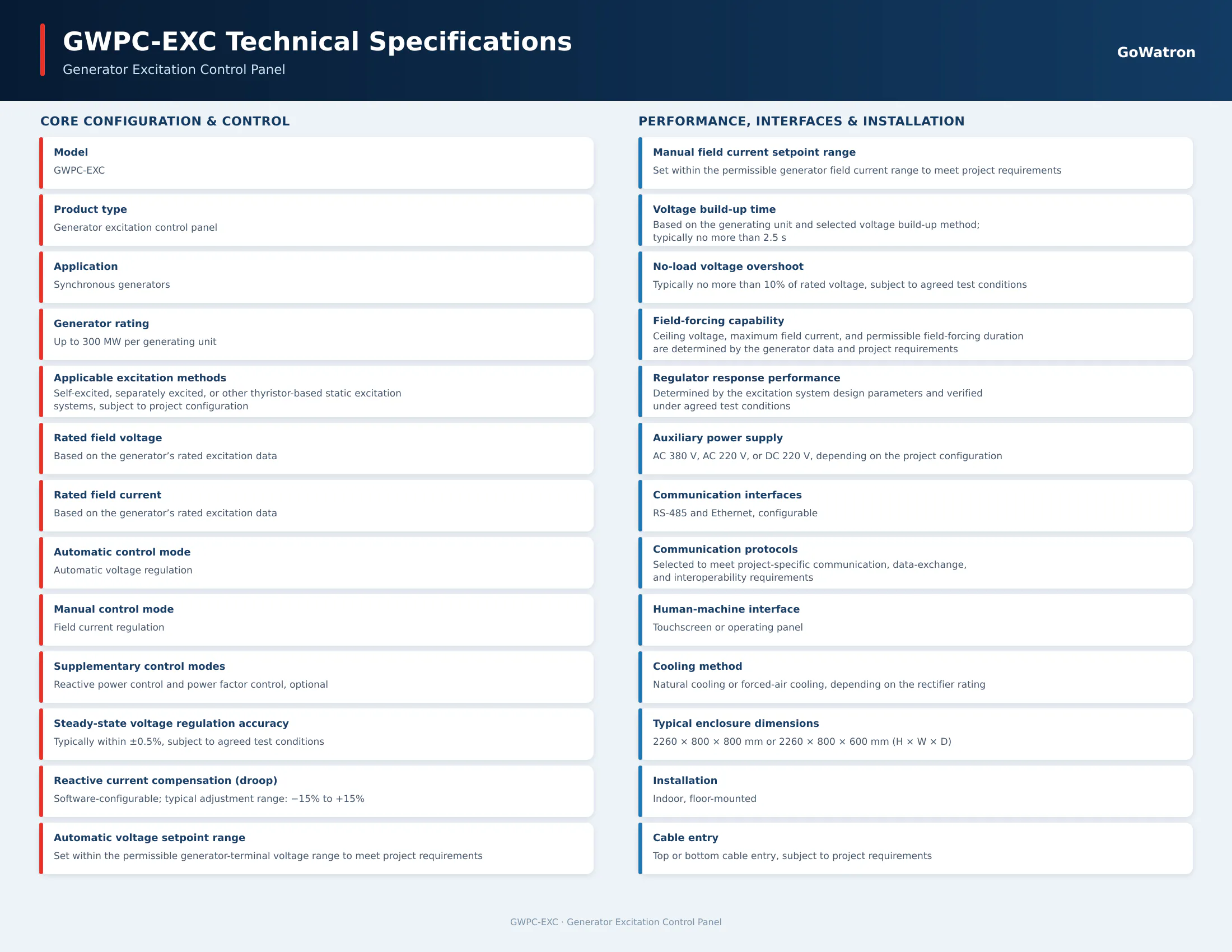
Note: An excitation system cannot be selected solely on the basis of the generator’s active power rating. System selection must also consider the rated field voltage, rated field current, excitation ceiling requirements, excitation method, rotor parameters, rectifier redundancy, cooling conditions, and applicable power-system operating requirements.
5. Applications
The GWPC-EXC Generator Excitation Control Panel is designed to provide excitation control, operating limiter functions, condition monitoring, and communications with plant automation systems for synchronous generating units with ratings up to 300 MW. Typical applications include:
- Hydropower plants: Suitable for hydroelectric generating units with ratings up to 300 MW that use self-excited, separately excited, or other project-specific thyristor-based static excitation systems.
- Thermal power plants: Suitable for the excitation control systems of steam turbine generators with ratings up to 300 MW per unit.
- Industrial captive power plants: Suitable for synchronous generating units used in steel, chemical, paper, cement, mining, and other industrial facilities.
- Industrial energy-recovery power generation: Suitable for synchronous generators used in projects that recover energy from industrial waste heat, process pressure, or waste gas.
- Biomass power plants: Suitable for synchronous generating units used in biomass-fired power generation facilities.
- Diesel generating units: Suitable for synchronous diesel generators requiring digital excitation control, reactive power regulation, or grid-connected operation.
- Other distributed generation systems: Suitable for distributed power generation projects that use synchronous generators and require controlled excitation.
The GWPC-EXC can interface with the unit control system, automatic synchronizing equipment, generator protection system, and plant SCADA system. Together, these systems support generator voltage build-up, pre-synchronization voltage matching, post-synchronization automatic voltage regulation, reactive power control, condition monitoring, and fault annunciation.
The excitation rating, rectifier configuration, field-forcing capability, de-excitation method, redundancy arrangement, communication protocols, and panel construction can be engineered according to the generator data and project-specific technical requirements.


