Which Transformers Need DGA Monitoring? Applications, Monitoring Methods and Selection Guidance
- Dissolved gas analysis (DGA) measures the concentrations of gases dissolved in insulating oil and evaluates their composition and trends. It helps identify indications of thermal faults, partial discharge and electrical discharges, including arcing, within transformers, supporting condition assessment and maintenance decisions.
- Performing DGA testing does not necessarily mean that an online DGA monitoring system must be installed. The decision to install online monitoring should consider transformer criticality, the consequences of failure, operating condition, standby capacity and maintenance requirements.
- This article explains where DGA is applicable, which transformers warrant priority consideration, and how to select between laboratory testing, online monitoring and different monitoring technologies.
1. Which Transformers and Electrical Equipment Are Suitable for DGA?
1.1 Equipment with Mineral Oil and Cellulosic Insulation
DGA is principally applicable to electrical equipment in which mineral insulating oil and cellulosic paper or pressboard form the main insulation system. Examples include:
- Oil-immersed power transformers;
- Oil-immersed reactors;
- Instrument transformers with suitable oil-paper insulation systems;
- Oil-filled bushings with suitable insulation systems.
DL/T 722-2014 and IEC 60599:2022 provide guidance on gas analysis and the interpretation of results for relevant equipment.
Equipment falling within the technical scope of DGA does not automatically require an online monitoring device. Depending on maintenance requirements, operators may use periodic laboratory analysis of oil samples, online monitoring, or a combination of both.
1.2 Is DGA Applicable to Dry-Type Transformers?
- Dry-type transformers do not contain insulating oil and are therefore outside the scope of dissolved gas analysis in oil.
- Condition monitoring should instead use appropriate methods, such as temperature monitoring and partial discharge testing, selected according to transformer construction and operating risks.
1.3 What About Equipment Filled with Ester Insulating Liquids?
- Natural and synthetic ester insulating liquids have gas-generation characteristics that differ from those of mineral oil. Their DGA results should be evaluated using guidance and interpretation criteria appropriate to the insulating liquid.
- When selecting an online DGA monitor, compatibility with the insulating liquid must also be confirmed. Interpretation limits established for mineral-oil-filled equipment should not be applied indiscriminately to ester-filled equipment.
2. Which Transformers Should Receive Priority for Online DGA?
2.1 Critical Transformers with Severe Failure Consequences
Online DGA should receive priority consideration for oil-immersed transformers supplying essential loads, operating without adequate standby capacity, or requiring long replacement lead times.
The assessment should consider:
- Whether an outage would cause a substantial interruption to the electricity supply;
- Whether failure would interrupt a critical production process;
- Whether standby transformers or load-transfer arrangements are available;
- How long repair, replacement and restoration would take.
For these assets, online DGA tracks gas concentrations between manual sampling events, helping operators identify developing abnormal trends.
2.2 High-Voltage, Large-Capacity Main Transformers
- Oil-immersed main transformers operating at 110 kV, 132 kV, 220 kV and higher voltage levels are important candidates for DGA condition monitoring.
- However, voltage rating alone should not determine whether online DGA is installed. Rated power, loading, operating arrangements, standby capacity and previous abnormal findings should also be assessed.
- Multi-gas online monitoring warrants particular consideration for main transformers that operate under sustained high loading, have significant outage consequences, or already exhibit abnormal gas-generation trends.
2.3 Critical Power Plant and Industrial Transformers
Typical examples include:
- Generator step-up transformers;
- Essential unit auxiliary or station auxiliary transformers;
- Start-up or standby transformers;
- Rectifier transformers and furnace transformers serving critical production processes;
- Other oil-immersed transformers whose failure could cause substantial production losses.
The need for online DGA should be determined by the transformer’s role in the electrical supply or production process.
Multi-gas monitoring may be appropriate where several fault gases and their rates of increase need to be evaluated.
2.4 Transformers with Abnormal Gassing or Adverse Operating Events
More frequent DGA testing or additional online monitoring should be considered when:
- One or more gas concentrations are abnormal;
- Gas concentrations continue to rise;
- Gas-generation rates increase significantly;
- The transformer has experienced overloading, cooling-system abnormalities or external short-circuit events;
- Previous faults or maintenance findings raise concerns about its internal condition.
Results should be assessed alongside historical DGA data, loading, temperature and event records. A single gas-concentration measurement does not fully describe the development of a fault.
Abnormal results should first be verified and the associated equipment risk assessed. Additional monitoring must not be used as a substitute for necessary investigation or corrective action.
2.5 Older Transformers with Uncertain Condition
- Older transformers warrant careful condition assessment, but exceeding 20 years in service does not, by itself, establish that a transformer is approaching the end of its useful life.
- The need for increased testing should be determined from insulation condition, loading history, maintenance records and gas trends.
- Online monitoring may be particularly valuable for older transformers that exhibit abnormal gassing, operate under sustained high loading, or have limited standby capacity.
2.6 Transformers at Remote or Difficult-to-Access Sites
- Online DGA can provide remotely accessible trend data for critical transformers where site visits are costly or manual oil sampling is difficult.
- Before installation, operators should confirm the availability of auxiliary power, communication facilities, suitable installation connections and maintenance access.
- The monitor’s suitability for high altitude, extreme temperatures and other demanding environmental conditions must also be verified.
3. When Should Newly Commissioned Transformers Undergo DGA?
- DGA data should be obtained before energisation in accordance with the applicable commissioning requirements to establish a baseline. Follow-up testing during early service should comply with the relevant procedures, manufacturer’s instructions and commissioning plan.
- Pre-energisation baseline data and early-service results help identify abnormal changes after the transformer enters service. The requirement should not be expressed merely as completing an initial test “within the first year”.
- A newly commissioned transformer does not automatically require online DGA. Online monitoring may be justified for critical main transformers, while other equipment may be managed through laboratory testing and appropriate early-service follow-up.
4. How Should Online Monitoring and Laboratory DGA Be Selected?
- In this article, laboratory DGA means taking an oil sample from the transformer for subsequent analysis. Oil sampling does not necessarily require the transformer to be de-energised.
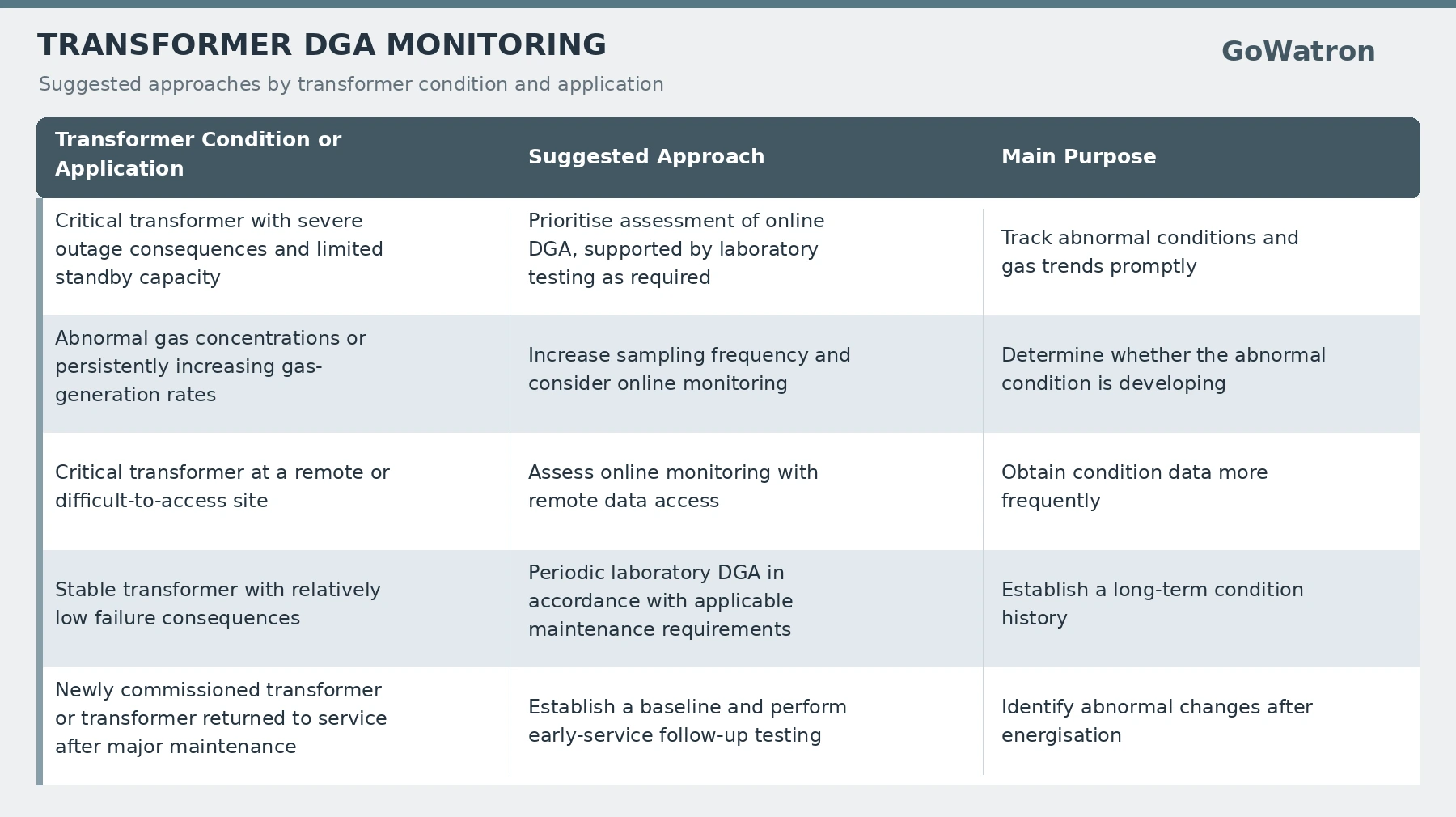
- Online monitoring provides timely trend information. Laboratory analysis supports multi-gas assessment, verification of abnormal readings and further diagnosis.
- Online monitoring and laboratory DGA are complementary. Even where online monitors are installed, laboratory testing may still be required by maintenance procedures or needed to verify data quality and investigate abnormal results.
5. How Should Single-Hydrogen Monitoring and Multi-Gas DGA Be Selected?
5.1 Single-Hydrogen Monitoring for Basic Early Warning
- Hydrogen is an important gas in transformer DGA. Online dissolved hydrogen monitoring provides concentration and trend information that can help operators decide whether further oil sampling and investigation are needed.
- A single-hydrogen monitoring solution may be suitable where the main objectives are basic early warning, trend tracking or an upgrade to an existing transformer’s monitoring arrangements.
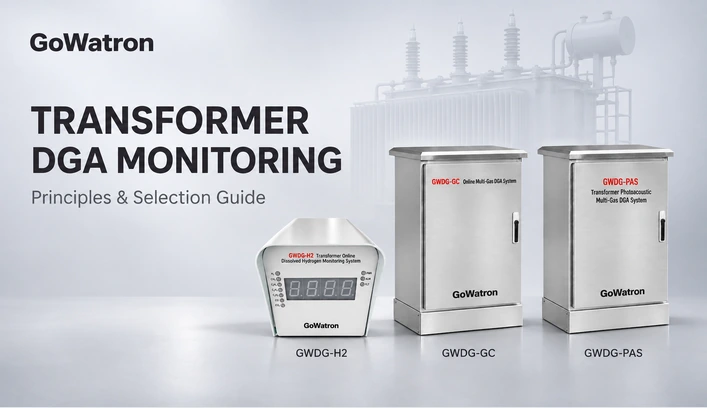
- For example, the GoWatron GWDG-H2 Transformer Online Dissolved Hydrogen Monitoring System measures dissolved hydrogen in insulating oil, with a measurement cycle of no more than 10 minutes, and can transmit results to a supervisory system.
- Its compact, integrated design supports installation on oil-immersed transformers that meet the specified installation requirements. Typical applications include power plant transformers, substation transformers, railway traction transformers and special-purpose oil-immersed transformers.
- Single-hydrogen monitoring provides early-warning and trend information. Hydrogen concentration alone cannot reliably distinguish all fault types. Abnormal findings should be investigated using multi-gas DGA and other relevant diagnostic information.
5.2 Multi-Gas Monitoring for Broader Diagnostic Information
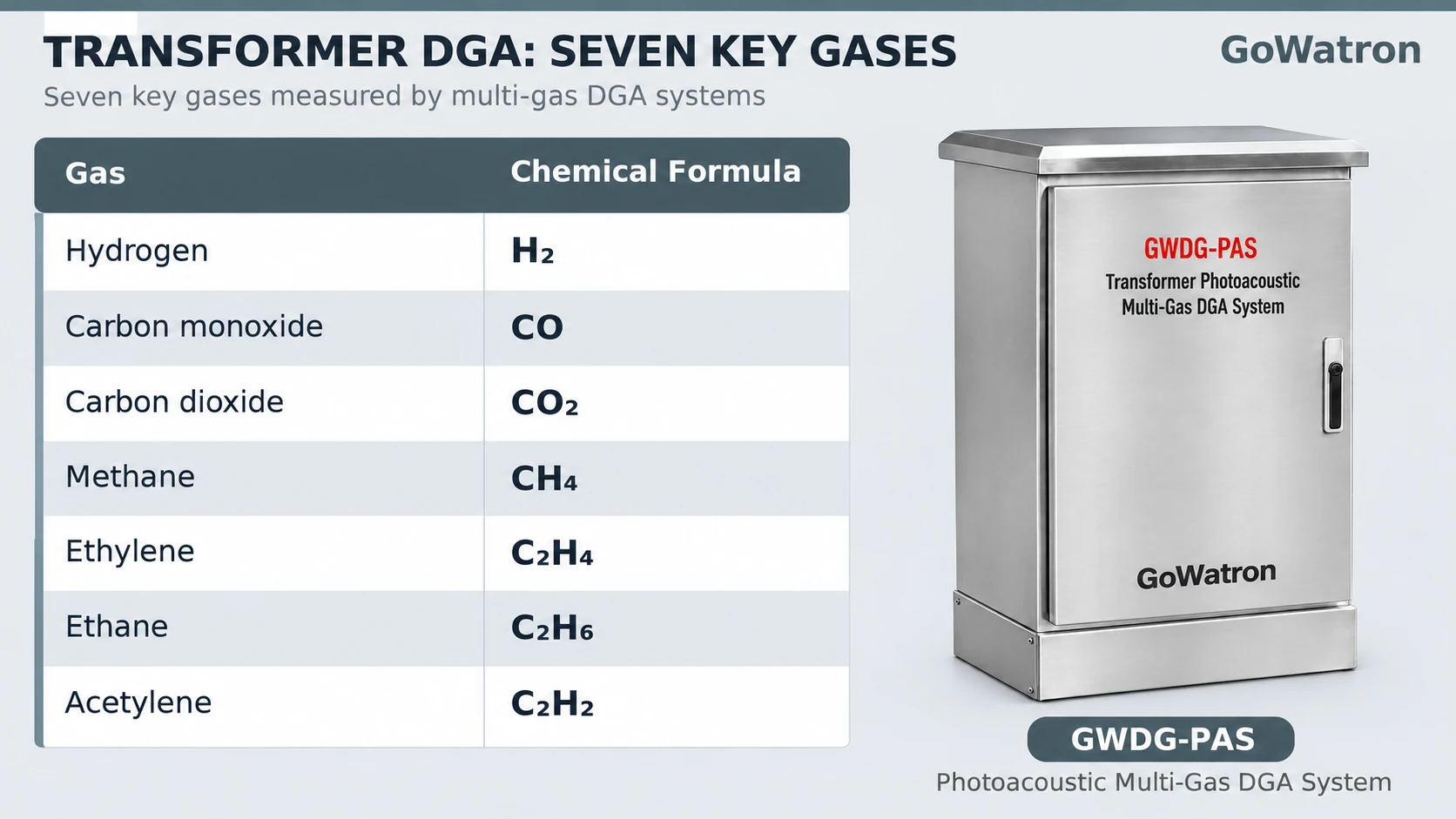
Their concentrations, relative proportions, rates of increase and historical trends support the assessment of thermal faults, electrical discharges and degradation involving the oil-paper insulation system.
5.3 Gas Chromatography: GWDG-GC
- For projects specifying gas chromatography, the GoWatron GWDG-GC Transformer Multi-Gas DGA System is an option for consideration.
- The system automatically performs oil sampling, gas extraction, gas analysis and data recording at configured intervals. It monitors seven key dissolved gases and supports gas-concentration trending, gas-generation-rate analysis and historical data review.
- The product is primarily intended for oil-immersed transformers rated at 132 kV and above.
- Its integrated carrier-gas supply module reduces maintenance associated with external carrier-gas cylinders. Routine inspection and maintenance remain necessary in accordance with the product instructions.
5.4 Photoacoustic Spectroscopy: GWDG-PAS
- For projects requiring multi-gas monitoring while seeking to reduce maintenance associated with carrier gas and chromatographic columns, the GoWatron GWDG-PAS Transformer Photoacoustic Multi-Gas DGA System may be considered.
- The system uses photoacoustic spectroscopy to measure seven key dissolved gases periodically. It does not require conventional carrier gas, chromatographic columns or chemical reagents.
- The product is primarily intended for critical oil-immersed power transformers rated at 132 kV and above. Application to oil-immersed transformers and reactors at other voltage levels can also be assessed against project requirements.
5.5 Product Selection Comparison
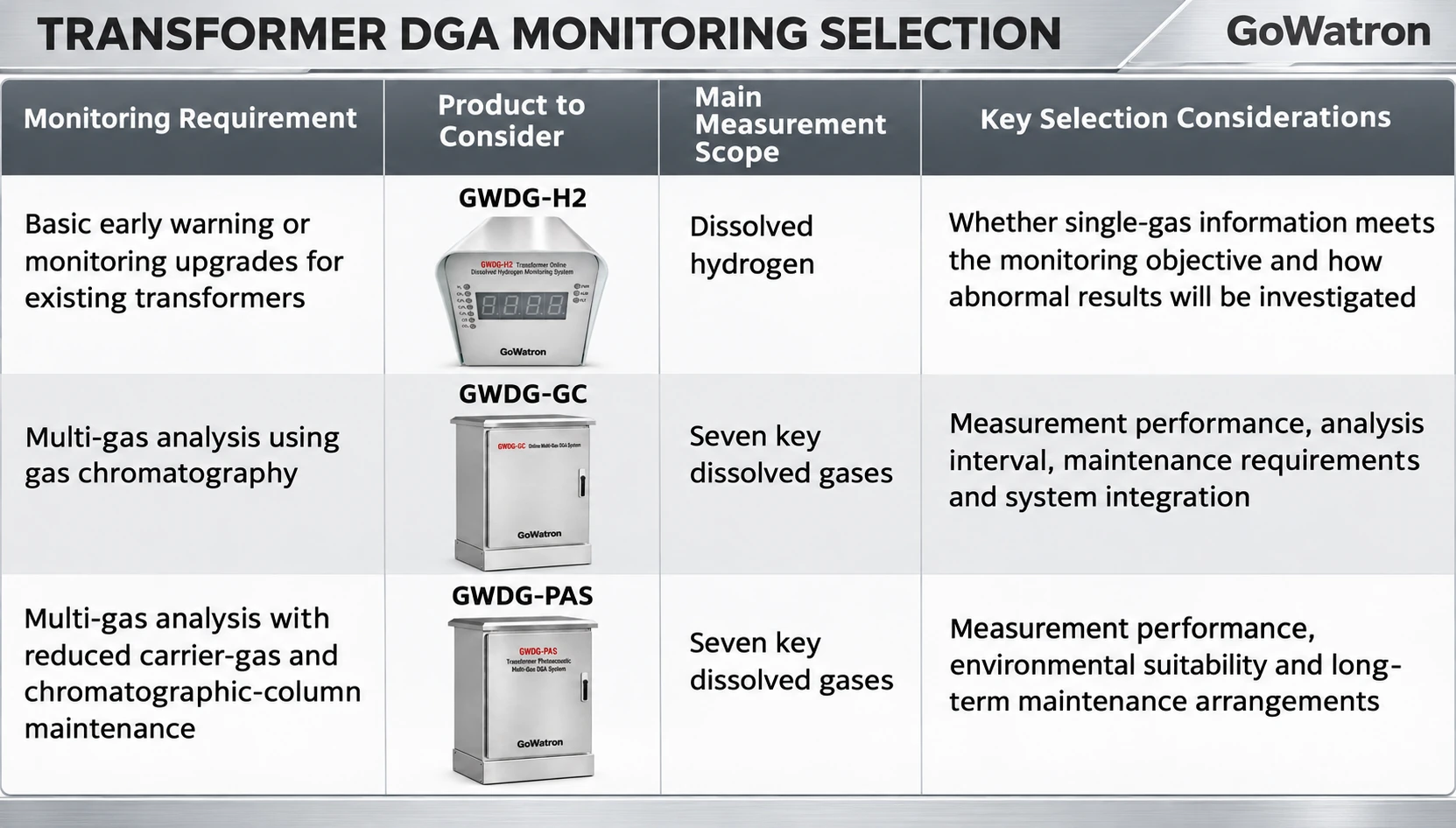
- Gas chromatography and photoacoustic spectroscopy are different measurement technologies. Neither should be assumed to offer superior accuracy solely because of its operating principle.
- Selection should compare detection limits, measurement accuracy, repeatability, measurement intervals and relevant test evidence.
- A product’s stated application voltage range also does not mean that every transformer within that range requires the device. The final configuration should follow the equipment’s monitoring needs and project specifications.
6. How Should DGA Testing Intervals Be Determined?
DGA testing intervals should follow applicable testing and maintenance requirements, manufacturer’s instructions, equipment condition and historical trends.
A universal interval of three to six months should not be assigned to all critical transformers. Likewise, quarterly testing should not be prescribed solely because a transformer has reached a particular age.
The testing programme should consider:
- Gas concentrations and rates of increase;
- Transformer criticality and standby capacity;
- Loading, temperature and operating arrangements;
- Recent commissioning, major maintenance or insulating-oil treatment;
- Abnormal events and previous fault records.
For equipment with abnormal gassing, the testing schedule should be reviewed promptly using verification results and risk assessment. Operators should not simply wait for the next routine sampling date.
An online monitor’s measurement cycle is different from the interval between manual oil samples. Online measurement intervals should be selected according to monitor capability, equipment risk and the required warning timescale.
7. What Should Be Confirmed Before Installing Online DGA?
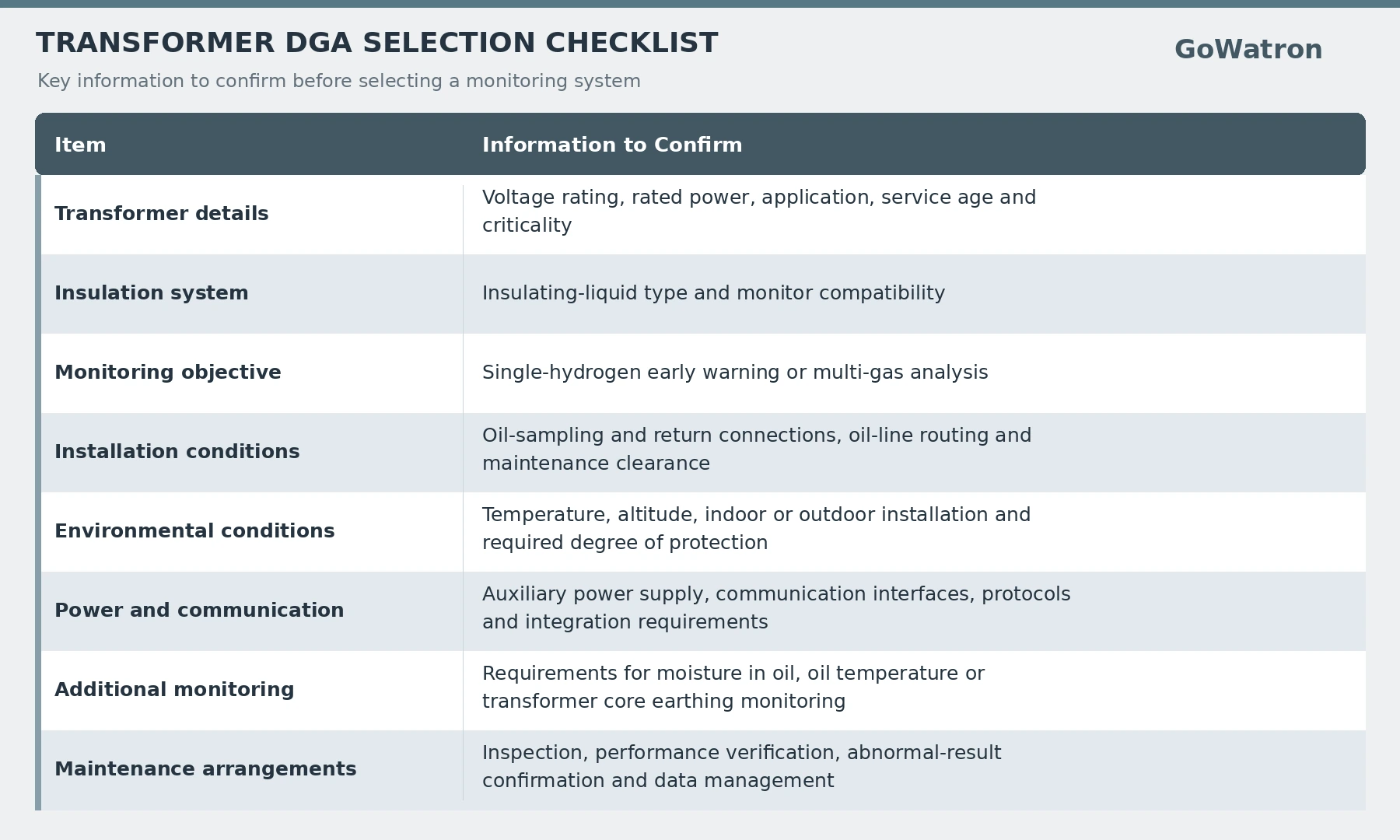
- Moisture in oil and transformer core earthing parameters are obtained through separate monitoring modules. They are not gas components measured directly by the gas analyser. Available functions should be confirmed for the selected model and project configuration.
- DGA provides condition-monitoring information and diagnostic guidance. Final fault assessment and operational decisions should combine DGA results with operating records, laboratory verification, electrical testing and site inspection findings.


