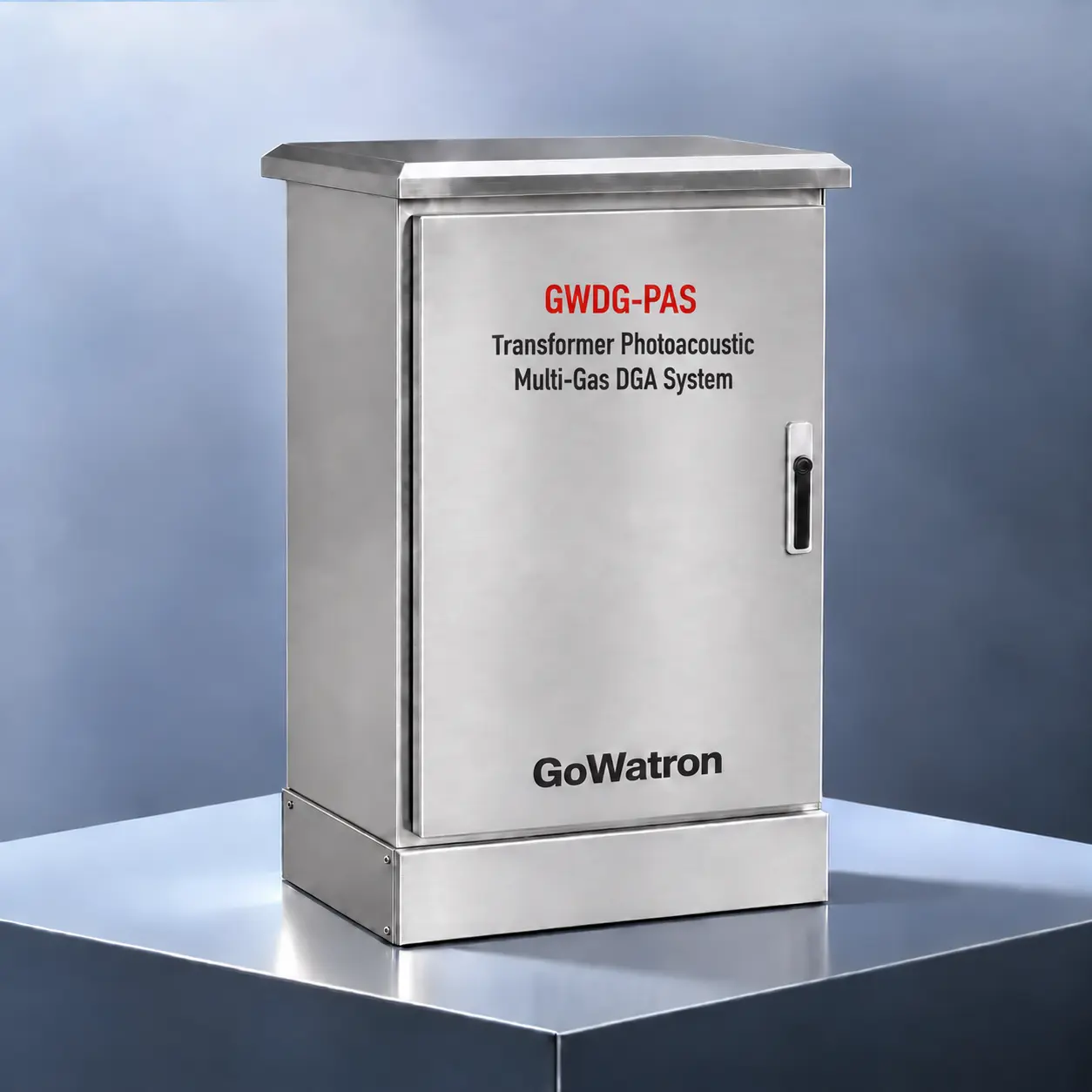
GWDG-PAS Transformer Photoacoustic Multi-Gas DGA System
- The GWDG-PAS is an online multi-gas dissolved gas analysis (DGA) monitoring system developed and manufactured by GoWatron. It is primarily designed for critical oil-immersed power transformers rated at 132 kV and above. Depending on project requirements, it can also be applied to oil-immersed transformers and reactors of other voltage classes.
- Based on photoacoustic spectroscopy (PAS), the system integrates oil sampling and circulation, oil-gas separation, gas measurement, data analysis, alarm management, and remote communication. It periodically measures seven key dissolved fault gases in transformer oil: hydrogen (H₂), carbon monoxide (CO), carbon dioxide (CO₂), methane (CH₄), ethylene (C₂H₄), ethane (C₂H₆), and acetylene (C₂H₂). Optional moisture-in-oil and transformer core grounding current monitoring modules are also available.
- Unlike conventional online gas chromatography systems that require carrier gas and chromatographic columns, the GWDG-PAS does not require conventional carrier gas, chromatographic columns, or chemical reagents. This reduces consumable use and routine maintenance requirements. The system records gas concentrations, historical trends, and gas generation rates, providing essential data for the early detection of overheating, partial discharge, low-energy discharge, arcing, and degradation of solid insulation within transformers.




1. Product Description
- The GWDG-PAS integrates oil sampling and circulation, oil-gas separation, gas measurement, data analysis, alarm management, and communication in a single online monitoring system. It is available in floor-mounted and wall-mounted configurations to accommodate different installation conditions in power plants, substations, railway traction substations, and industrial facilities.
- The system draws a small representative oil sample from the transformer through the oil sampling connection. Dissolved gases are extracted from the oil by the integrated oil-gas separation unit and transferred to the photoacoustic measurement cell for analysis. After measurement, the oil sample is returned to the transformer through a closed-loop oil circuit.
- The photoacoustic measurement process does not require carrier gas, chromatographic columns, or chemical reagents. This reduces the maintenance associated with carrier-gas replacement and chromatographic-column servicing in conventional online gas chromatography systems.
- At each preset measurement interval, the system automatically performs oil sampling, oil-gas separation, gas measurement, concentration calculation, data storage, and oil return. Results from successive measurement cycles are recorded to establish long-term trends in gas concentrations and gas generation rates.
- The GWDG-PAS supports RS-485 and Ethernet communication. Depending on project requirements, it can be configured with Modbus RTU, Modbus TCP, IEC 60870-5-104, or IEC 61850 for integration with substation automation systems, asset condition monitoring platforms, and remote diagnostic platforms.
2. Main Functions
2.1 Online Multi-Gas Monitoring
- The system monitors seven key dissolved fault gases in transformer oil:
- Hydrogen (H₂)
- Carbon monoxide (CO)
- Carbon dioxide (CO₂)
- Methane (CH₄)
- Ethylene (C₂H₄)
- Ethane (C₂H₆)
- Acetylene (C₂H₂)
- These gases provide essential data for assessing thermal faults, partial discharge, low-energy discharge, high-energy discharge, arcing, and thermal degradation of oil-paper insulation.
2.2 Moisture-in-Oil and Transformer Core Grounding Current Monitoring
- Depending on the selected system configuration, the following auxiliary monitoring functions can be integrated:
- Moisture-in-oil monitoring
- Transformer core grounding current monitoring
- Moisture in oil and transformer core grounding current are measured by separate monitoring modules and are not gas components measured by the photoacoustic detector. Their data can be displayed, stored, and transmitted together with the DGA results to support comprehensive transformer condition assessment.
2.3 Gas Trend and Rate-of-Change Analysis
- The system records the concentration, historical trend, and generation rate of each monitored gas. When a gas concentration or gas generation rate reaches a configured alarm threshold, the system generates an alarm and transmits it to the supervisory system.
- The system provides condition monitoring data and early-warning information. Final diagnostic decisions should be based on a comprehensive assessment of transformer loading, oil temperature, winding temperature, historical DGA data, laboratory verification results, electrical test results, and on-site inspection findings.
2.4 Fault Diagnosis Support
- Depending on the monitored gas configuration and available software functions, the system can provide gas-ratio analysis, total dissolved combustible gas (TDCG) calculation, gas generation rate calculation, and historical trend analysis to support the identification of:
- Partial discharge
- Low-energy discharge
- High-energy discharge and arcing
- Low-, medium-, and high-temperature thermal faults
- Insulating oil degradation
- Thermal degradation of cellulosic insulation
- Diagnostic methods and alarm thresholds can be configured in accordance with IEC 60599, project specifications, transformer operating history, and the asset owner’s maintenance practices.
2.5 Remote Data Transmission and System Integration
- The system supports RS-485 and Ethernet communication. Depending on project requirements, the following communication protocols and alarm outputs can be provided:
- Modbus RTU
- Modbus TCP
- IEC 60870-5-104
- IEC 61850
- Alarm output via relay dry contacts
- Monitoring data can be transmitted to a substation automation system, asset condition monitoring platform, or remote diagnostic platform for centralized monitoring and management of multiple transformers.
2.6 Local Display and Operation
An optional local LCD is available for:
- Viewing current measurement results
- Reviewing historical trends and alarm records
- Configuring measurement intervals and alarm thresholds
- Viewing system operating status
- Configuring communication parameters
- Performing commissioning and self-diagnostic operations
2.7 Self-Diagnostics and System Status Monitoring
The system provides power-on self-tests and continuous status monitoring for:
- The infrared light source and photoacoustic measurement unit
- The oil circulation and oil-gas separation units
- Valves and pumps
- The temperature-control unit
- Communication interfaces
- The moisture-in-oil sensor
- The power supply and internal modules
- When an internal abnormality is detected, the system generates a diagnostic event record and issues an alarm.
2.8 Flexible Installation
The system is available in the following installation configurations:
- Floor-mounted enclosure
- Wall-mounted enclosure
- The appropriate installation method should be selected according to the locations of the transformer oil sampling and return ports, oil-line routing distance, available maintenance clearance, and site environmental conditions.
3. Operating Principle
- The GWDG-PAS uses photoacoustic spectroscopy to measure gas samples extracted from transformer oil.
- At each preset measurement interval, the system draws a representative oil sample from the transformer. The oil-gas separation unit releases the dissolved gases into the gas phase under controlled conditions. The extracted gas sample is then transferred to the photoacoustic measurement cell, where it is exposed to modulated infrared light at selected wavelengths.
- Each target gas absorbs infrared energy at its characteristic absorption wavelengths. Periodic absorption produces localized heating and corresponding pressure fluctuations, generating a weak acoustic signal. A high-sensitivity acoustic sensor detects this signal.
- The system applies compensation for infrared source intensity, gas temperature, gas pressure, spectral cross-interference, and oil-gas equilibrium characteristics. The corrected signal is then used to calculate the concentration of each target gas dissolved in the transformer oil.
The complete measurement sequence includes:
- Oil sampling and circulation
- Oil-gas separation
- Gas sample transfer
- Photoacoustic signal detection
- Signal compensation and concentration calculation
- Data storage and trend analysis
- Oil return
- Alarm generation and data transmission
The GWDG-PAS performs periodic online measurements and continuously stores the results from successive measurement cycles to establish long-term condition trends.
4. Key Features
- Multi-gas photoacoustic spectroscopy
- Monitoring of seven key dissolved fault gases
- Optional moisture-in-oil monitoring
- Optional transformer core grounding current monitoring
- No conventional carrier gas or chromatographic columns required
- No chemical reagents required for gas measurement
- Reduced consumable use and routine maintenance requirements
- Floor-mounted and wall-mounted configurations available
- Gas concentration and generation-rate trending
- Configurable alarm thresholds and system self-diagnostics
- Local display, historical data storage, and event recording
- RS-485 and Ethernet communication
- Integration with substation automation systems and remote diagnostic platforms
- Outdoor-rated enclosure and temperature-control options available
5. Technical Specifications
The following values represent typical GWDG-PAS specifications. Final specifications are subject to the selected system configuration, official product datasheet, and applicable test reports
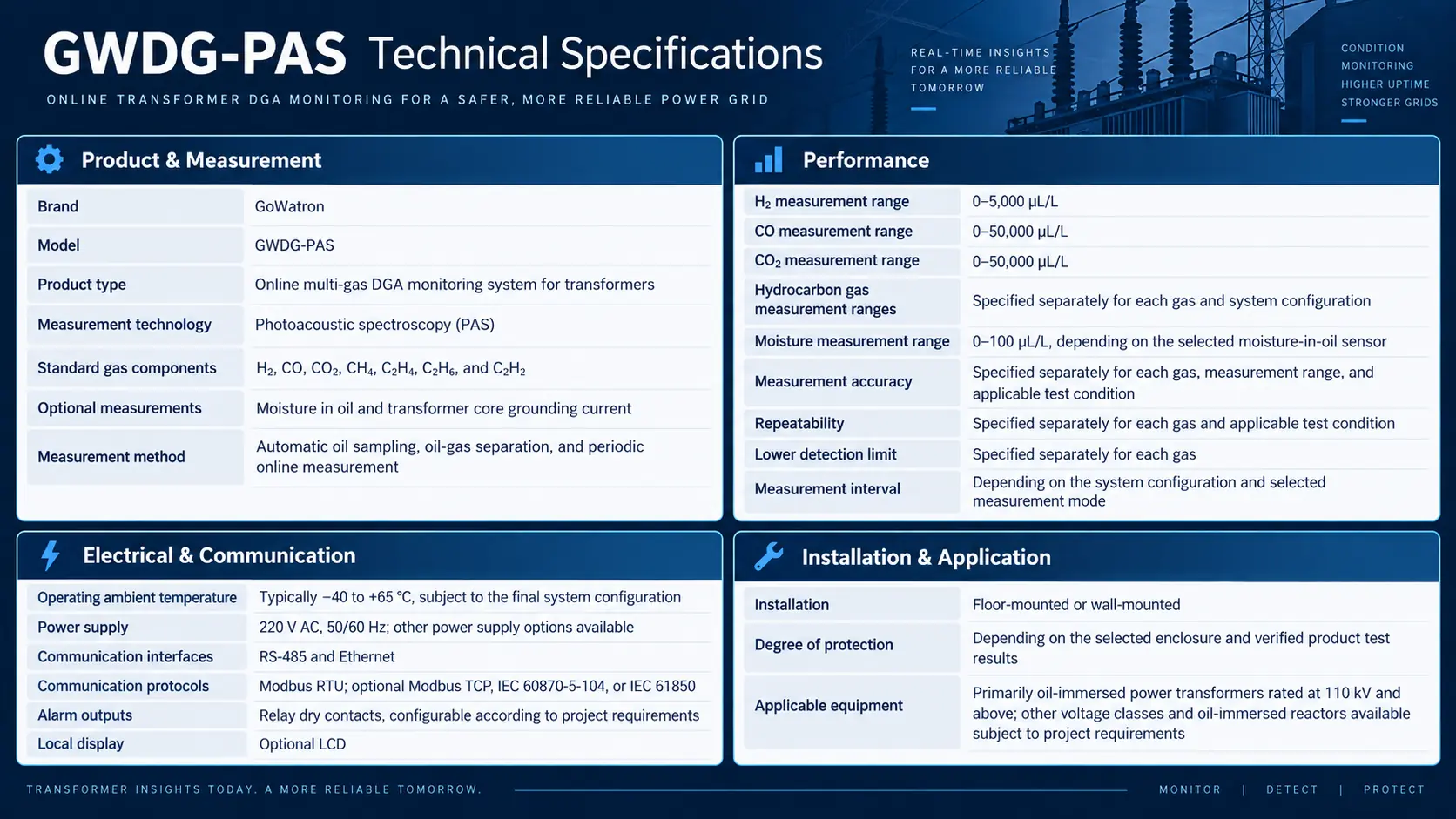
Note: Gas measurement ranges, measurement accuracy, repeatability, lower detection limits, measurement intervals, operating temperature, degree of protection, dimensions, weight, and power consumption should be confirmed against the final GWDG-PAS hardware configuration, official product datasheet, and applicable test reports.
6. Applications
- Power plant main transformers: Suitable for main transformers and generator step-up transformers in thermal, hydroelectric, gas-fired, nuclear, wind, and solar power plants. The system continuously tracks dissolved fault gas trends and provides data to support condition-based maintenance of critical transformers.
- Substation power transformers: Suitable for oil-immersed power transformers in 132kV, 230kV, 330 kV, 500 kV, and higher-voltage substations, helping operators identify rapid gas generation, abnormal overheating, and discharge activity at an early stage.
- Railway traction transformers: Suitable for oil-immersed traction transformers in high-speed and conventional electrified railway traction substations, providing long-term monitoring of dissolved gas trends under fluctuating load conditions.
Special-purpose industrial transformers: Suitable for large rectifier transformers, electric furnace transformers, and other critical oil-immersed transformers used in metallurgical, chemical, mining, and other industrial facilities, supporting insulation condition assessment under demanding operating conditions. - Renewable energy collector and step-up substations: Suitable for collector transformers and step-up transformers in wind farms, solar power plants, and battery energy storage facilities. Remote communication capabilities support centralized monitoring of unmanned and geographically dispersed sites.
- Oil-immersed reactors: Depending on the equipment oil-circuit arrangement and project requirements, the system can be used for online dissolved gas monitoring of shunt reactors and other oil-immersed reactors.
- Retrofit of aging transformers: Suitable for upgrading existing oil-immersed transformers with online condition monitoring. With appropriate oil sampling, oil return, and communication connections, DGA trending and remote alarm functions can be added without replacing the transformer itself.
7. Reference Standards
- IEC 60567: Oil-filled electrical equipment—Sampling of free gases and analysis of free and dissolved gases in mineral oils and other insulating liquids—Guidance
- IEC 60599: Mineral oil-filled electrical equipment in service—Guidance on the interpretation of dissolved and free gases analysis
- IEC 61850: Communication networks and systems for power utility automation
- Applicable Chinese DL/T standards for online transformer monitoring equipment, as specified in the project technical agreement
- Relevant power industry standards and project specifications applicable in the country or region of installation
Compliance with specific standards and editions should be confirmed by the applicable type-test reports, test certificates, and project technical agreement.


