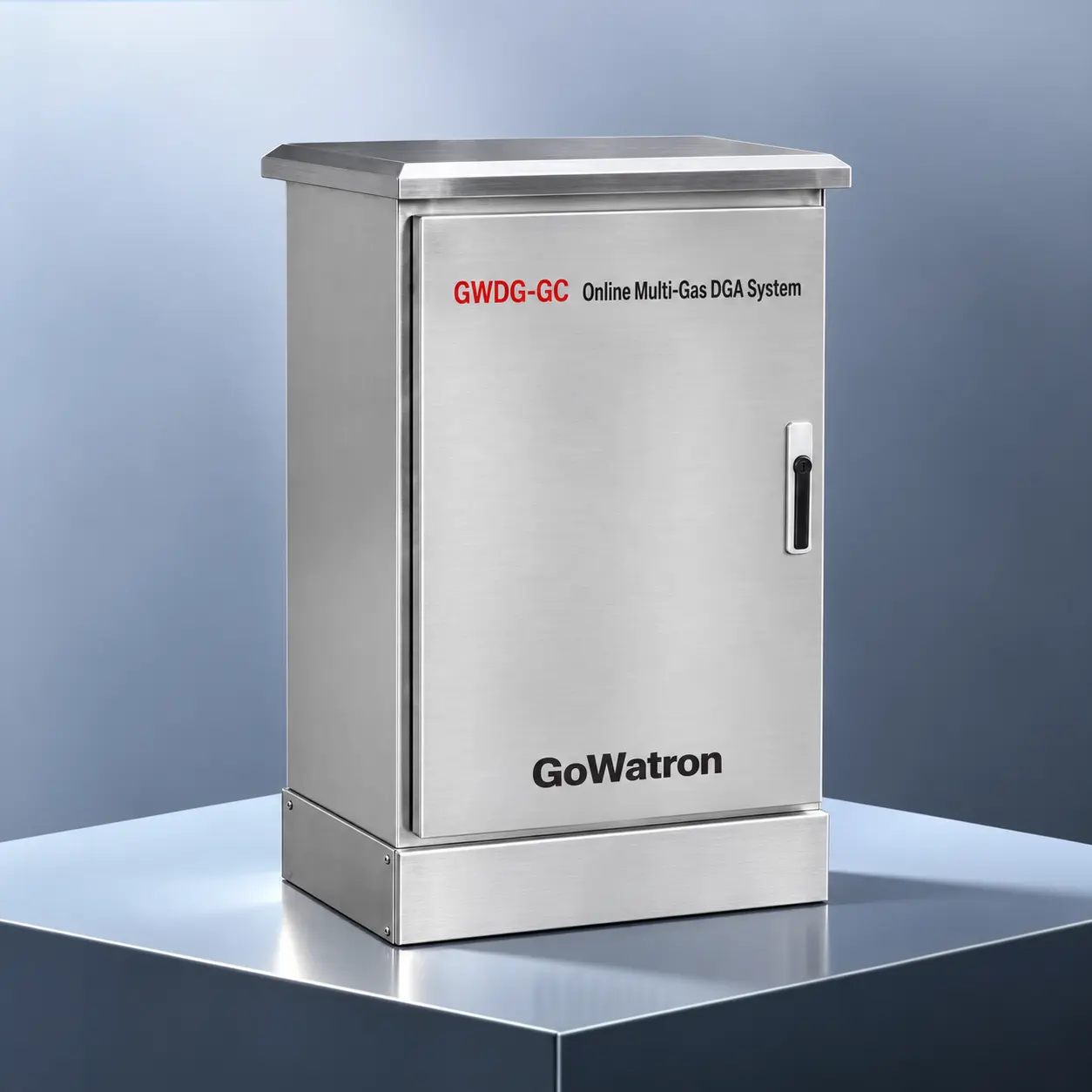
GWDG-GC Transformer Multi-Gas DGA System
Product Desc
- The GoWatron GWDG-GC Online Multi-Gas DGA System uses gas chromatography to monitor multiple fault gases dissolved in transformer insulating oil. It is designed for oil-immersed transformers with rated voltages of 132 kV and above.
- The system automatically collects oil samples at preset intervals and measures key dissolved fault gases. It can also monitor moisture in oil and transformer core grounding status. By analyzing gas concentrations, gas generation rates, and historical trends, the system helps identify potential overheating, electrical discharge, and insulation deterioration, providing reliable data for early fault warning, condition assessment, and maintenance planning.




Multi-Gas DGA
7 Key Gases + Moisture

Gas Chromatography
Vacuum Degassing

Flexible Monitoring
Auto, Manual & Scheduled

Fault Diagnosis
IEC 60599-Based Analysis

Communication
RS-485 / IEC 61850

Fast Delivery
Global Shipping

Warranty
2 Year Warranty
1. Product Description
- The GoWatron GWDG-GC is designed for the online condition monitoring of oil-immersed power transformers used in power plants, substations, traction substations, and other critical power facilities.
- The system integrates automatic oil sampling, vacuum degassing, multi-gas chromatographic analysis, data processing, fault diagnosis, alarm management, and communication functions. It automatically performs oil sampling, gas extraction, chromatographic analysis, data storage, and information transmission according to a user-defined monitoring schedule.
- Floor-standing and wall-mounted versions are available to accommodate different installation environments and space requirements. The integrated carrier gas supply module eliminates the need for external carrier gas cylinders, thereby reducing routine maintenance requirements and long-term operating costs.
2. Main Functions
2.1 Online Multi-Gas DGA Monitoring
- The system measures and analyzes the following seven key fault gases dissolved in transformer insulating oil:
- Hydrogen (H₂);
- Carbon monoxide (CO);
- Carbon dioxide (CO₂);
- Methane (CH₄);
- Ethylene (C₂H₄);
- Ethane (C₂H₆);
- Acetylene (C₂H₂).
- The concentrations, relative proportions, gas generation rates, and historical trends of these gases provide valuable information for identifying potential thermal faults, partial discharge, low-energy discharge, high-energy discharge, and thermal degradation of solid insulation.
2.2 Moisture and Core Grounding Monitoring
- In addition to dissolved gas analysis, the system can be configured to monitor moisture in oil and transformer core grounding status, providing more comprehensive information for transformer condition assessment.
- Moisture and core grounding status are measured by dedicated monitoring modules, not by the gas chromatographic analyzer.
2.3 Automatic Monitoring and Configurable Intervals
- The system supports both manual and scheduled automatic monitoring.
- In automatic mode, the monitoring interval can be configured through the system software according to transformer importance, operating condition, and maintenance requirements. The system automatically completes oil sampling, degassing, chromatographic analysis, data processing, result storage, and data transmission.
Main functions include:
- Manual triggering of measurement;
- Scheduled automatic monitoring;
- User-configurable monitoring intervals;
- Automatic oil sampling and degassing;
- Automatic multi-gas analysis and data storage;
- Historical data retrieval;
- Gas concentration trend analysis;
- Abnormal-condition alarms;
- Remote data transmission.
2.4 Fault Diagnosis
- The system analyzes individual gas concentrations, relative gas ratios, gas generation rates, and historical trends to support transformer condition assessment.
Available diagnostic methods include:
- IEC 60599-based DGA interpretation;
- Fuzzy three-ratio method;
- Duval Triangle method;
- Cubic diagram method;
- Key gas method;
- Gas concentration and generation-rate trend analysis.
- These methods assist in identifying potential partial discharge, low-energy discharge, high-energy discharge, and thermal faults at different temperature levels.
- DGA results should be treated as diagnostic guidance. Final fault assessment should be based on engineering judgment in conjunction with transformer operating conditions, electrical test results, insulating-oil test results, loading records, and other available monitoring data.
2.5 Data Recording and Alarm Management
The system can record and display:
- Current concentration of each gas;
- Historical gas concentration trends;
- Absolute gas generation rates;
- Relative gas generation rates;
- Moisture-in-oil measurements;
- Transformer core grounding status;
- System operating status;
- Alarm and event records;
- System faults and maintenance notifications.
- When a gas concentration, gas generation rate, or other monitored parameter exceeds its configured threshold, the system generates the corresponding alarm and transmits the information to the substation automation system or remote condition-monitoring platform.
2.6 Communication and System Integration
- The system supports RS-485 and Ethernet communication. Depending on the selected configuration, the following communication protocols are available:
- Modbus RTU;
- Modbus TCP;
- IEC 61850.
- The GWDG-GC can be integrated with a substation automation system, transformer condition-monitoring platform, or remote data center for centralized monitoring and management of measurement data, alarms, and system operating status.
- The applicable IEC 61850 version, data model, and supported services are subject to the selected system configuration and the project-specific technical agreement.
2.7 System Self-Diagnostics
The system monitors the operating status of its principal functional units, including:
- Oil circulation system;
- Vacuum degassing unit;
- Carrier gas supply module;
- Gas chromatographic analysis module;
- Gas detectors;
- Temperature control system;
- Data acquisition system;
- Communication interfaces;
- Power supply.
If an internal abnormality is detected, the system records the event and generates an alarm or maintenance notification.
3. Operating Principle
- The GWDG-GC uses gas chromatography to measure and analyze multiple trace fault gases dissolved in transformer insulating oil.
- At each preset monitoring interval, the system automatically extracts a fixed-volume oil sample from the transformer. The oil sample enters the degassing unit, where the dissolved gases are extracted under vacuum.
- The extracted gas mixture is carried into the chromatographic column by the carrier gas. Because the individual gas components have different retention characteristics, they are separated in the chromatographic column and sequentially delivered to the detector.
- The detector converts the response of each gas component into an electrical signal. The system processes these signals using stored calibration data to calculate the concentration of each gas.
- After completing the analysis, the system stores the results, evaluates gas concentrations and generation rates against configured alarm thresholds, and analyzes historical trends. The results can be displayed locally or transmitted to a substation automation system or remote condition-monitoring platform.
- Dissolved gas concentrations are normally expressed in µL/L, which is equivalent to ppm by volume.
4. Primary Function
- The GWDG-GC measures and analyzes multiple trace fault gases dissolved in transformer insulating oil. It can also monitor moisture in oil and transformer core grounding status.
- The system helps identify early signs of developing faults and provides online monitoring data, alarms, and diagnostic support to enhance the safety and reliability of oil-immersed transformer operation.
5. Basic Specifications
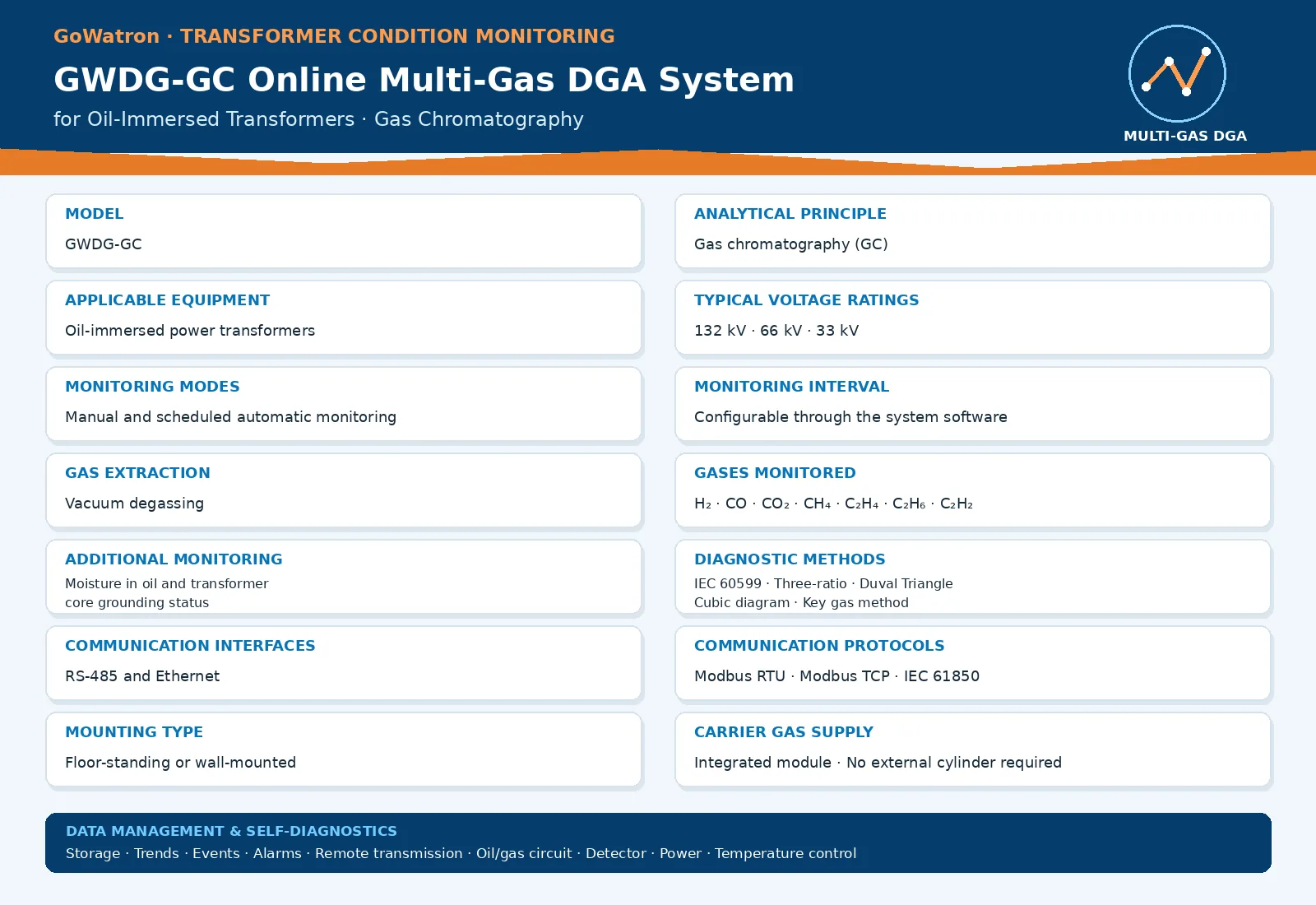
- Specific gas components, communication protocols, diagnostic methods, and additional monitoring parameters are subject to the selected system configuration and project-specific technical agreement.
6. Applications
The GWDG-GC is applicable to oil-immersed transformers with rated voltages of 132 kV and above in the following applications:
- Power plants: Suitable for the online condition monitoring and early fault warning of oil-immersed main transformers in thermal, hydroelectric, and other power plants.
- Transmission and distribution substations: Suitable for online multi-gas DGA monitoring and condition assessment of oil-immersed power transformers in transmission and distribution networks.
- Traction substations: Suitable for operating-condition monitoring and early fault warning of oil-immersed traction transformers used in electrified railway systems.
- Large industrial facilities: Suitable for online condition monitoring of oil-immersed transformers in metallurgical, petrochemical, mining, and other large industrial facilities.
- Special-purpose transformer installations: Suitable for special-purpose oil-immersed transformers that meet the system’s oil-sampling, oil-return, and insulating-liquid compatibility requirements.


