Online Arc-Flash Monitoring Systems: Applications and GoWatron Solutions
- Online arc-flash monitoring systems are primarily used inside low- and medium-voltage switchgear and associated power distribution assemblies. They detect the optical radiation produced by internal arc faults in real time. When integrated with arc-flash protection relays and circuit-breaker tripping circuits, these systems can issue alarm or trip signals according to the configured protection logic, enabling circuit breakers to clear faults and reduce the risk of equipment damage and personal injury.
- These systems are particularly relevant where prospective short-circuit currents are high, equipment is densely arranged, continuity of supply is critical, or power outages would cause significant losses. Their configuration should be determined according to the switchgear construction, primary circuit arrangement, protection zones and circuit-breaker configuration.
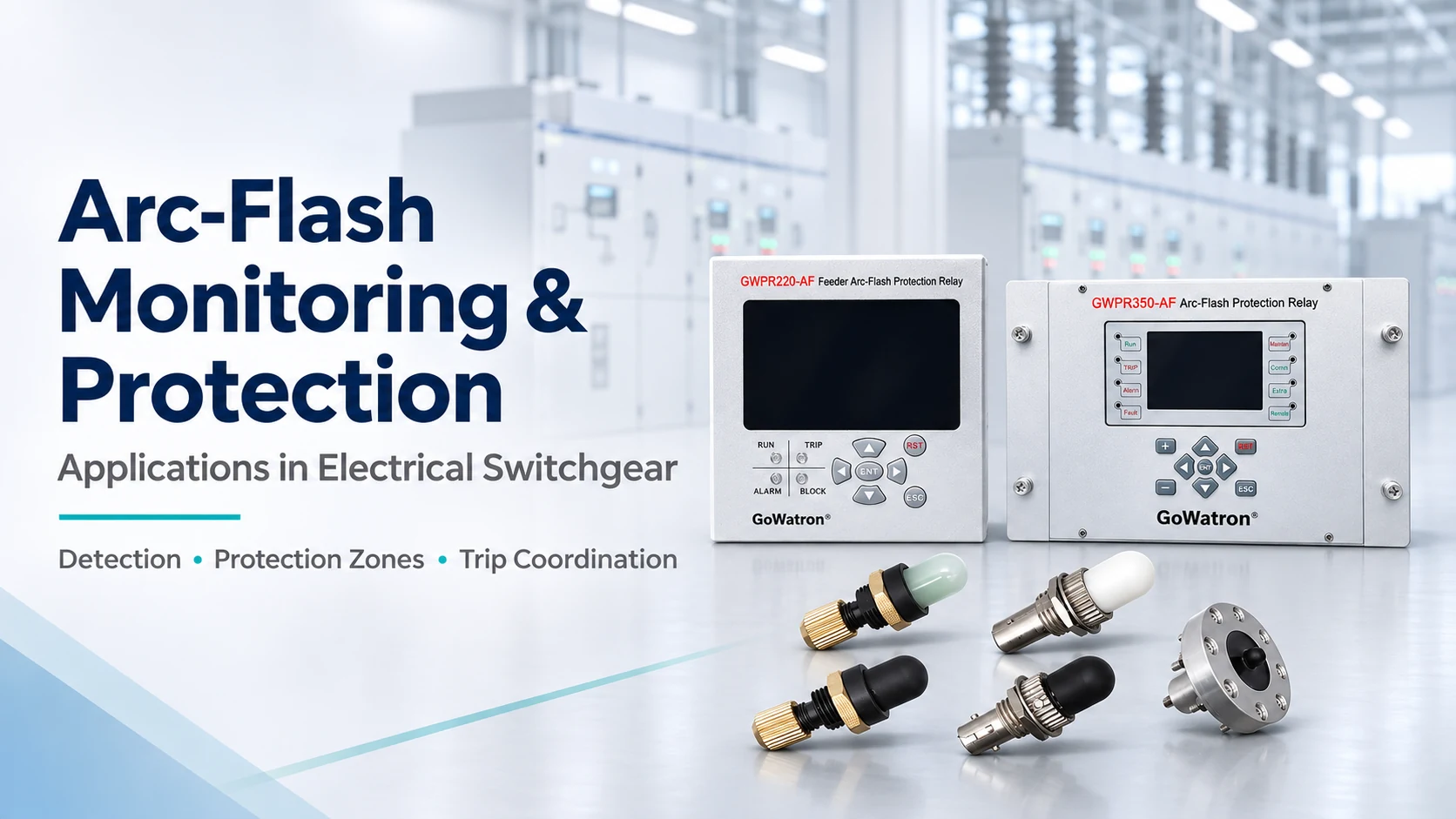
- GoWatron online arc-flash monitoring systems combine arc-flash sensors, arc-flash protection relays, current measurement circuits and circuit-breaker tripping circuits to provide zone-based monitoring and protection for feeder panels, busbars and associated compartments. The main products include:
- GWPR220-AF Feeder Arc-Flash Protection Relay: primarily intended for feeder-related and local protection zones.
- GWPR350-AF Busbar Arc-Flash Protection Relay: primarily intended for busbar protection and centralised protection across multiple switchgear panels.
- GWPR-AF-S Series Arc-Flash Sensors: used to detect optical signals within designated protection zones.
1. Substations and Power Plant Auxiliary Distribution Systems
- Substation low- and medium-voltage switchgear and power plant auxiliary distribution systems are typical applications for online arc-flash monitoring systems. Internal arc faults may occur at busbar connections, circuit-breaker connections and cable terminations as a result of insulation failure, defective connections or the ingress of foreign objects.
Depending on the switchgear construction, GWPR-AF-S Series Arc-Flash Sensors can be installed in busbar compartments, circuit-breaker compartments and cable compartments. Protection relays are then selected according to the equipment and zones to be protected:
- The GWPR220-AF Feeder Arc-Flash Protection Relay is used for feeder-related and local compartment protection, with detection zones and tripping logic configured according to the potential fault locations.
- The GWPR350-AF Busbar Arc-Flash Protection Relay is used for busbar protection and centralised protection across multiple panels, with protection zones established according to the busbar sectionalising arrangement, incomers and bus couplers.
In systems with multiple power sources, all sources capable of feeding a faulted zone must be identified, and trip outputs must be assigned to the relevant circuit breakers.
An internal switchgear fault cannot always be cleared by tripping the circuit breaker in the affected panel. For example, a fault on the supply side of that circuit breaker or within the busbar zone may require tripping the relevant incomer, bus-coupler or other source circuit breakers.
2. Data Centres, Hospitals and Critical Infrastructure
- Data centres, hospitals, airports and rail transport facilities have demanding requirements for continuity of supply and limitation of outage extent. If an internal arc fault persists, it may damage adjacent equipment and extend the resulting outage.
- In these applications, an online arc-flash monitoring system should combine fast detection, dependable operation and protection selectivity. GoWatron can combine the GWPR220-AF Feeder Arc-Flash Protection Relay and the GWPR350-AF Busbar Arc-Flash Protection Relay to establish protection zones based on feeders, busbar sections and power-source connections, with an appropriate trip matrix.
- For systems incorporating dual supplies, bus couplers or standby power sources, protection coordination should be checked under the different operating configurations to ensure reliable isolation of the faulted zone.
- The ability to maintain supply to unaffected loads also depends on the distribution system arrangement, fault location and availability of alternative supplies.
3. Industrial Plants and Large Production Facilities
- Steelworks, petrochemical plants, mines, cement plants and manufacturing facilities commonly operate extensive low- and medium-voltage switchgear, motor control centres and essential power distribution equipment. Internal arc faults can damage equipment, interrupt production and result in lengthy repair and restoration periods.
- Depending on the switchgear construction and required protection coverage, GoWatron online arc-flash monitoring systems can provide local feeder protection, centralised busbar protection or a combination of both. The GWPR220-AF Feeder Arc-Flash Protection Relay is used for feeder-related zones, while the GWPR350-AF Busbar Arc-Flash Protection Relay is used for busbar protection and zone-based protection across multiple panels.
- The type, quantity and installation positions of the GWPR-AF-S Series Arc-Flash Sensors should be determined according to internal obstructions, detection coverage and protection-zone boundaries. Sensor quantities should not be selected solely according to the number of switchgear panels.
- Where dust, moisture, corrosive substances or significant vibration are present, the environmental suitability of the relays and sensors should be verified. For installations in hazardous areas with potentially explosive atmospheres, the suitability of the installation location, applicable certification and installation method must be assessed separately.
4. Photovoltaic Power Plants and Wind Farms
- Online arc-flash monitoring systems can also be applied to collector-system switchgear, low- and medium-voltage switchgear at step-up substations, and auxiliary distribution equipment in photovoltaic power plants and wind farms.
- Depending on the collector circuits, busbar sectionalising arrangement and incomer configuration, GoWatron can use the GWPR220-AF Feeder Arc-Flash Protection Relay for feeder-related zones and the GWPR350-AF Busbar Arc-Flash Protection Relay for busbar and centralised multi-panel protection. The circuit breakers required to isolate the faulted zone are determined from the primary circuit arrangement.
- GWPR-AF-S Series Arc-Flash Sensors can be positioned according to the switchgear compartment layout to provide optical signals for the relevant protection zones.
- These applications primarily concern internal arc faults in switchgear. Series arc-fault detection on the photovoltaic DC side, and arc-fault protection inside DC combiner boxes or inverters, require separate verification of the detection principle, product suitability and DC fault-interruption scheme. An AC switchgear protection configuration should not be assumed to be suitable for these applications.
5. Public and Commercial Building Distribution Systems
- For distribution rooms in large office buildings, shopping centres, schools and public venues, the need for an online arc-flash monitoring system can be assessed according to prospective short-circuit current, equipment construction, personnel exposure and the consequences of an outage.
- For critical incomer panels, bus-coupler panels and shared busbar zones, the GWPR350-AF Busbar Arc-Flash Protection Relay can be combined with GWPR-AF-S Series Arc-Flash Sensors to establish the required protection zones. For individual feeder panels, the GWPR220-AF Feeder Arc-Flash Protection Relay can be selected according to the required detection coverage and tripping logic.
- If integration with a building power monitoring system is required, the communication configuration and available data should be verified for the selected relay, including alarms, protection operation events and device status.
- Remote monitoring supports operational management. Fast protection should be implemented through protection and tripping circuits that meet the project design requirements.
6. Retrofitting Existing Switchgear and Distribution Systems
An online arc-flash monitoring system can be added to an existing distribution system where suitable installation and wiring conditions are available, to improve protection against internal arc faults.
Depending on the retrofit scope, the GWPR220-AF Feeder Arc-Flash Protection Relay, GWPR350-AF Busbar Arc-Flash Protection Relay and GWPR-AF-S Series Arc-Flash Sensors can be selected. The configuration should be determined using the following information:
- The single-line diagram, number of switchgear panels and busbar sectionalising arrangement.
- The internal compartment construction and available sensor mounting positions.
- The current transformer configuration and availability of suitable current measurement signals.
- Circuit-breaker trip interfaces, control power supplies and interrupting capabilities.
- Protection zones and circuit breakers to be tripped under the different operating configurations.
After installation, sensor detection, protection criteria, the configured trip matrix and the actual tripping circuits should be verified. This verification should confirm the effectiveness of the complete protection chain from fault detection to circuit-breaker operation.
7. How Should a GoWatron Online Arc-Flash Monitoring System Be Selected?
Selection of an online arc-flash monitoring system should begin with the required protection coverage and fault-isolation arrangement. The relays, sensors and associated circuits can then be selected accordingly.
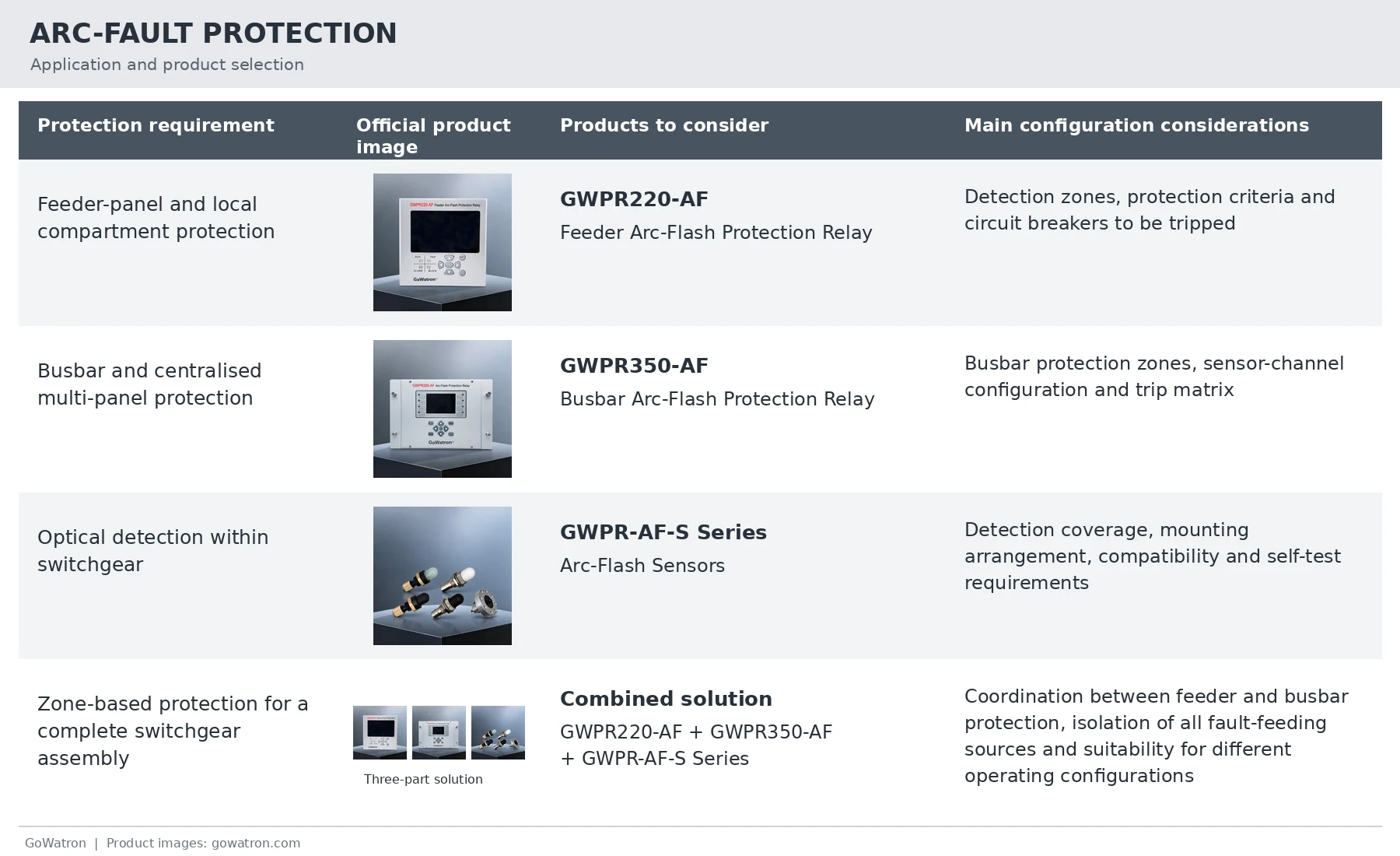
- The detection and protection logic should also be selected according to site conditions.
- Where light-only detection is used to initiate tripping, particular attention should be paid to external intense light sources and optical signals produced during normal switching operations.
- Where optical detection is combined with overcurrent supervision or other electrical criteria, the measurement locations and pickup thresholds should be verified to ensure dependable detection of the intended faults. The selected electrical criteria must remain appropriate for the relevant fault types and system operating configurations.
- The number of channels, sensor compatibility, protection functions and communication options must be confirmed against the technical documentation and project configuration for the selected model.
8. Applicable Voltage Levels and Protection Limitations
- For typical distribution projects, schemes can be developed for relevant switchgear in systems operating at 0.4 kV, 6 kV, 10 kV, 11 kV, 20 kV, 22 kV, 33 kV and 35 kV. Actual suitability depends on the selected product documentation, switchgear construction and project-specific configuration. The primary system voltage is not the voltage applied directly to the electrical inputs of the arc-flash protection relay.
- An online arc-flash monitoring system is not equivalent to a single arc-flash protection relay. A complete protection scheme requires coordinated detection, signal processing, protection logic and fault interruption. Monitoring and alarm functions alone do not automatically isolate a fault.
- An arc-flash protection relay can issue a trip command rapidly, but the total fault-clearing time also includes any additional delays in the tripping circuit and the circuit breaker’s interrupting time. Relay operating time must therefore not be presented as the total fault-clearing time.
- Online arc-flash monitoring systems detect optical signals from arcing that has already started. They should not be described as providing comprehensive predictive warning of insulation deterioration, overheated connections or partial discharge. Where monitoring of these conditions is required, appropriate additional condition-monitoring methods should be provided.


