What Are the Advantages of Integrated AC/DC Power Supply Systems Compared with Conventional DC Power Supply Panels?
- An integrated AC/DC power supply system brings AC distribution, a DC auxiliary power supply and, where required, an uninterruptible power supply (UPS), DC-fed inverters and telecommunications power supplies into a coordinated arrangement with centralised monitoring.
- For this comparison, conventional DC power supply panels refer to stand-alone panels serving DC loads, rather than panels integrated with AC distribution and other power supply subsystems.
- The main advantages of integrated AC/DC power supply systems are coordinated system design, appropriate sharing of battery resources and centralised monitoring. Depending on the configuration, these features can improve space utilisation, simplify maintenance and reduce duplicated equipment. The benefits are particularly relevant to substations, power plants and industrial facilities requiring several types of power supply.
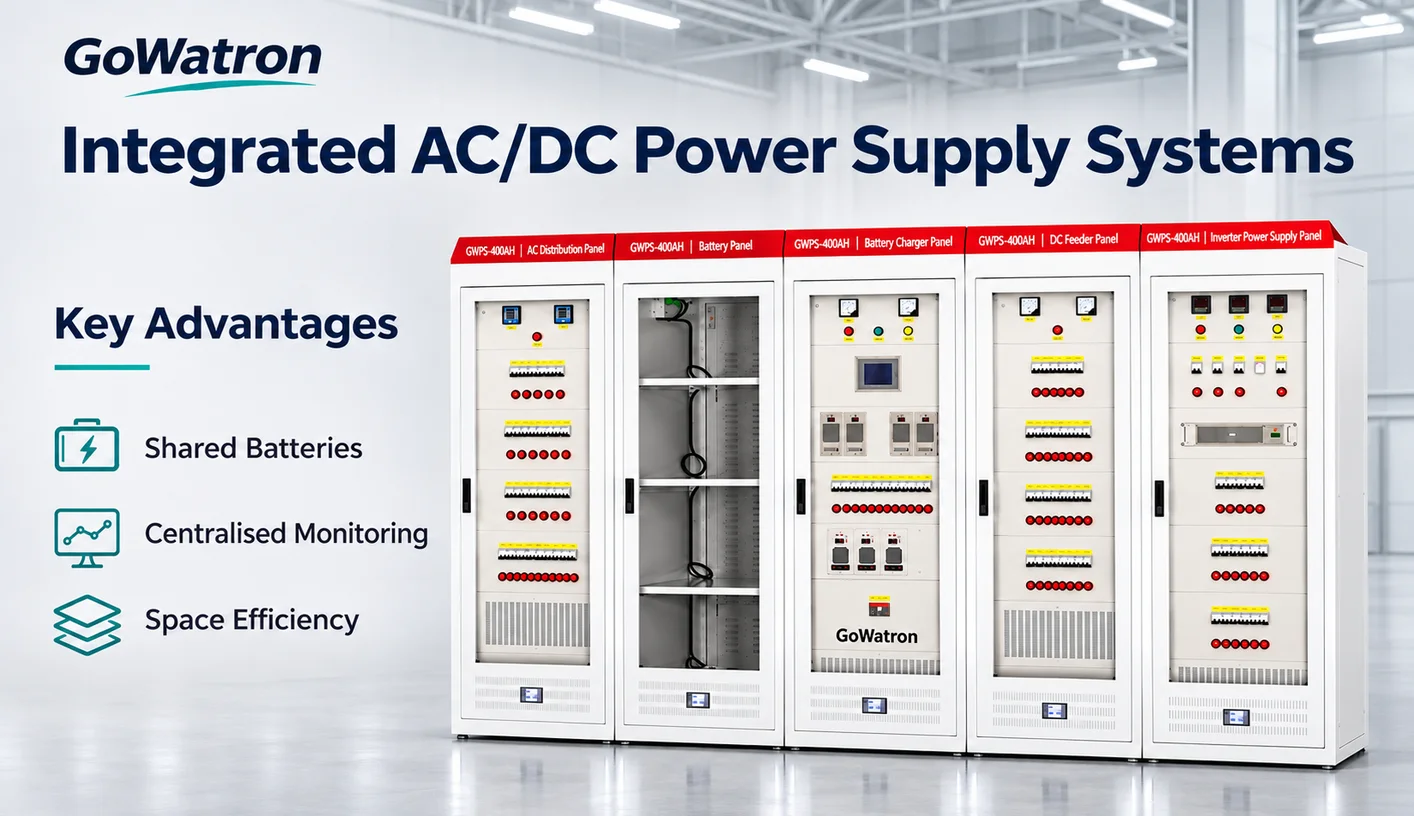
1. Coordinated Provision of Multiple Power Supplies
A conventional DC power supply panel primarily supplies DC auxiliary loads, including protection relays, control and signalling circuits, and circuit-breaker operating circuits. Where a facility also requires an uninterruptible AC supply or a telecommunications power supply at a different DC voltage, additional equipment is generally needed.
Depending on project requirements, an integrated AC/DC power supply system can incorporate:
- AC incoming supply circuits and outgoing distribution circuits;
- A 110 V or 220 V DC auxiliary power supply for protection, control and switchgear operation;
- A UPS or DC-fed inverter system for critical AC loads;
- DC/DC converters supplying telecommunications loads, such as −48 V DC equipment;
- Battery banks, insulation monitoring devices and monitoring equipment supporting centralised supervision.
A UPS and an inverter are not equivalent. A UPS provides continuity of AC power using an energy storage arrangement and associated conversion and switching functions. A DC-fed inverter converts power from the DC system into AC; the complete supply arrangement
determines its backup capability and transfer characteristics.
Coordinated design helps define supply arrangements, capacity allocation among subsystems and subsystem interfaces. This can reduce duplicated engineering and simplify interface coordination. The functions included depend on the specified configuration.
2. Shared Battery Resources Where Appropriate
With a suitable system architecture, a battery bank can support DC auxiliary loads and, through inverters or DC/DC converters, critical AC loads and telecommunications loads. This can reduce the equipment, installation space and maintenance associated with separate battery banks.
Sharing battery resources does not mean that the system must use only one battery bank. The number of battery banks and their connection arrangements depend on supply reliability, busbar sectionalisation and maintenance requirements.
Battery capacity should not be determined simply by adding the rated power of all connected equipment. Battery sizing should account for:
- The loads requiring battery backup and their operating duties;
- The required autonomy (backup time) for each load category;
- Short-duration loads, including circuit-breaker tripping and closing;
- Inverter and DC/DC converter efficiencies;
– Battery discharge characteristics, ambient temperature and ageing allowances.
Appropriate sharing can improve resource utilisation, provided that the required independence of critical supplies and effective fault isolation are maintained.
3. More Efficient Cabinet Layout and Site Cabling
- Coordinated cabinet design and compact equipment arrangements can reduce the number of separate cabinets, duplicated monitoring devices and some inter-cabinet connections. They can also simplify cable routing and the provision of maintenance access.
- These benefits are particularly useful in electrical rooms with limited space, prefabricated substations and retrofit projects involving several existing power supply systems.
- However, an integrated AC/DC power supply system does not necessarily fit into a single cabinet. The number of cabinets and the required floor space depend on battery capacity, the number of outgoing distribution circuits, UPS or inverter ratings, redundancy, cooling and maintenance access requirements.
- Any claimed reduction in floor space should be supported by layouts providing equivalent functions and capacities. A general claim such as “over 30% less floor space” should therefore be avoided without supporting project data.
4. Centralised Monitoring for More Efficient Maintenance
An integrated AC/DC power supply system can provide a common monitoring platform that consolidates measurements, operating status and alarms from its power supply subsystems. Monitoring devices and subsystem controllers provide the information displayed on this platform.
This reduces the need to check several separate equipment interfaces. Depending on the configuration, monitoring can cover:
- AC incoming supply status and electrical measurements;
- Rectifier module status and fault alarms;
- DC busbar voltage, load current and outgoing distribution circuit status;
- Battery bank measurements and individual cell or monobloc battery measurements;
- DC system insulation condition, as reported by insulation monitoring devices;
- The operating status and alarms of the UPS, DC-fed inverters and telecommunications power supplies.
A monobloc battery is a battery unit containing multiple cells in a single case. Monitoring may therefore be performed at individual cell level or monobloc level, depending on the battery arrangement and monitoring equipment.
Centralised monitoring helps operators assess related events across different subsystems and supports inspection and fault investigation. The level of fault localisation depends on the sensors, monitoring devices and communication functions provided.
5. Easier Module Maintenance and Capacity Expansion
- With a modular design, rectifier capacity can be selected to suit the load. Module redundancy, such as N+1, and hot-swappable modules may also be available, subject to the equipment design.
- In an N+1 arrangement, N modules provide the required capacity and one additional module provides redundancy. The remaining modules must be capable of supplying the specified load following the loss of one module.
- Hot-swappable modules are designed for removal and replacement while the system remains energised, in accordance with the manufacturer’s procedures.
- Modularity, module redundancy and hot-swappable modules are not exclusive to integrated AC/DC power supply systems. Modern conventional DC power supply panels can also provide these features. The benefit of integration lies primarily in coordinating equipment configuration, monitoring and maintenance across the complete installation.
- Expansion capability also depends on AC supply capacity, busbar current ratings, available outgoing distribution circuits, cooling, battery capacity and cabinet space. Spare module positions alone do not establish that the system can accommodate additional loads.
6. Convenient Integration with Remote Monitoring Systems
- Where suitable communication functions are provided, an integrated AC/DC power supply system can consolidate information from several power supply subsystems and transmit it to a substation automation system or a supervisory control and data acquisition (SCADA) system.
- This supports remote status monitoring, alarm handling and analysis of operating records.
- Support for remote measurements, status indications, control commands and parameter adjustment should be verified individually. Communication interfaces, protocols, data point lists and control permissions must match the requirements of the receiving system.
- An Ethernet or RS-485 interface alone does not establish support for all of these functions.
7. Potential Reduction in Overall Installation and Maintenance Costs
- For projects that would otherwise require separate conventional DC power supply panels, UPS systems, telecommunications power supplies and AC distribution equipment, an integrated arrangement can reduce duplication, share appropriate resources and consolidate monitoring.
- These measures can help reduce overall installation and maintenance costs.
- However, integrated AC/DC power supply systems are not necessarily less expensive in every application. Their economic value depends on load types, capacity, required autonomy, redundancy and the extent of any retrofit work.
- Where only a DC auxiliary power supply is required, with no need to integrate a UPS, a DC-fed inverter or telecommunications power supplies, a conventional DC power supply panel may remain a simpler and more economical choice.
8. Does Integration Necessarily Improve Reliability?
- An integrated AC/DC power supply system can improve continuity of supply and maintainability through appropriate engineering. However, overall reliability depends on the system architecture and cannot be established by integration alone.
- For example, suitable module redundancy can allow continued operation following a single module failure, provided that the remaining capacity is sufficient and the fault is effectively isolated. Module redundancy does not, however, address every possible failure of battery banks, busbars or distribution circuits.
- Shared battery banks and common busbars also require appropriate fault isolation, protection coordination, busbar sectionalisation and maintenance arrangements to limit the consequences of a subsystem fault.
- A meaningful comparison should therefore assess an integrated AC/DC power supply system against a complete arrangement comprising conventional DC power supply panels, UPS or inverter systems, telecommunications power supplies and AC distribution equipment, using equivalent load capacities, autonomy requirements and reliability criteria.


