Transmission Line Protection Relays: Types and Selection Guide
- GoWatron transmission line protection relays provide solutions for distance protection (ANSI 21), line current differential protection (ANSI 87L) and coordinated overcurrent backup protection. The product range includes the GWPR320-DIS Distance Protection Relay, GWPR320-LD Line Current Differential Protection Relay and GWPR300-L Line Protection Relay.
- Selecting a suitable transmission line protection relay requires consideration of the network voltage, line characteristics, system earthing arrangement, available communication channels and protection coordination requirements.
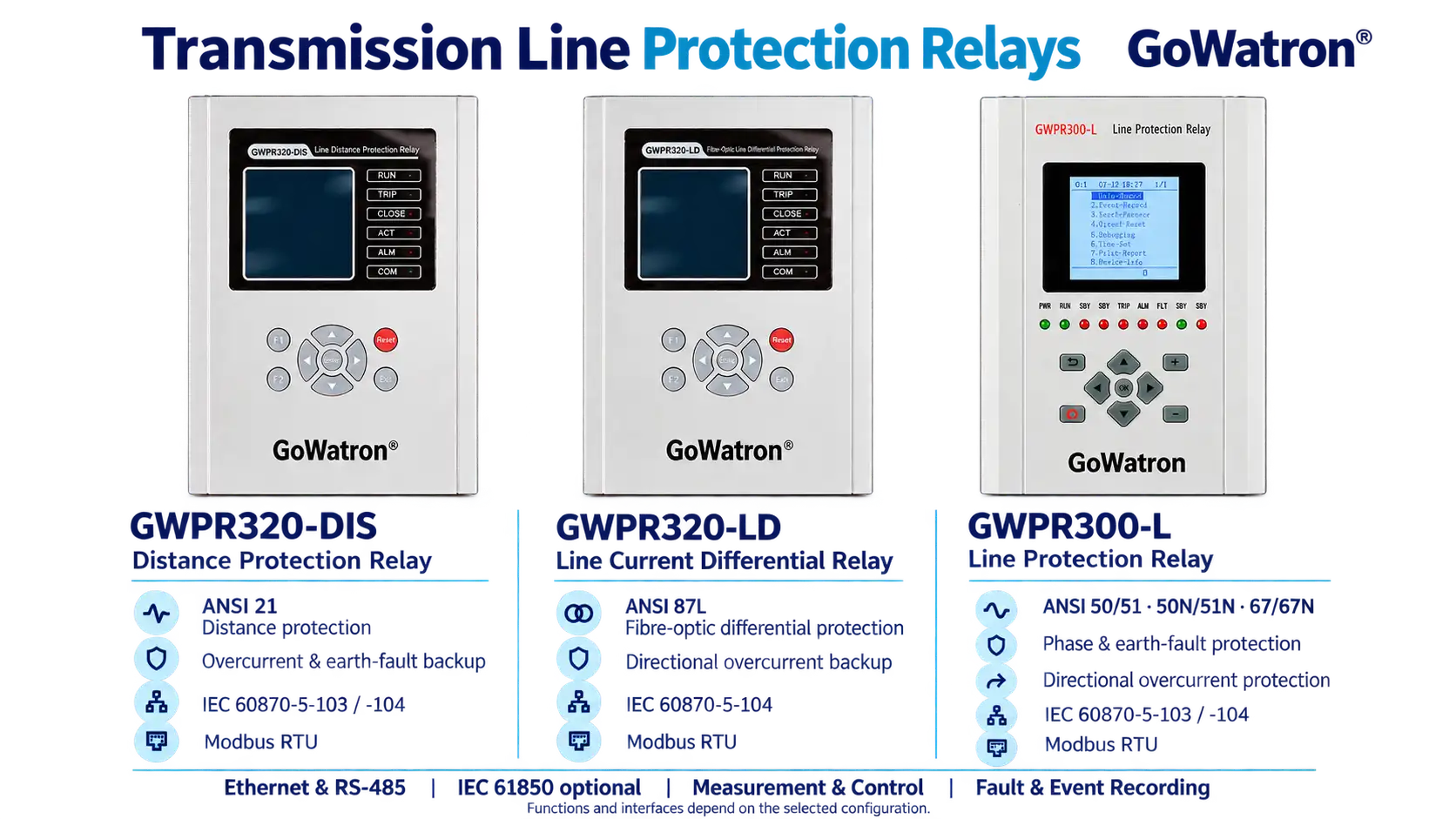
1. Product Overview
- A transmission line protection relay detects electrical faults on a protected line and initiates circuit breaker tripping to isolate the faulted section. A properly designed and coordinated protection scheme helps limit equipment damage, maintain power system stability and reduce interruptions to healthy parts of the network.
The main protection types covered in this guide are:
- Distance protection.
- Line current differential protection.
- Phase overcurrent and directional phase overcurrent protection.
- Earth-fault overcurrent and directional earth-fault protection.
These functions may be applied as main protection, supplementary protection or backup protection, depending on the network design and relay configuration.
2. Transmission Line Protection Relay Types
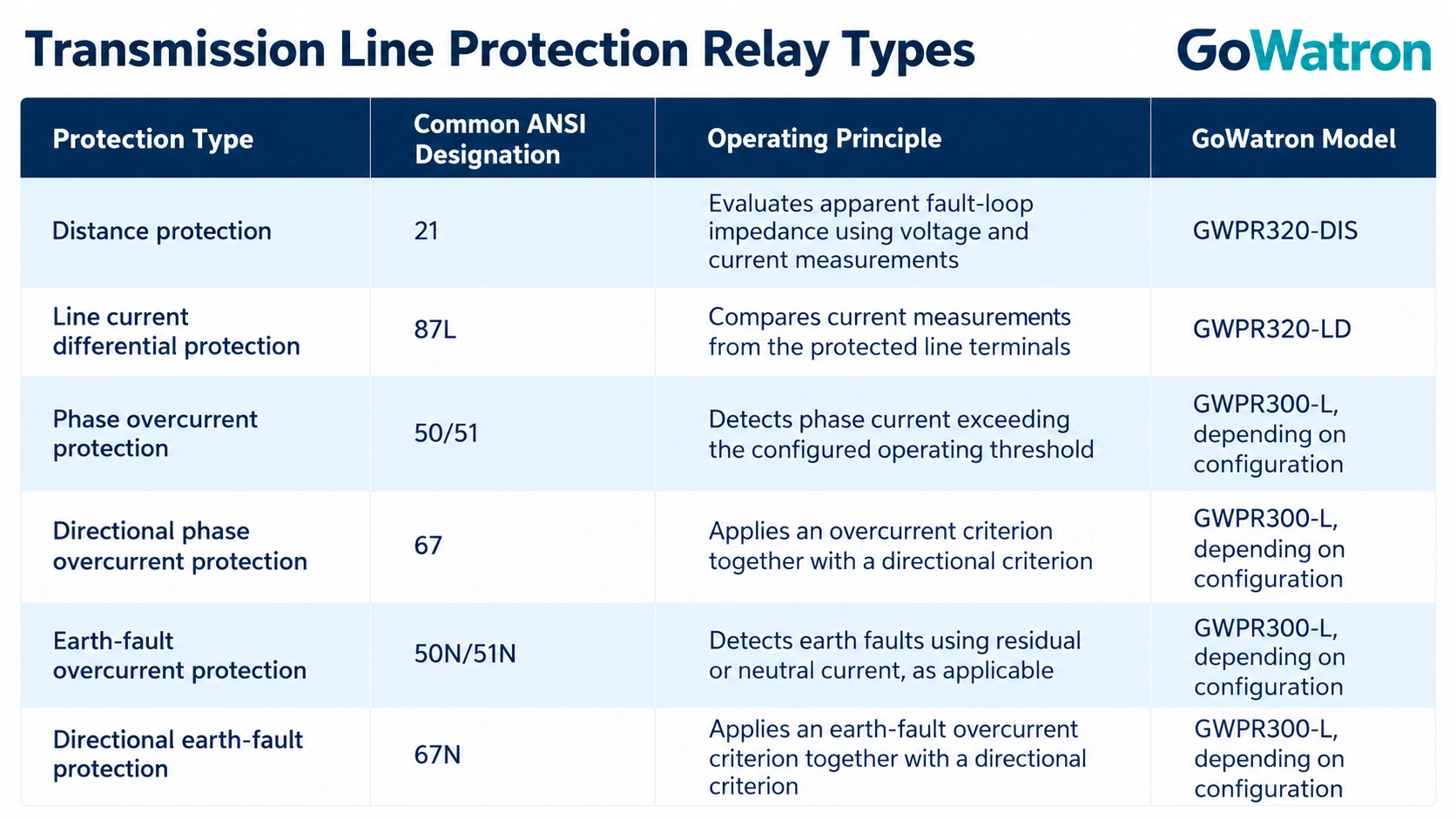
The protection functions listed above indicate the principal role of each product. Additional functions and hardware options depend on the selected relay configuration.
2.1 Distance Protection
- Distance protection evaluates the apparent impedance of a fault loop and compares it with a configured operating characteristic.
- For a given line, impedance is related to line length. However, the apparent impedance measured during a fault is also affected by fault resistance, remote-end infeed and other network conditions. Distance protection settings must therefore be based on a protection study rather than line length alone.
2.2 Line Current Differential Protection
- Line current differential protection compares currents from the terminals of the protected line through a communication channel.
- Its protection zone is defined by the terminal CT locations. The relay evaluates differential and restraint quantities to distinguish internal faults from load current and external faults.
2.3 Overcurrent-Based Line Protection
- Overcurrent-based line protection operates when the measured current exceeds a configured threshold, subject to the applicable time delay, directional criterion and supervision logic.
- It can provide main protection where network conditions permit, or supplementary and backup protection within a transmission line protection scheme.
3. GWPR320-DIS Distance Protection Relay
The GWPR320-DIS Distance Protection Relay provides impedancebased line protection using voltage and current measurements.
The relay is intended for projects requiring a distance protection scheme. Its application and settings should consider:
- Positivesequence and zerosequence line impedances.
- Current transformer (CT) and voltage transformer (VT) ratios.
- Line length and network topology.
- Maximum load conditions.
- Fault resistance and remoteend infeed.
- Coordination with adjacent protection.
- Requirements for communicationassisted tripping, where applicable.
A distance protection scheme may operate using local measurements. Communicationassisted schemes can provide additional tripping capabilities when supported by the selected configuration.
Distance protection may also provide backup to line current differential protection, subject to the overall protection design.
4. GWPR320-LD Line Current Differential Protection Relay
- The GWPR320-LD Line Current Differential Protection Relay provides ANSI 87L protection by comparing current measurements from the protected line terminals through a suitable communication channel.
- With current reference directions defined as entering the protection zone, terminal currents approximately sum to zero during normal operation and external faults. In practice, line charging current, CT errors and measurement errors can produce differential current.
An internal fault produces an imbalance that is evaluated against the relay’s differential operating characteristic.
- Application engineering should address:
- CT ratios, polarity and accuracy classes.
- CT saturation during external faults.
- Sampletime alignment between terminals.
- Communication delay, delay asymmetry and channel availability.
- Line charging current, where significant.
- Protection behaviour following communication failure.
- Coordination with independent backup protection.
Sampletime alignment ensures that the compared currents represent corresponding instants. The method used to achieve this depends on the relay design and communication arrangement.
5. GWPR300-L Line Protection Relay
The GWPR300-L Line Protection Relay supports overcurrentbased line protection and coordinated backup protection.
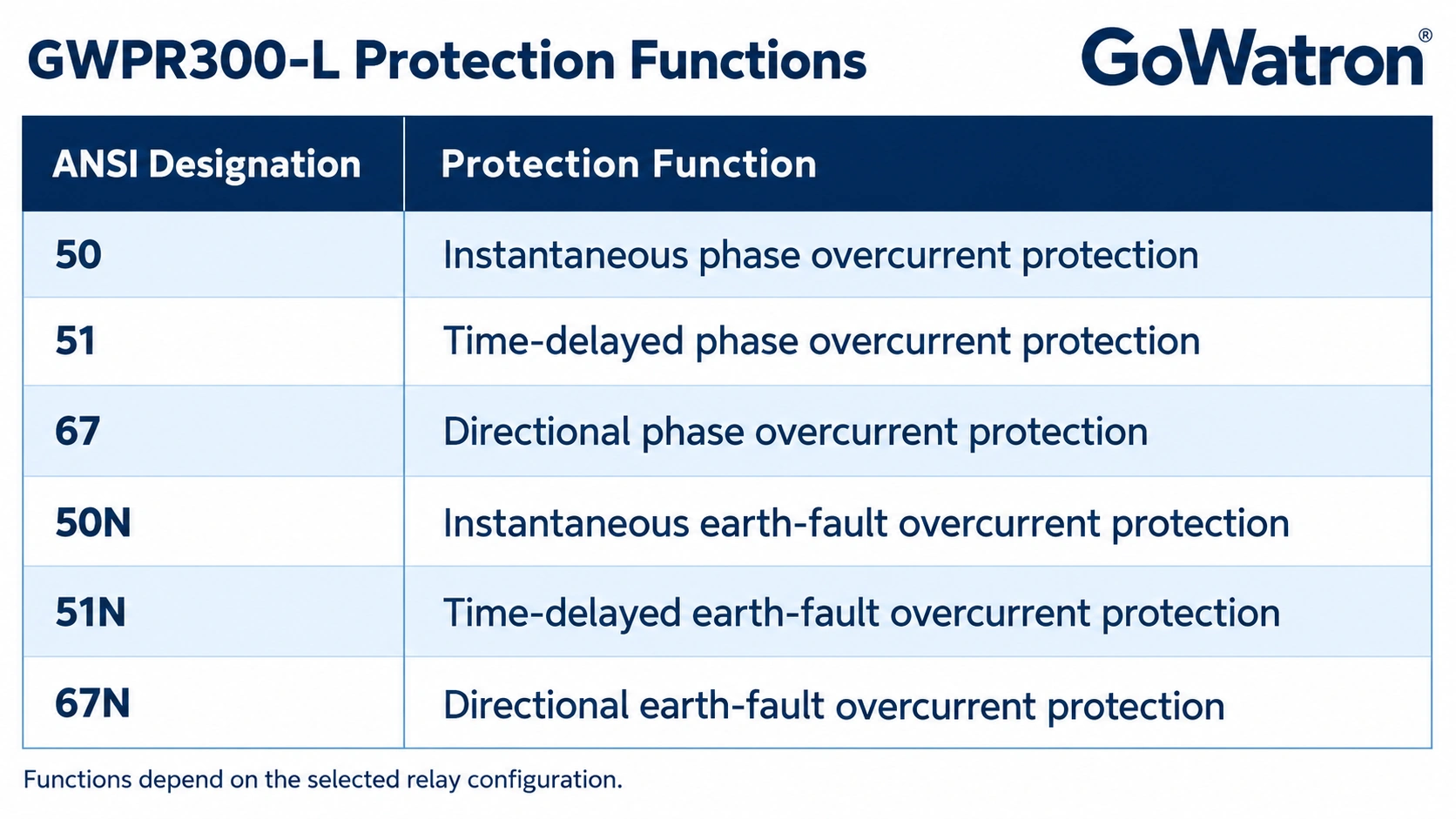
- Directional protection helps distinguish faults in the selected operating direction. Its application requires suitable polarising quantities and settings appropriate to the network.
- Earth-fault protection sensitivity depends on the system earthing arrangement, available fault current and CT arrangement.
- The GWPR300-L can be considered where overcurrent-based line protection or separate backup protection is required. Coordination should account for load current, minimum and maximum fault levels, adjacent relay characteristics and circuit breaker clearing times.
6. Transmission Line Protection Relay Selection Guide
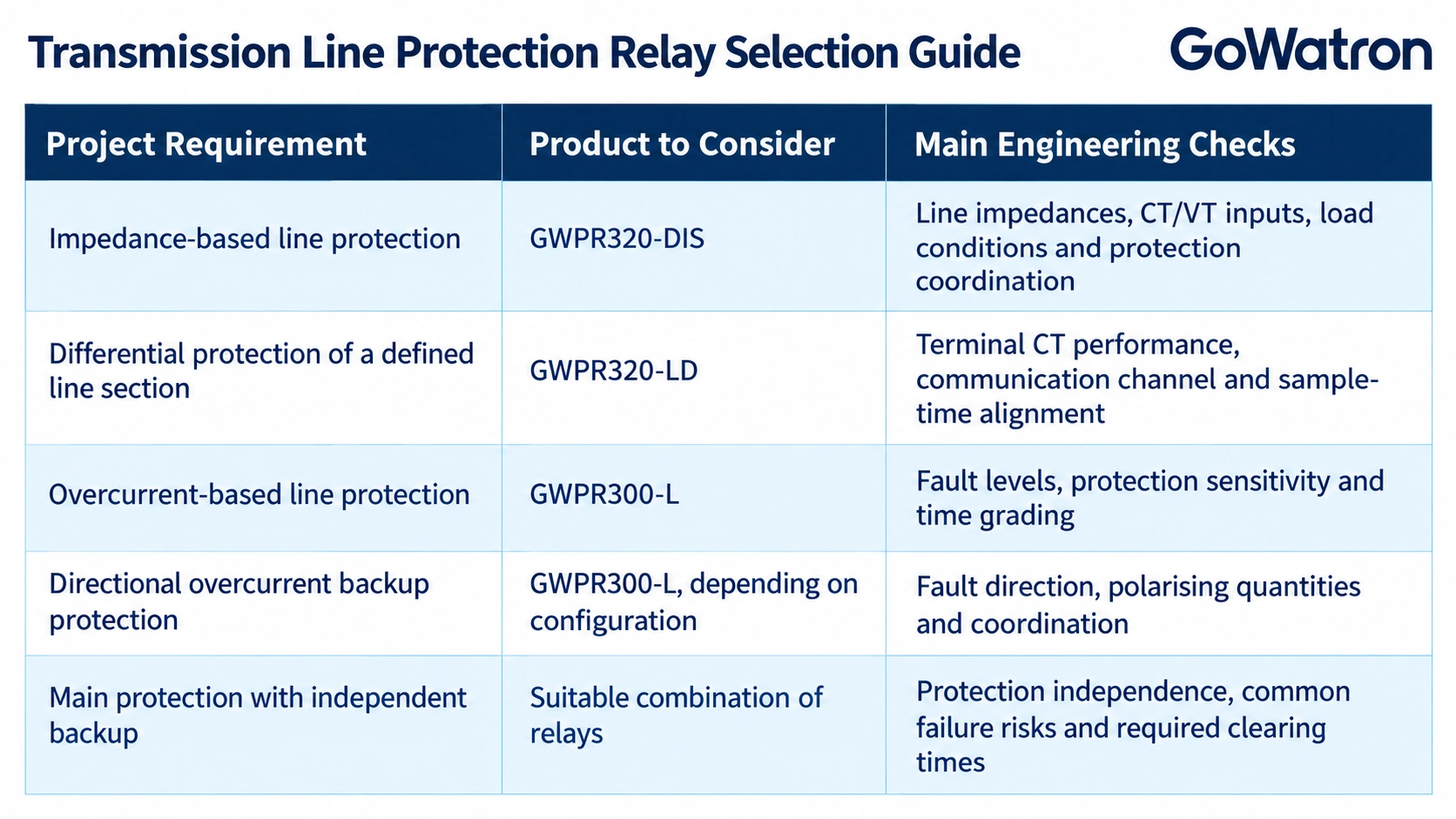
6.1 Assess the Network Arrangement
- Identify whether the protected line forms part of a radial, ring or interconnected network. Multiple sources and changing power flow can affect protection directionality and coordination.
6.2 Check the Line Characteristics
- Confirm whether the circuit consists of an overhead line, underground cable or a combination of both. Obtain the line length, sequence impedances and other data required for the protection study.
6.3 Evaluate Communication Availability
- For line current differential protection, verify that the proposed channel meets the relay’s requirements for delay, asymmetry and availability.
- Where communication-assisted distance protection is required, confirm the supported scheme and signalling interfaces.
6.4 Verify CT and VT Suitability
- Check CT ratios, polarity, accuracy classes, burden and saturation performance. For distance protection, also verify the VT arrangement, secondary ratings and voltage circuit supervision requirements.
6.5 Coordinate Main and Backup Protection
- Define the required operating times, selectivity and backup coverage. Consider circuit breaker clearing times and the response to relay, communication or auxiliary supply failures.
- System voltage is one selection factor; it does not determine the required protection principle on its own.
7. Typical Applications
Subject to the selected model’s ratings and configuration, GoWatron line protection relays can be considered for:
- Overhead line protection.
- Underground cable protection.
- Mixed overhead line and cable circuits.
- Substation interconnecting lines.
- Industrial power network interconnections.
- Power station and renewable generation connection lines.
- Coordinated line backup protection.
The final selection should follow the project protection study and applicable utility requirements.
8. Information Required for Selection and Quotation
To request a suitable GoWatron transmission line protection relay, provide:
- Rated system voltage and frequency.
- Single-line diagram and network operating arrangements.
- Line length and overhead line or cable details.
- Positive-sequence and zero-sequence line impedances.
- CT ratios, accuracy classes and secondary ratings.
- VT ratios and secondary ratings.
- System earthing method.
- Minimum and maximum short-circuit levels.
- Required main and backup protection functions.
- Available communication channels.
- Auxiliary supply voltage.
- Required binary inputs, output contacts and SCADA interfaces.
- Applicable project specifications and quantity.
This information supports selection of the appropriate GWPR320-DIS, GWPR320-LD or GWPR300-L configuration.


