Main Advantages of Ring Main Units (RMUs)
- A ring main unit (RMU) is a type of medium-voltage (MV) switchgear widely used in electrical distribution systems, including 10 kV, 11 kV, 20 kV, 22 kV and 33 kV distribution networks. The applicable voltage levels depend on the rated characteristics and design of the equipment.
- RMUs are widely used in urban distribution networks, industrial parks, commercial buildings, compact substations and renewable energy integration and distribution systems because of their compact design, environmental adaptability, flexible configuration and compatibility with distribution automation systems, as well as their contribution to improved supply reliability.
- The main advantages of RMUs are outlined below.
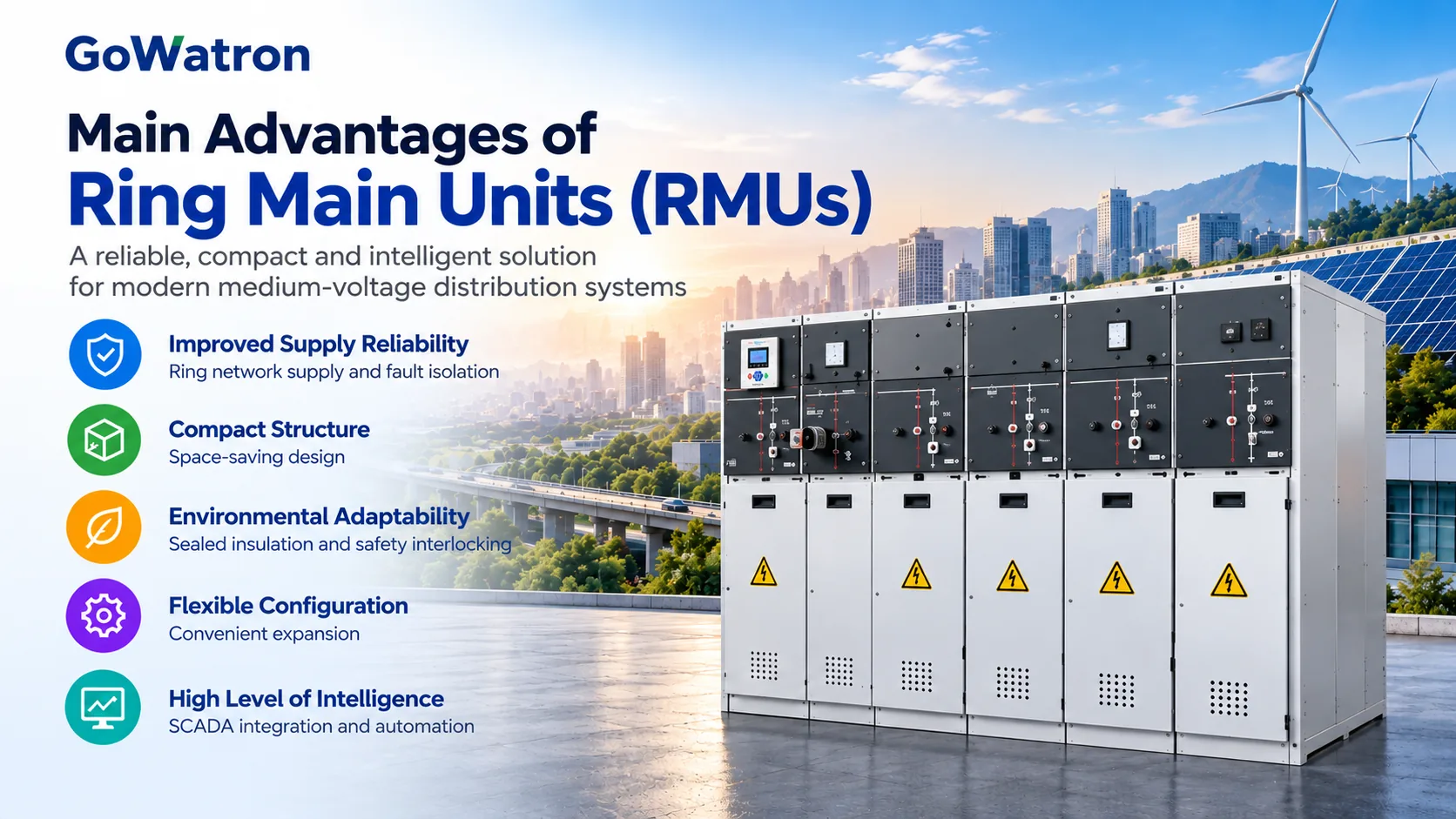
1. Improved Supply Reliability (Ring Network Supply and Fault Isolation)
- Improved Supply Continuity: RMUs are commonly installed in ring distribution networks, supporting alternative supply paths and flexible network operating arrangements. When a short-circuit, earth fault or other fault occurs on a section of the distribution network, the faulty section can be isolated through appropriately coordinated protection and switching arrangements. Where network conditions permit, power can then be restored to unaffected sections through an alternative supply path, thereby reducing the extent and duration of supply interruptions.
- Dual-source Supply: RMUs can be used in dual-source or multi-source distribution systems, including interconnected medium-voltage distribution networks with normally open points. By appropriately configuring incoming and outgoing switching devices, protection relays and distribution automation equipment, RMUs can improve operational flexibility and supply reliability. They are particularly suitable for hospitals, data centres, airports and industrial facilities where continuity of electricity supply is critical.
- Important Note: Ring distribution networks are often designed with a ring topology but operated in an open-ring configuration. An RMU does not inherently guarantee an uninterrupted power supply. The actual power restoration time depends on the network topology, fault location, protection configuration, switching arrangements and level of automation.
2. Compact Structure and Space-saving Design
- Multiple Insulation Technologies: Modern RMUs may employ SF₆ gas insulation, SF₆-free gas insulation, solid insulation or air insulation. Gas-insulated and certain solid-insulated designs enable compact equipment construction by incorporating primary live components within enclosed or insulated compartments, reducing the overall dimensions of the switchgear.
- Compact Design: Compared with certain conventional air-insulated medium-voltage switchgear arrangements designed for similar applications, compact RMUs generally require less installation space. This can reduce the floor area required for electrical distribution rooms and associated civil engineering costs.
- RMUs are particularly suitable for compact substations, underground distribution rooms, urban distribution substations and industrial facilities where installation space is limited.
- The actual dimensions and space-saving benefits depend on the rated voltage, rated normal current, applicable short-circuit ratings, insulation technology and functional unit configuration.
3. Environmental Adaptability and Operational Safety (Sealed Insulation and Safety Interlocking)
- Reduced Environmental Influence: RMUs incorporating gas-tight compartments or solid-insulated components can reduce the exposure of primary live parts to moisture, dust, salt mist, condensation and other external environmental influences. This helps minimise the risk of insulation faults caused by adverse environmental conditions.
- The actual environmental performance depends on the equipment’s degree of protection, insulation design and specified service conditions.
- Reduced Maintenance Requirements: RMUs employing sealed insulation systems can reduce contamination of internal live components and consequently lower routine maintenance requirements.
- Certain sealed compartments may require little or no internal maintenance during their specified service life under prescribed operating conditions. However, operating mechanisms, auxiliary circuits, electrical connections and other associated components must still be inspected and maintained in accordance with the manufacturer’s instructions.
- Personnel Safety: RMUs are generally equipped with mechanical interlocking systems, earthing switches and safety arrangements designed to prevent incorrect switching operations.
- Equipment with an appropriate internal arc classification may also incorporate metal-enclosed construction, pressure relief arrangements and other protective measures to reduce the risks to personnel associated with internal arcing faults.
- The safety performance of an RMU should be assessed against the applicable requirements of the IEC 62271 series, relevant type-test results, internal arc classification, where applicable, and actual installation conditions.
- A sealed enclosure alone does not guarantee complete protection against the consequences of an internal arcing fault.
4. Flexible Configuration and Convenient Expansion
- Modular Design: RMUs can be configured with different functional units according to the requirements of the electrical distribution system.
- Typical functional units include load-break switch units, circuit-breaker units, metering units and cable connection units.
- These units can be combined to provide incoming feeder control, outgoing feeder control, transformer protection, electrical energy metering and other distribution functions.
- Flexible Configuration and Expansion: RMUs with extensible modular designs can accommodate additional functional units or configuration changes as distribution network requirements evolve.
- This flexibility can support increasing load demand, modifications to distribution feeders and future system upgrades.
- However, not all RMUs support on-site expansion. Fixed-configuration RMUs and extensible RMUs differ in their construction and expansion capabilities.
- The actual expansion options depend on the manufacturer’s equipment design, busbar connection arrangements and applicable technical specifications.
5. High Level of Intelligence and Automation
- Distribution Automation Integration: Modern RMUs can be equipped with protection relays, short-circuit and earth-fault indicators, current and voltage sensors, motorised operating mechanisms and distribution automation terminals (DTUs/RTUs), depending on project requirements.
- These devices provide the necessary infrastructure for condition monitoring, fault detection and remote operation within medium-voltage distribution networks.
- Remote Monitoring, Signalling and Control: When integrated with DTUs/RTUs, communication networks and SCADA systems, RMUs can support the following functions:
- Telemetry: Remote acquisition of electrical measurements, including current, voltage, power and other operating parameters.
- Remote Signalling: Remote monitoring of switch positions, earthing switch positions, fault alarms and equipment operating status.
- Remote Control (Telecontrol): Remote opening and closing of switching devices, subject to the required safety interlocks, operating permissions and control conditions.
- Fault Location, Isolation and Service Restoration: When RMUs operate in conjunction with protection relays, DTUs/RTUs and distribution automation systems, they can support fault information acquisition, faulted-section identification, remote fault isolation and restoration of supply to unaffected network sections.
- Where the required automation logic and control arrangements are implemented, the system can also support feeder automation and Fault Location, Isolation and Service Restoration (FLISR) functions.
- SCADA System Integration: SCADA-ready RMUs can be integrated with distribution automation master stations and SCADA systems through appropriately configured communication and control equipment.
Depending on the installed protection relays, DTUs/RTUs and communication devices, supported protocols may include:
- IEC 60870-5-104
- IEC 61850
- Modbus RTU/TCP
- These communication capabilities enable remote monitoring, operational data exchange, fault indication and supervisory control within medium-voltage distribution networks.
- Important Note: A SCADA-ready RMU does not necessarily include a complete distribution automation system as standard.
- Its actual automation capabilities depend on the configuration of motorised operating mechanisms, measurement sensors, communication interfaces, control terminals, protection functions and associated system equipment.
Summary of Applications
Due to these advantages, RMUs are widely used in the following applications:
- Urban Distribution Network Upgrades: RMUs are used in urban medium-voltage distribution networks, switching stations, ring distribution substations and compact substations to improve network flexibility and supply reliability.
- Industrial and Commercial Buildings: RMUs are installed in large factories, data centres, commercial complexes, high-rise buildings and industrial parks to provide medium-voltage power distribution, feeder control and fault protection.
- Renewable Energy Integration: RMUs are used in medium-voltage distribution and grid connection systems associated with distributed photovoltaic power generation, wind farms, battery energy storage systems and electric vehicle charging infrastructure.
- They support power collection, distribution control, switching operations and electrical system protection.
- Smart Distribution Networks: By integrating protection relays, DTUs/RTUs, measurement sensors and SCADA communication capabilities, RMUs can form an important part of modern distribution automation systems.
They support remote monitoring, fault location, fault isolation and service restoration, helping to improve the operational efficiency and automation capabilities of electrical distribution networks.
Overall, ring main units (RMUs) provide a compact, reliable and flexible solution for modern medium-voltage electrical distribution systems.
Through their space-saving construction, adaptable network configurations, switching and protection capabilities, and optional intelligent monitoring and automation functions, RMUs help improve supply reliability, operational safety and distribution network management.


