Types of Electrical Distribution Boxes: Classification & Selection Guide
1. What Is an Integrated Electrical Distribution Assembly?
- An integrated electrical distribution assembly combines multiple electrical functions—such as power distribution, protection, measurement, energy metering, control and communication—within a single enclosure or cabinet. Depending on the application, it may also provide reactive power compensation, power quality monitoring and remote automation functions.
- In this article, integrated electrical distribution assembly is used as a broad descriptive term for equipment combining several electrical functions. It is not a separately defined equipment category under IEC standards.
- A basic distribution box primarily provides power distribution and circuit protection, whereas an integrated assembly incorporates additional functions to meet specific operational and system management requirements.
- In engineering practice, the terms distribution box, distribution cabinet, distribution panel and distribution board are used depending on equipment construction, application and regional terminology. These terms are not always interchangeable.
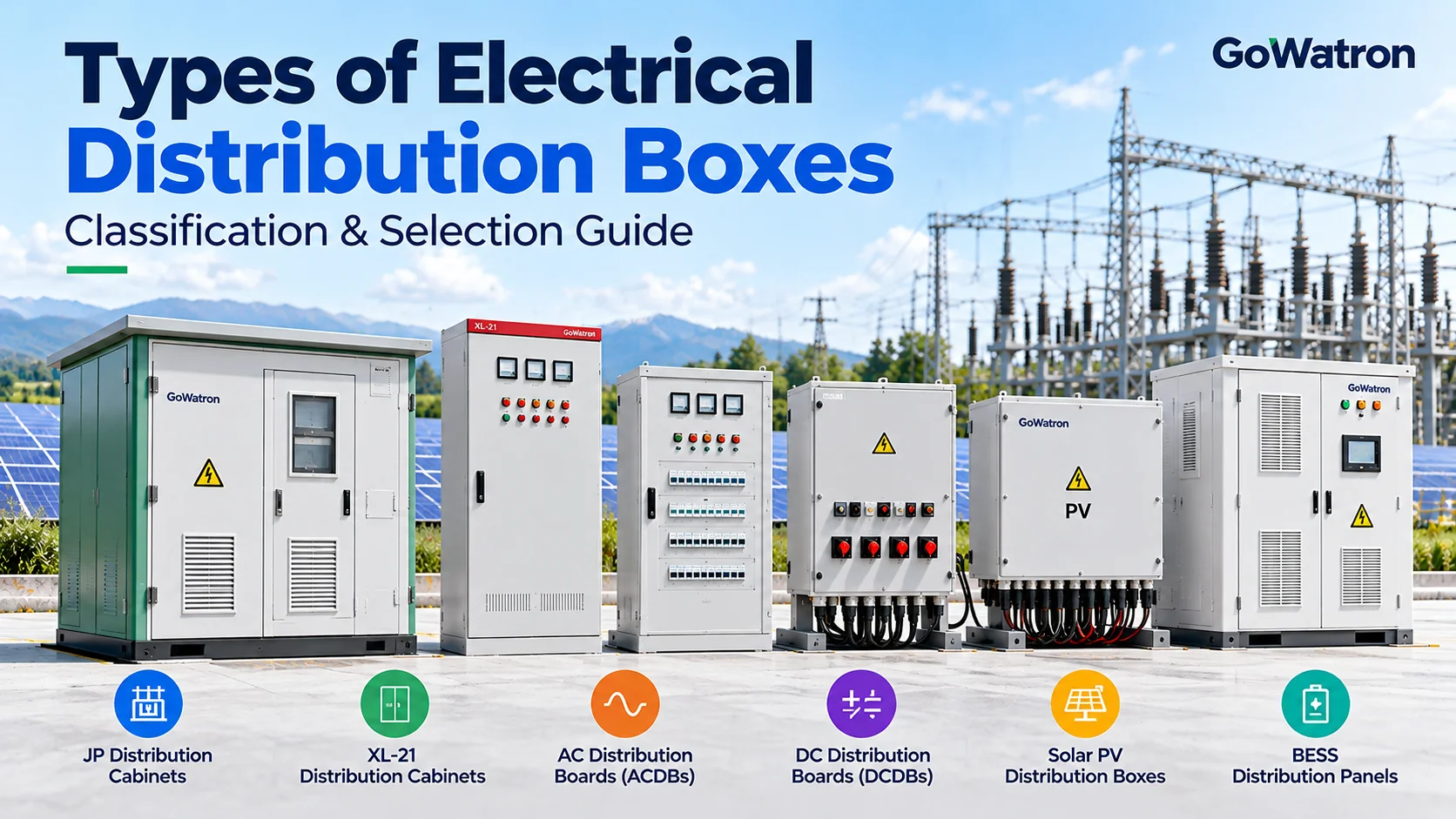
Based on their applications, integrated electrical distribution assemblies can be grouped into five main categories:
- Outdoor Low-Voltage Integrated Distribution Cabinets (JP Cabinets)
- Substation AC and DC Distribution Boards (ACDB / DCDB)
- Industrial Power and Lighting Distribution Panels
- Solar PV and Battery Energy Storage Distribution Panels
- Intelligent LV Distribution Units for Package Substations
This classification is based on engineering applications and functional characteristics rather than a formal IEC classification. Some functions and applications overlap between categories.
2. Main Types of Integrated Electrical Distribution Assemblies
2.1 Outdoor Low-Voltage Integrated Distribution Cabinets (JP Cabinets)
- An outdoor low-voltage integrated distribution cabinet, commonly known as a JP cabinet in the Chinese electrical industry, is primarily installed on the low-voltage side of distribution transformers and in outdoor low-voltage distribution networks.
- JP cabinets are widely used in rural distribution networks, distribution network upgrades and distribution transformer installations in China.
- Their distinguishing characteristic is the combination of low-voltage power distribution, energy metering, feeder protection and optional reactive power compensation within a single cabinet.
Main Functions
- Power distribution: Distributes electrical power from the transformer LV terminals to outgoing feeders.
- Energy metering: Measures and records electrical energy consumption and related electrical parameters.
- Electrical protection: Provides overload and short-circuit protection, with residual current protection as specified in the project design.
- Reactive power compensation: Controls capacitor bank switching to improve the power factor.
- Intelligent monitoring: Collects operating data and transmits it to distribution monitoring systems when the relevant equipment is installed.
Typical Applications
- JP cabinets are commonly installed on the LV side of 10/0.4 kV and 11/0.4 kV distribution transformers.
- Other applications include rural distribution networks, residential developments, industrial facilities and outdoor LV distribution systems serving public infrastructure.
Key Characteristics
- JP cabinets typically feature metal enclosures suitable for outdoor installation, with particular emphasis on protection against rain, dust and corrosion, as well as convenient operation and maintenance.
- The required ingress protection rating should be determined by the installation environment and project specifications, using the IP classification defined in IEC 60529.
- Their main distinguishing features are centralised feeder management, energy metering and optional reactive power compensation on the low-voltage side of distribution transformers.
2.2 Substation AC and DC Distribution Boards (ACDB / DCDB)
- Substation auxiliary power distribution boards are used in power plants, substations and large industrial electrical installations to distribute electrical power to protection, control, communication, lighting and other auxiliary equipment.
They are classified by supply type into AC Distribution Boards (ACDBs) and DC Distribution Boards (DCDBs).
(1) AC Distribution Board (ACDB)
An AC Distribution Board distributes and protects AC auxiliary power circuits.
Main Functions
- AC power distribution: Distributes station AC power to auxiliary loads.
- Circuit protection: Provides overload and short-circuit protection for outgoing AC circuits.
- Source transfer: Transfers between available AC sources when an automatic or manual transfer arrangement is provided.
- Operating status monitoring: Monitors supply conditions, circuit status and alarms through the installed monitoring equipment.
Typical Applications
- ACDBs commonly supply lighting, ventilation, air-conditioning, heating, battery chargers and other AC auxiliary loads in substations and power plants.
- Their primary purpose is to provide organised and reliable AC auxiliary power distribution.
(2) DC Distribution Board (DCDB)
- A DC Distribution Board distributes and protects station DC auxiliary power circuits.
- In substations, DC supplies are particularly important for protection, control and signalling functions that must remain available during specified AC supply disturbances.
Main Functions
- DC power distribution: Distributes DC power from the station DC system to individual loads.
- Circuit protection: Provides protection for DC outgoing circuits against applicable overcurrent faults.
- Supply monitoring: Monitors DC voltage, circuit status and alarms through the installed monitoring equipment.
- Control power supply: Supplies circuit breaker control circuits, protection relays and other essential control equipment.
Typical Applications
- DCDBs are used in transmission and distribution substations, power plants, industrial substations and electrical control systems.
- A DCDB normally receives power from the station DC power supply system.
- The complete station DC system may include battery chargers, battery banks, DC busbars, insulation monitoring and other associated equipment. These components are not necessarily housed within the DCDB itself.
Key Differences Between ACDB and DCDB
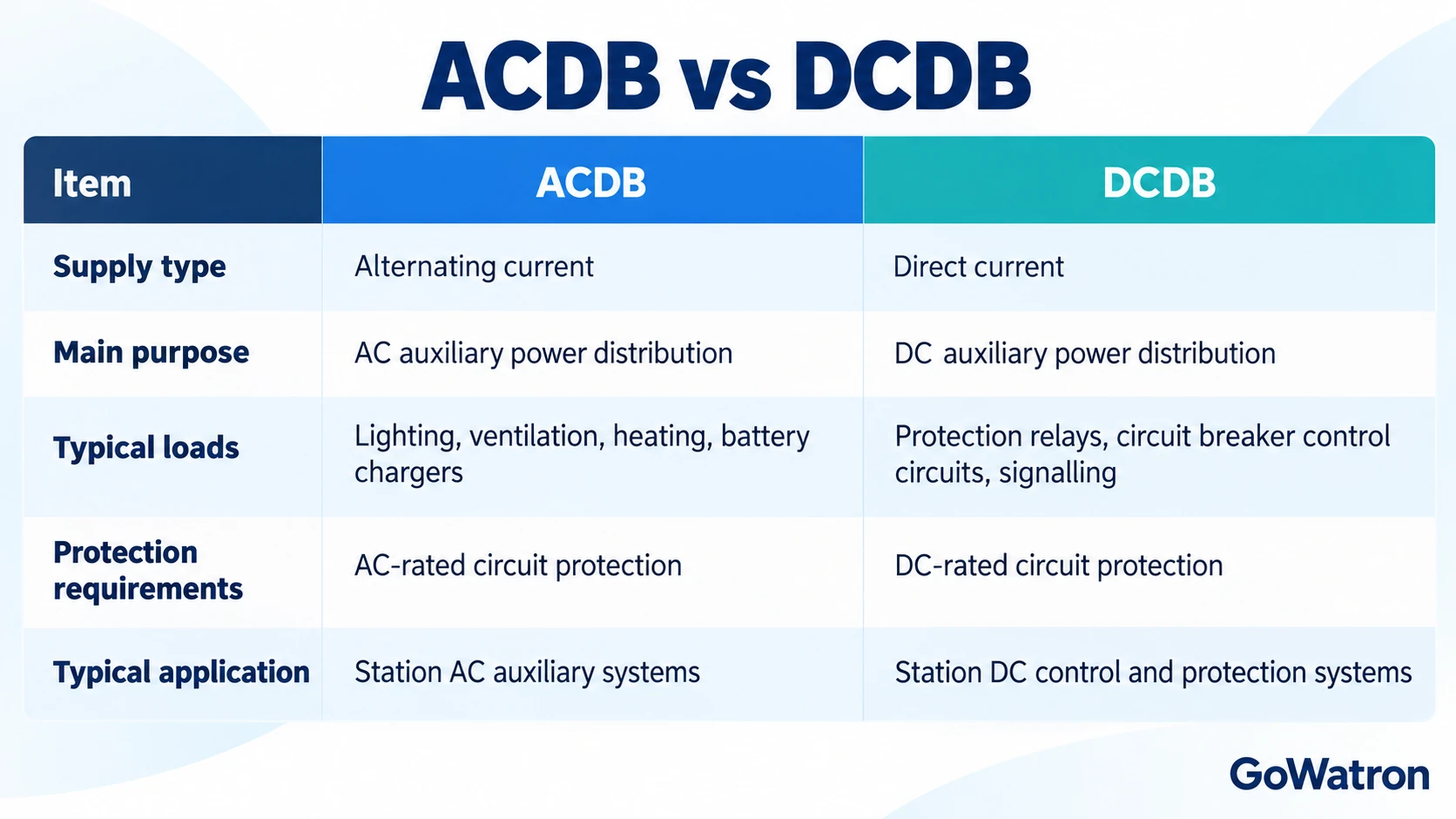
ACDBs and DCDBs perform different functions and should not automatically be treated as a single combined AC/DC distribution assembly.
2.3 Industrial Power and Lighting Distribution Panels
- Industrial Power and Lighting Distribution Panels are mainly used in low-voltage distribution systems in industrial plants, commercial buildings and public facilities.
- Their main characteristic is the distribution of electrical power to both industrial equipment and lighting circuits within a common distribution assembly, as specified in the project design.
Main Functions
- Power distribution: Supplies electrical power to motors, pumps, fans and other industrial equipment.
- Lighting distribution: Distributes power to lighting circuits, socket outlets and other relatively small loads.
- Circuit protection: Provides overload and short-circuit protection for individual distribution circuits.
- Equipment control: Supports local or automatic control of selected loads.
- Electrical monitoring: Measures voltage, current, power and electrical energy in designated circuits.
Typical Applications
- Industrial production workshops
- Commercial buildings and shopping centres
- Public buildings and infrastructure
- Industrial auxiliary distribution systems
- Floor-level power and lighting distribution
Key Characteristics
- These panels are designed to accommodate different load characteristics and provide appropriate circuit protection and control.
- For motor circuits, starting current, operating characteristics and control methods should be considered during system design.
- In the Chinese market, XL-21 and PZ are commonly used product series designations. They are not internationally standardised classifications of integrated electrical distribution assemblies.
2.4 Solar PV and Battery Energy Storage Distribution Panels
- Solar PV and Battery Energy Storage Distribution Panels are used in photovoltaic generation, battery energy storage systems and other renewable energy installations.
- Unlike conventional AC distribution applications, renewable energy systems frequently include both DC and AC circuits.
- Distribution equipment is therefore classified by its position and function within the electrical system.
(1) PV DC Combiner Box
A PV DC Combiner Box combines the DC outputs of multiple photovoltaic strings into one or more DC output circuits.
Main Functions
- DC string combining: Combines multiple photovoltaic string outputs.
- Circuit isolation: Provides a means of isolating designated DC circuits using appropriately rated switching devices.
- Overcurrent protection: Provides string or output circuit protection as determined by the PV system design.
- Surge protection: Limits transient overvoltages through suitable DC surge protective devices.
- String monitoring: Measures string current, voltage and operating status when monitoring equipment is installed.
Typical Applications
- PV DC combiner boxes are commonly installed between photovoltaic arrays and inverters in commercial, industrial and utility-scale solar PV systems.
- Key Characteristics
PV DC combiner boxes are designed for photovoltaic DC operating conditions.
Their design must account for the maximum system voltage, expected current, fault characteristics and the DC ratings of switching and protective devices.
(2) PV AC Grid Connection Panel
- A PV AC Grid Connection Panel is used on the AC output side of photovoltaic inverters.
- Its main purpose is to distribute AC power and provide the required isolation, metering and grid-interface protection functions.
Main Functions
- AC power distribution: Distributes inverter AC output power.
- Circuit protection: Provides protection and isolation for AC distribution circuits.
- Energy metering: Measures generated and exported electrical energy.
- Grid-interface protection: Provides voltage, frequency and other protection functions specified by the applicable grid connection requirements.
- Anti-islanding protection: Detects unintentional islanding through compliant inverter functions or separate protection equipment, as applicable.
Typical Applications
- PV AC grid connection panels are used in distributed photovoltaic systems, commercial rooftop PV installations and utility-scale solar power plants.
Key Characteristics
- Their protection and control requirements depend on the grid connection arrangement, inverter characteristics and applicable grid codes.
- Anti-islanding protection does not necessarily require a separate relay inside every AC distribution panel.
(3) Battery Energy Storage Distribution Panel
- A Battery Energy Storage System (BESS) Distribution Panel is used for electrical distribution on the DC or AC side of a battery energy storage system.
- Depending on its position, it may be classified as a BESS DC Distribution Unit or a BESS AC Distribution Panel.
Main Functions
- DC power distribution: Distributes and connects battery-side DC circuits.
- AC power distribution: Distributes power on the AC side of the Power Conversion System (PCS).
- Circuit isolation: Provides isolation of designated circuits for operation and maintenance.
- Electrical protection: Provides protection suitable for the relevant DC or AC circuit characteristics.
- Electrical monitoring: Measures electrical parameters and operating conditions.
Typical Applications
- Commercial and industrial battery energy storage systems
- Grid-scale battery energy storage installations
- Renewable energy and storage integration projects
- Microgrids
- Hybrid solar PV and battery energy storage systems
Key Characteristics
- BESS distribution equipment must accommodate the electrical characteristics of battery systems and power conversion equipment.
- Particular attention is required for DC voltage, bidirectional power flow, fault current characteristics, isolation and protection coordination.
- PV DC combiner boxes, PV AC grid connection panels and BESS distribution panels serve different purposes and are not directly interchangeable.
2.5 Intelligent LV Distribution Units for Package Substations
- An Intelligent LV Distribution Unit for Package Substations is used in the low-voltage distribution section of a prefabricated or package substation.
- Its primary function is to combine low-voltage power distribution, feeder protection, electrical measurement, energy metering and intelligent monitoring within the substation distribution arrangement.
Main Functions
- LV power distribution: Distributes electrical power from the transformer LV side to outgoing feeders.
- Feeder protection: Protects low-voltage distribution circuits.
- Measurement and metering: Acquires electrical parameters and energy consumption data.
- Operating status monitoring: Monitors circuit conditions, switching status and alarms.
- Reactive power compensation: Provides compensation when specified in the system design.
- Remote communication: Transmits operating data to supervisory or distribution automation systems.
Typical Applications
- Prefabricated substations
- Urban distribution networks
- Industrial park substations
- Distributed energy installations
- Intelligent distribution networks
Key Characteristics
- Intelligent LV distribution units support the integration of distribution functions with monitoring and automation systems.
- Depending on the installed equipment and system architecture, they can provide the four principal remote functions used in power system automation:
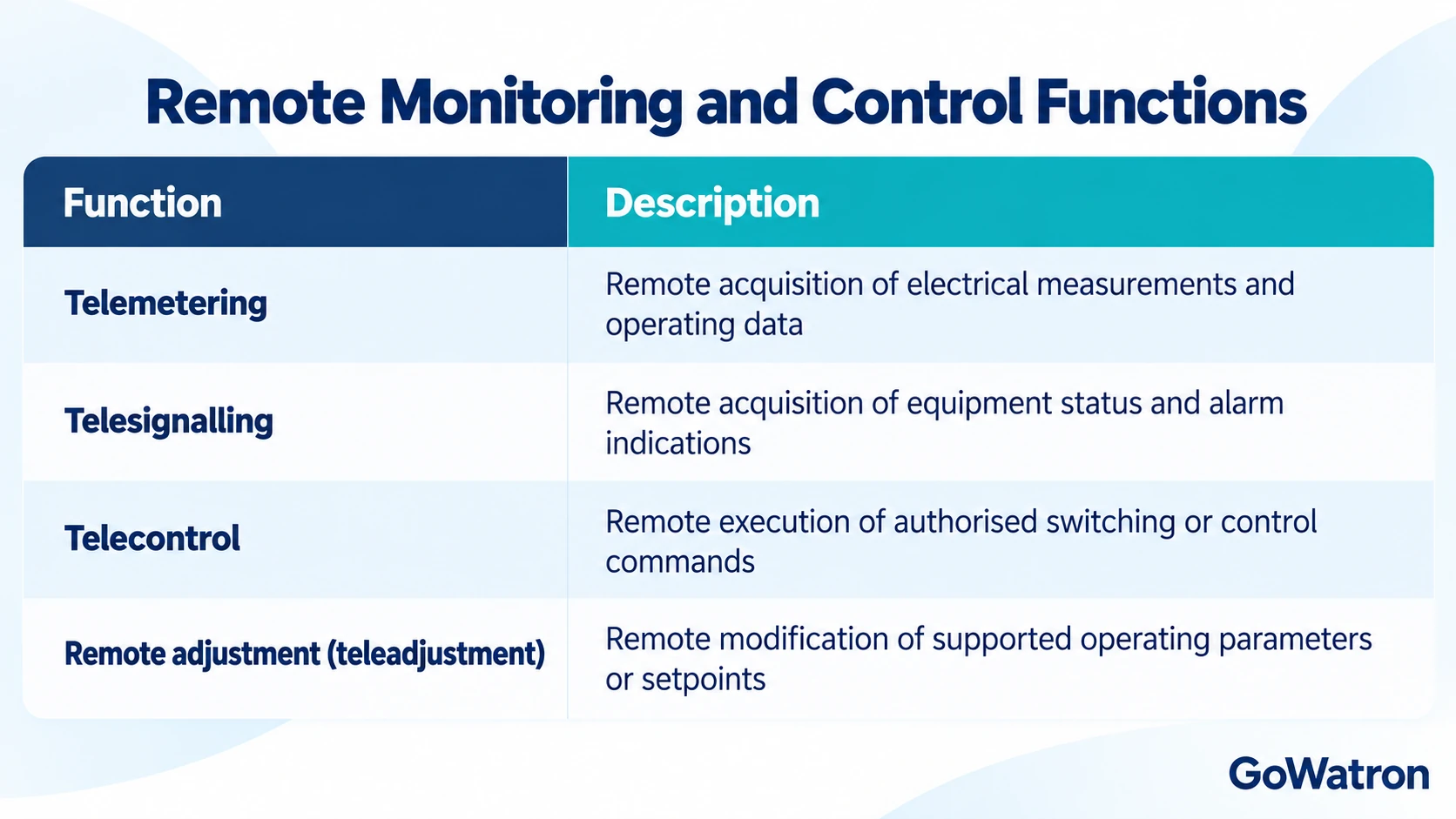
- The availability of these functions depends on the installed equipment, communication architecture and control permissions.
- Their distinguishing characteristic is the integration of LV distribution functions with the overall package substation and its automation system.
3. Main Differences Between Integrated Electrical Distribution Assemblies
- Different types of distribution assemblies can be distinguished by their applications, power supply characteristics, primary functions and installation environments.
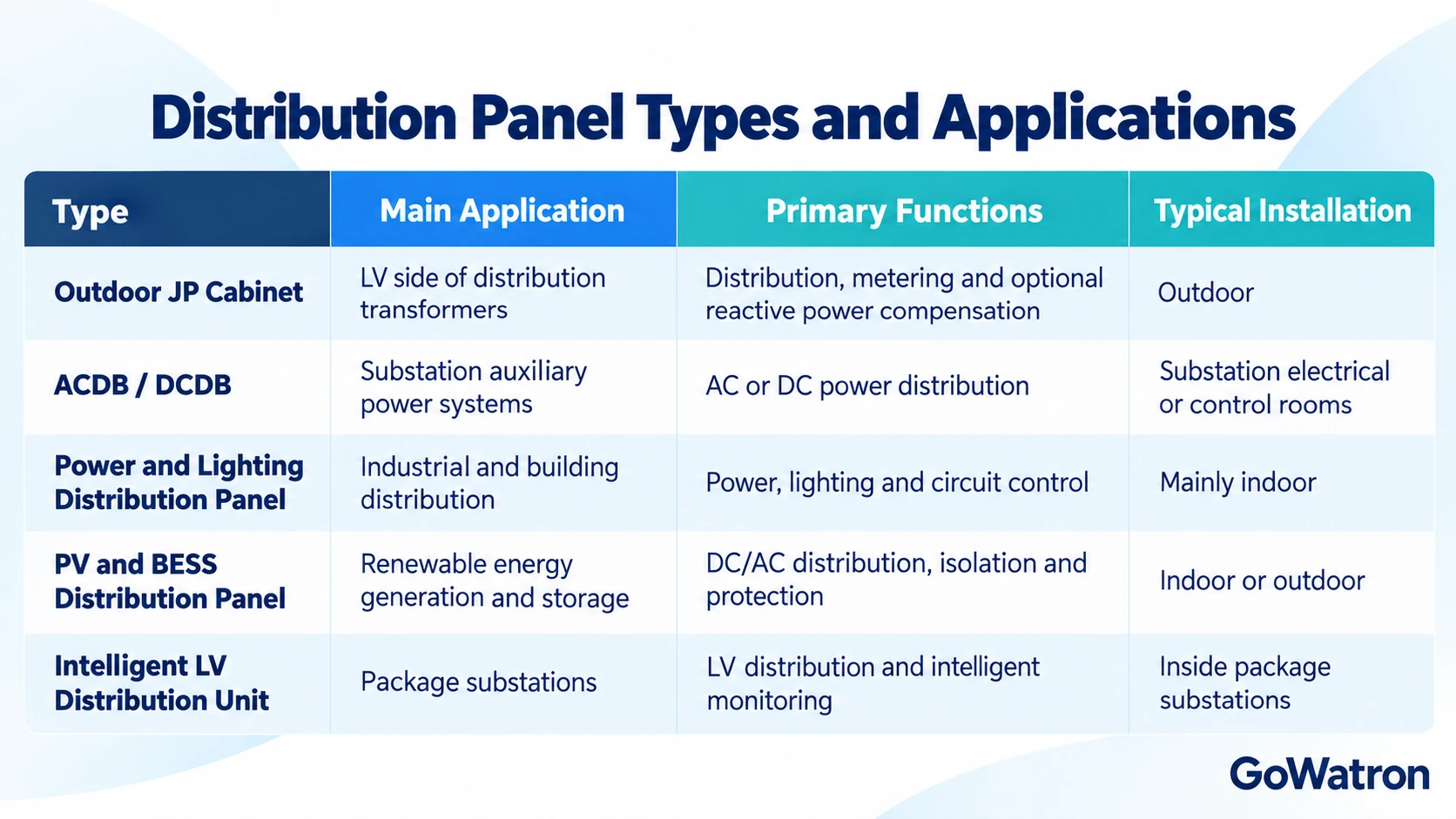
- Outdoor JP cabinets primarily focus on centralised low-voltage distribution management at distribution transformer installations.
- ACDBs and DCDBs focus on the reliable distribution of station auxiliary power.
- Industrial power and lighting distribution panels serve different types of electrical loads and their associated control requirements.
- PV and BESS distribution equipment is designed around the electrical characteristics of renewable energy and storage systems.
- Intelligent LV distribution units combine low-voltage distribution functions with monitoring and automation capabilities within package substations.
4. Working Principles of Integrated Electrical Distribution Assemblies
- Although integrated distribution assemblies are used in different applications, their fundamental operating principles are similar.
- Electrical power from an upstream source enters the assembly through an incoming circuit and is distributed to individual loads through internal busbars and outgoing feeder circuits.
- Circuit breakers, fuses and other protective devices provide the necessary protection against overloads, short circuits and other specified abnormal conditions.
- Where measurement and metering functions are provided, the assembly collects electrical parameters such as voltage, current, power and electrical energy.
- Intelligent distribution assemblies can transmit operating data to supervisory systems through communication interfaces.
- Remote switching operations can also be performed where suitable control functions, authorisation mechanisms and safety interlocks are provided.
- The protection, measurement and control functions depend on the equipment configuration and system design.
5. How to Select the Right Integrated Electrical Distribution Assembly
- The selection process should begin with the intended application, followed by an assessment of the electrical system, installation environment and functional requirements.
- In this section, the terms must, should and may indicate mandatory requirements, recommended engineering practices and optional provisions, respectively. The actual obligations depend on the applicable standards, regulations and project requirements.
5.1 Selection Based on Application
- For outdoor low-voltage distribution at transformer installations, a JP cabinet or another suitable outdoor LV distribution assembly may be selected.
- For substation auxiliary power systems, ACDBs and DCDBs should be selected based on the required AC or DC supply arrangement.
- For industrial plants and commercial buildings, power and lighting distribution panels should be selected based on the connected loads and control requirements.
- For photovoltaic and battery energy storage systems, DC and AC circuits should be assessed separately.
- For package substations, the LV distribution unit should be selected based on the transformer arrangement, feeder configuration and automation requirements.
5.2 Selection Based on Electrical System Characteristics
The following electrical parameters should be considered:
- Rated operating voltage
- Rated current and load characteristics
- Prospective short-circuit current
- Number of incoming and outgoing circuits
- AC or DC supply characteristics
- Circuit protection and isolation requirements
Different electrical systems impose different switching and protection requirements.
For example, DC switching devices must be suitable for the relevant DC voltage and fault conditions, while photovoltaic systems require consideration of PV-specific operating and fault characteristics.
The selected assembly must satisfy the applicable electrical safety and performance requirements.
5.3 Selection Based on Installation Environment
- The installation environment influences enclosure construction, ingress protection and thermal performance.
- Indoor assemblies should be selected with consideration of available space, ventilation, heat dissipation and maintenance access.
- Outdoor assemblies require additional consideration of rain, dust, solar radiation, condensation and corrosion.
- The required ingress protection rating should be determined by the installation environment and project specifications, using the IP classification defined in IEC 60529.
- An IP rating alone does not establish an enclosure’s corrosion resistance, UV resistance or overall weathering performance.
5.4 Selection Based on Functional Requirements
- The required functions should be identified before selecting the distribution assembly.
- Basic applications may require only power distribution and circuit protection.
- More advanced applications may require energy metering, reactive power compensation, power quality monitoring or remote communication.
- For intelligent distribution systems, communication compatibility, data acquisition, remote control requirements and system integration should also be considered.
5.5 Selection Based on Applicable Standards
- Low-voltage switchgear and controlgear assemblies should be assessed against the applicable parts of the IEC 61439 series, based on their equipment category and intended use.
- Enclosure ingress protection classifications are defined by IEC 60529.
- For photovoltaic, battery energy storage and other specialised applications, the relevant equipment and system standards, local electrical regulations and grid connection requirements must also be considered.
- The selected equipment must comply with applicable mandatory safety and regulatory requirements.
6. Development Trends in Integrated Electrical Distribution Assemblies
- Integrated electrical distribution assemblies are evolving towards greater intelligence, modularity and communication capability as distribution automation and renewable energy applications continue to develop.
6.1 Intelligent Monitoring
- Modern distribution assemblies increasingly incorporate electrical parameter acquisition, operating status monitoring, fault alarms and remote management functions.
- These capabilities support improved operational visibility and more efficient maintenance planning.
6.2 Modular Design
- Modular construction improves configuration flexibility and allows distribution circuits, metering functions, protective devices and communication equipment to be adapted to different applications.
- It can also simplify future modifications and system expansion.
6.3 Communication and System Integration
- Intelligent distribution assemblies can connect to supervisory systems through RS-485, Ethernet or wireless communication interfaces.
- Common communication protocols include Modbus RTU, Modbus TCP and IEC 60870-5-104.
- Actual communication capabilities depend on the installed intelligent devices and gateways.
6.4 Expansion of Renewable Energy Applications
- The increasing deployment of distributed photovoltaic generation, battery energy storage and microgrids is creating new requirements for electrical distribution equipment.
- DC distribution, bidirectional power flow, grid-interface protection and energy management are becoming increasingly important considerations in renewable energy distribution system design.
7. Conclusion
- Integrated electrical distribution assemblies are used in transformer distribution networks, substation auxiliary power systems, industrial facilities, renewable energy installations and package substations.
- The five application-based categories discussed in this guide provide a practical framework for understanding their main functions and differences.
- Although these assemblies share the fundamental functions of power distribution and electrical protection, they differ in supply characteristics, functional priorities, installation environments and levels of automation.
- Selecting the appropriate distribution assembly requires an understanding of the intended application, followed by an evaluation of electrical system characteristics, protection requirements, environmental conditions and communication needs.
- As distribution automation, renewable energy and smart grid technologies continue to develop, integrated electrical distribution assemblies are increasingly combining power distribution, monitoring, control and communication functions to support more reliable, flexible and intelligent electrical distribution systems.


