Partial Discharge Sensor Selection Guide: Choosing TEV, UHF, HFCT and Acoustic Emission Sensors
Document Type: Technical Articles
Document Published: 2026-10-16
Last Updated: 2026-10-16
- Partial discharge (PD) sensors detect transient voltage, electromagnetic, high-frequency current or acoustic signals associated with partial discharge in electrical equipment. They provide data to support insulation condition assessment.
- Start with the equipment type and installation conditions, then select the detection method, communication arrangement and compatible monitoring equipment.
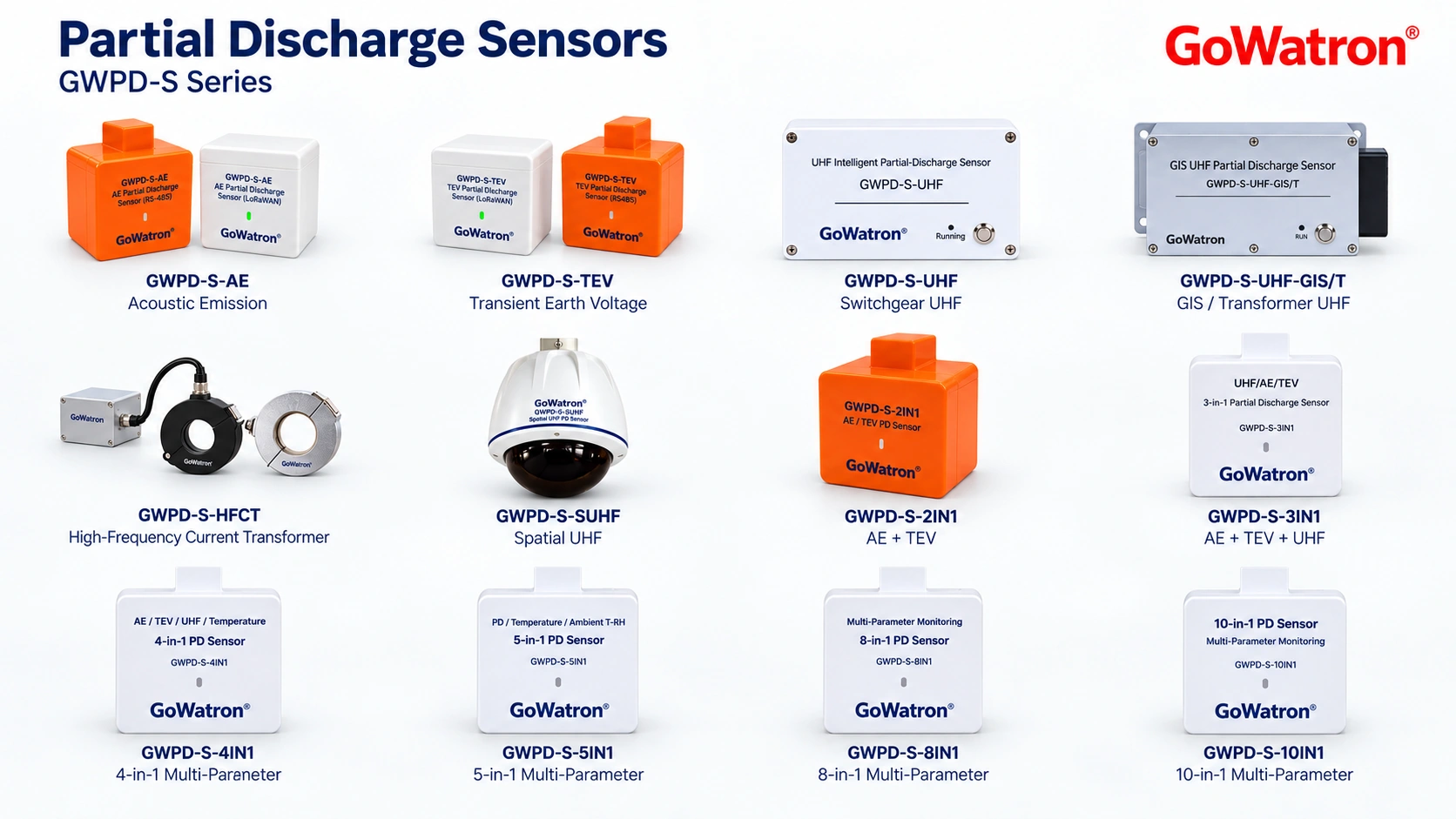
- For more partial discharge sensor specifications, visit: https://www.gowatron.com/products/pd-online-monitoring-systems/
1. Quick Selection Table for Partial Discharge Sensors
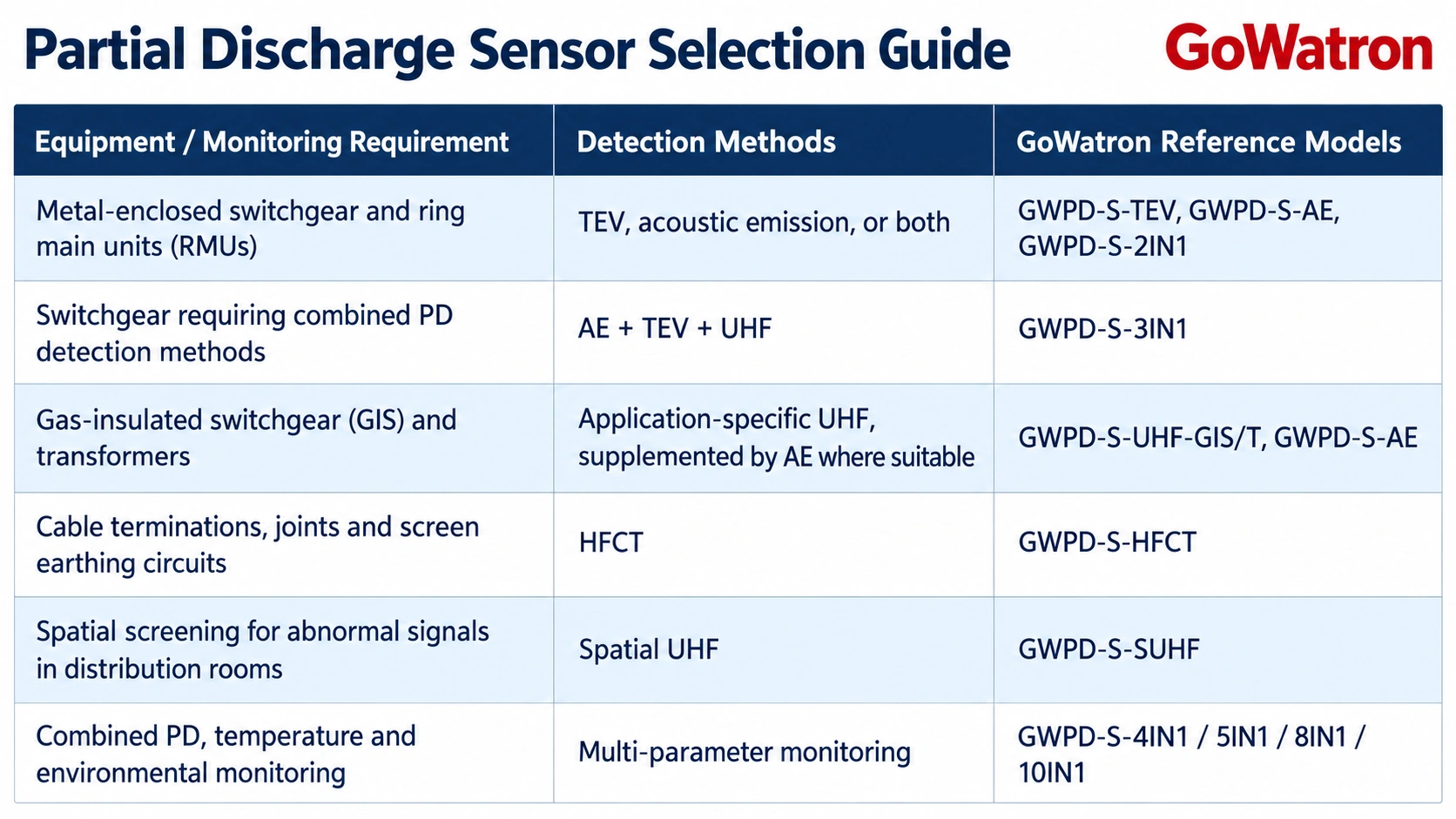
2. How Do the Four PD Detection Methods Differ?
TEV: For Metal-Enclosed Switchgear and RMUs
- A transient earth voltage (TEV) sensor uses capacitive coupling to detect transient voltage signals on an earthed metal enclosure.
- The GoWatron GWPD-S-TEV Transient Earth Voltage Partial Discharge Sensor has a detection frequency band of 3–100 MHz. Selection should consider enclosure construction, earthing and the mounting surface. Assess results alongside background interference and historical trends.
UHF: Confirm an Effective Electromagnetic Coupling Path
- An ultra-high frequency (UHF) PD sensor detects electromagnetic signals generated by partial discharge. An effective signal path from the discharge source to the sensor is essential.
| Model | Main application |
| GWPD-S-UHF | Switchgear UHF PD monitoring |
| GWPD-S-UHF-GIS/T | GIS / transformer UHF PD monitoring |
| GWPD-S-SUHF | Spatial UHF signal screening in distribution rooms |
- These models have different installation requirements and are not directly interchangeable. For GIS and transformers, confirm the available UHF interface, mounting arrangement and coupling path. Metal shielding can obstruct signal propagation.
HFCT: For Cable Screen Earthing Circuits
- A high-frequency current transformer (HFCT) detects high-frequency current pulses propagating through a suitable earthing circuit.
- The GoWatron GWPD-S-HFCT High-Frequency Current Transformer Partial Discharge Sensor has a split-core design and a reference frequency band of 0.1–20 MHz. It must be used with a matched acquisition unit.
- Key selection factors include the sensor aperture, cable screen bonding and cross-bonding arrangements, transfer impedance and compatibility with the acquisition unit input.
AE: Check Acoustic Propagation and Coupling
- An acoustic emission (AE) PD sensor detects acoustic signals generated by partial discharge.
- The GoWatron GWPD-S-AE Acoustic Emission Partial Discharge Sensor has a detection frequency band of 40 ± 1 kHz, within the ultrasonic range. It can be used on switchgear, RMUs, GIS and transformers where suitable acoustic propagation and coupling paths exist.
- Sensor position, coupling quality and mechanical noise affect detection performance.
3. Choosing 2-in-1, 3-in-1 and Multi-Parameter Sensors
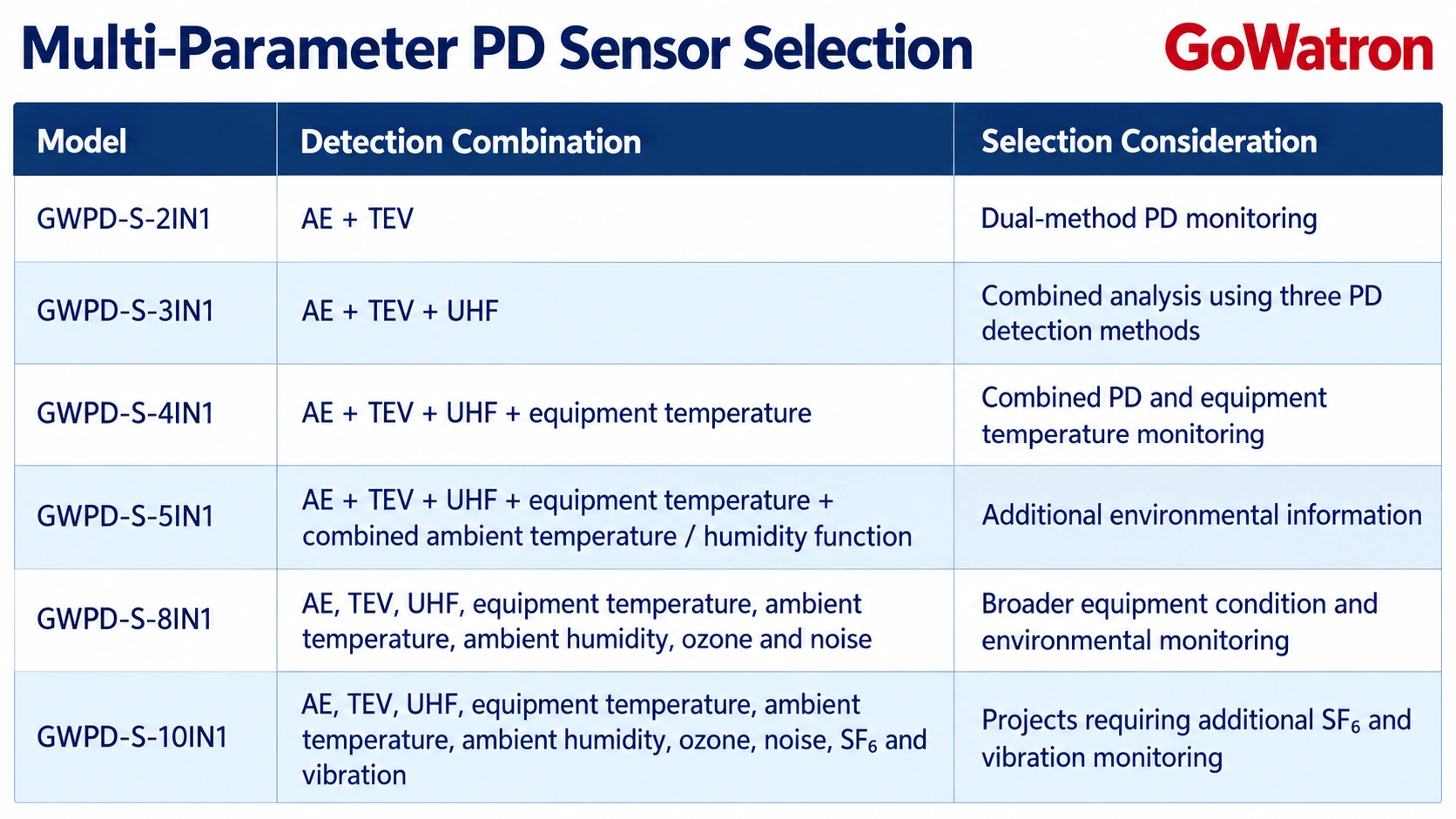
- Select the detection combination according to the monitoring task. Each channel requires suitable measurement conditions. Auxiliary parameters such as temperature and ozone cannot independently determine PD severity.
- The 5-in-1 model treats ambient temperature and humidity as one combined function; the 8-in-1 and 10-in-1 models count them as two separate parameters.
- The GWPD-S-3IN1 UHF frequency band is 300–1500 MHz. Check specifications for each model rather than applying one model’s frequency band to the entire series.
- The GWPD-S-4IN1 is a multi-parameter sensor and is distinct from the GWPD-M-4IN1 monitoring unit.
4. Five Checks Before Procurement
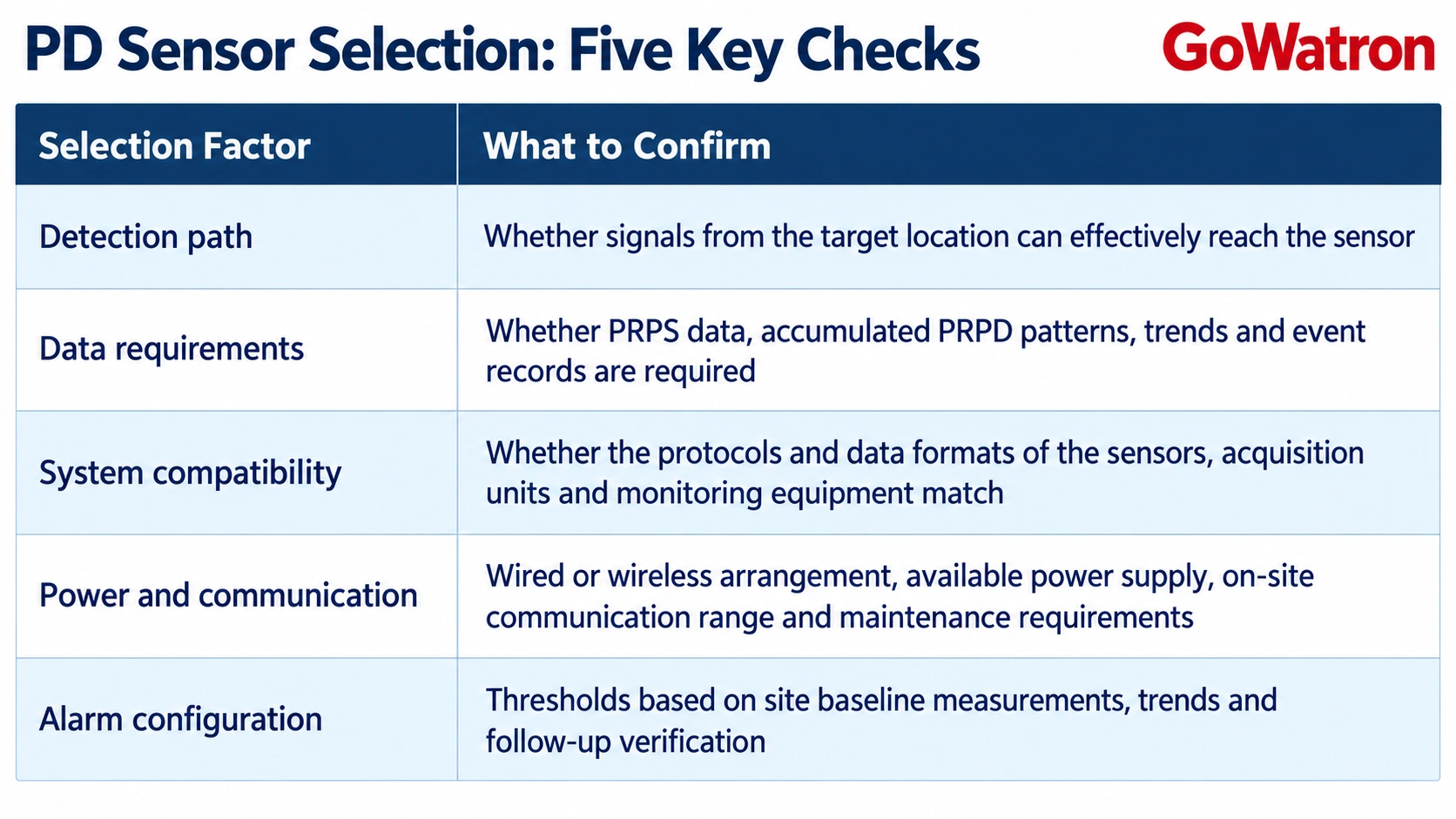
- PRPS means phase-resolved pulse sequence, and PRPD means phase-resolved partial discharge. Phase-resolved analysis requires a suitable power-frequency reference.
- A LoRa radio link does not by itself establish LoRaWAN compatibility. Confirm the wireless protocol and gateway requirements. Similarly, an RS-485 interface alone does not establish protocol compatibility; the communication protocol and register map must also match.
- Amplitude readings from different detection methods cannot be directly compared or converted to apparent charge in pC using a universal conversion factor. Wireless communication range does not represent PD detection coverage.
5. Request a Partial Discharge Sensor Selection Proposal
- Provide the equipment type, voltage level, quantity, installation photographs, communication requirements and platform integration needs. This information helps determine suitable sensor models, monitoring points and compatible monitoring equipment.
- The GoWatron GWPD series includes TEV, UHF, HFCT, acoustic emission and multi-parameter PD sensors. Solutions can be configured according to the monitoring objectives and installation conditions of switchgear, RMUs, GIS, transformers and cable systems.


