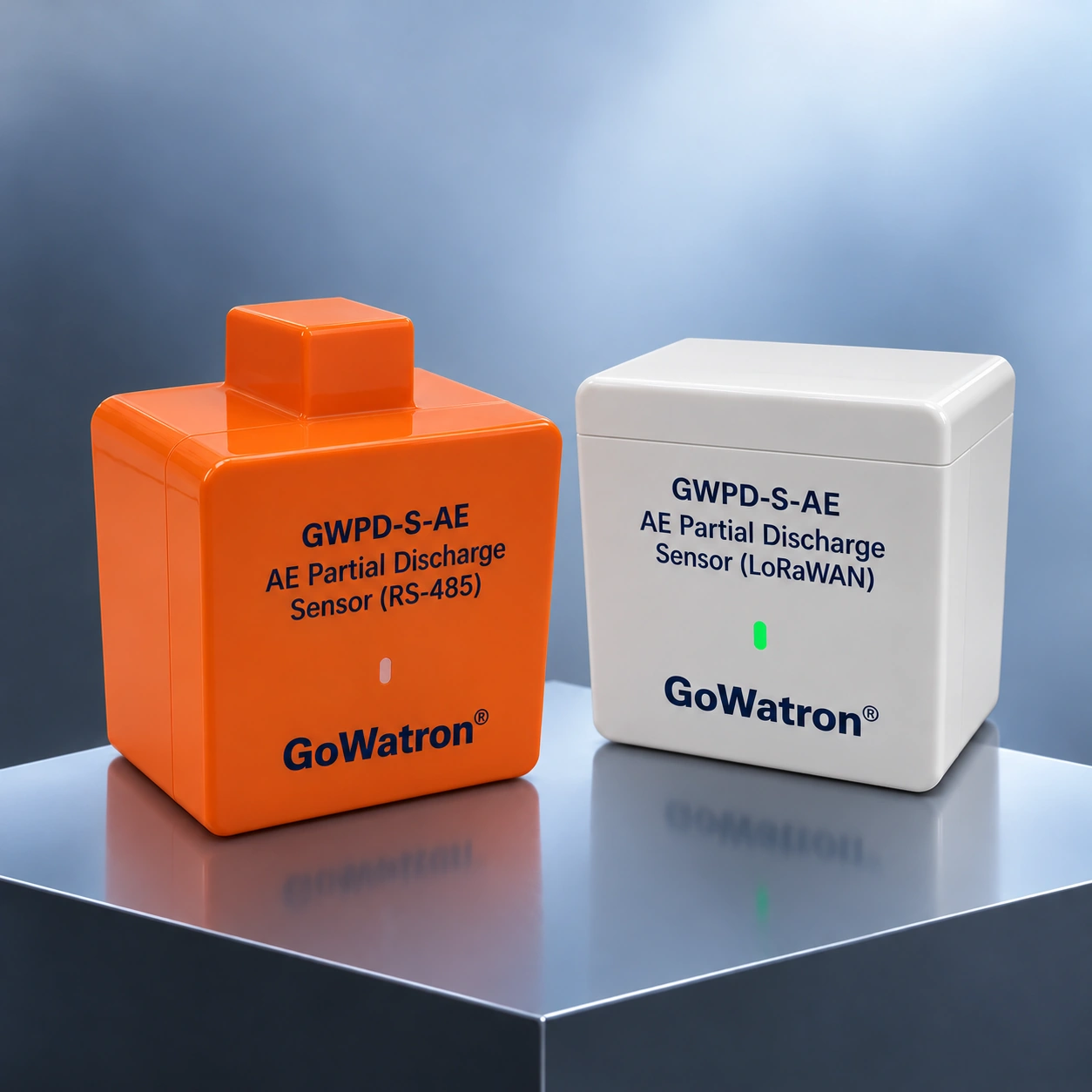
GWPD-S-AE Acoustic Emission Partial Discharge Sensor
- The GWPD-S-AE from GoWatron is an acoustic emission (AE) partial discharge sensor designed for insulation condition monitoring of electrical equipment. It captures ultrasonic acoustic emissions generated by partial discharge to support equipment condition assessment and condition-based maintenance.
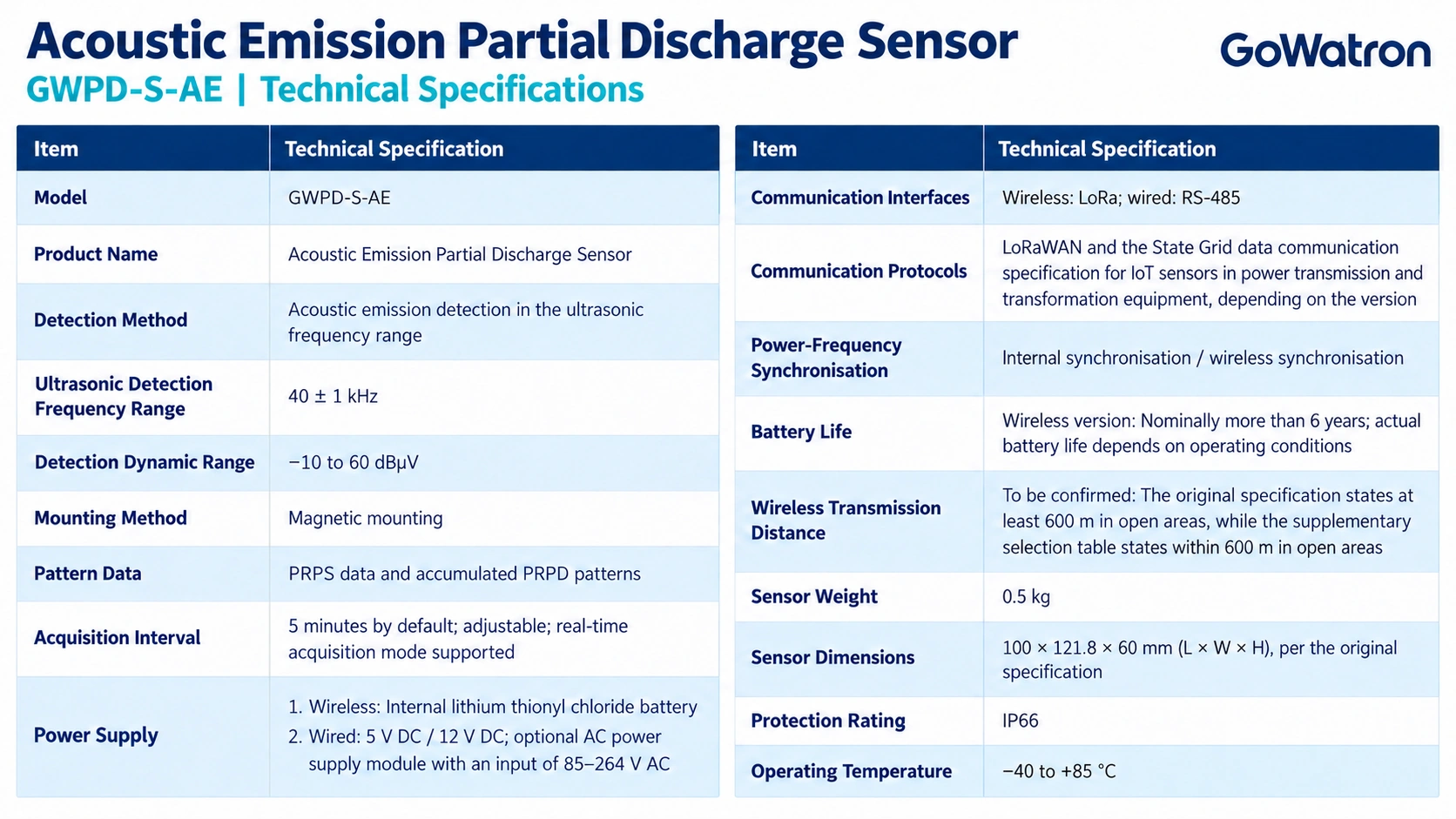
- The sensor has an ultrasonic detection frequency range of 40 ± 1 kHz and a detection dynamic range of −10 to 60 dBμV. Wireless and RS-485 wired versions are available, with internal or wireless power-frequency synchronisation. The sensor features magnetic mounting, an IP66 protection rating and an operating temperature range of −40 to +85 °C. Monitoring arrangements should suit the equipment structure and acoustic propagation conditions.




1、GWPD-S-AE Partial Discharge Sensor — Product Introduction
- The GWPD-S-AE Acoustic Emission Partial Discharge Sensor is an online monitoring device that integrates acoustic signal acquisition, processing and data communication. It is intended for electrical equipment with suitable acoustic propagation paths and sensor coupling conditions.
Partial discharge activity, including surface discharge and corona discharge, generates acoustic emissions containing ultrasonic frequency components. The GWPD-S-AE detects these signals around 40 kHz to assist in identifying suspected partial discharge activity and tracking changes over time. Detection performance depends on the discharge type, equipment structure, propagation medium, sensor location and background noise. - Magnetic mounting facilitates attachment to suitable ferromagnetic enclosure surfaces. Installation must provide secure attachment and suitable acoustic coupling. Incorrect sensor positioning or poor coupling can reduce detection performance.
- Wireless and wired versions can be selected according to the available site power supplies and communication requirements. The associated monitoring system can use phase-resolved pulse sequence (PRPS) data and accumulated phase-resolved partial discharge (PRPD) patterns, together with power-frequency phase information and historical trends, to analyse discharge characteristics and support maintenance planning.
2、GWPD-S-AE Partial Discharge Sensor — Product Functions
- Acoustic Emission Detection: An ultrasonic detection frequency range of 40 ± 1 kHz enables the sensor to capture acoustic emissions associated with partial discharge activity, including surface discharge.
- Signal Level and Trend Monitoring: A detection dynamic range of −10 to 60 dBμV provides data for comparing signal levels and analysing trends. Results should be assessed alongside background noise, sensor location and acoustic coupling conditions.
- PRPS and PRPD Data: Supports PRPS data and accumulated PRPD patterns, enabling the associated monitoring system to analyse pulse amplitude, phase and distribution characteristics.
- Adjustable Acquisition Interval: The default acquisition interval is 5 minutes and can be adjusted to suit monitoring requirements. A real-time acquisition mode is also supported. Acquisition and transmission settings affect battery life in the wireless version.
Wireless and Wired Versions:
- Wireless version: Uses LoRa wireless communication. A LoRaWAN configuration is also listed in the original specification. Data are transmitted through an associated gateway.
- Wired version: Uses an RS-485 communication interface for installations with external power supplies and communication cabling.
Low Power Consumption and Long Battery Life: The wireless version incorporates a lithium thionyl chloride battery with a nominal battery life of more than 6 years. Actual battery life depends on the acquisition interval, transmission frequency, operating temperature and wireless communication conditions.
Power Supply Options:
- Wireless version: Powered by an internal lithium thionyl chloride battery.
- Wired version: Available with 5 V DC or 12 V DC supply configurations. An optional AC power supply module accepts an input of 85–264 V AC.
Power-Frequency Synchronisation: Supports internal or wireless power-frequency synchronisation, providing a phase reference for relating detected acoustic pulses to the AC cycle and analysing discharge characteristics.
Environmental Protection: The sensor has an IP66 protection rating and an operating temperature range of −40 to +85 °C. Installation should take account of site environmental conditions, acoustic coupling requirements and maintenance access.
3、GWPD-S-AE Partial Discharge Sensor — Technical Specifications
4、GWPD-S-AE Partial Discharge Sensor — Operating Principle
The GWPD-S-AE detects acoustic emissions associated with partial discharge in the ultrasonic frequency range. Its operating process is as follows:
- Acoustic Emission Generation: Partial discharge activity, including surface discharge and corona discharge, releases localised energy and generates acoustic emissions containing ultrasonic frequency components.
- Acoustic Propagation: Acoustic signals travel to the sensor through the available propagation paths. Equipment structure, propagation medium, propagation distance and attenuation at interfaces affect signal reception. The sensor location must therefore suit its acoustic coupling method.
- Signal Acquisition: The sensing element receives ultrasonic acoustic signals around 40 kHz and converts them into electrical signals. The magnetic mounting structure secures the sensor in position, while effective signal reception also requires suitable acoustic coupling.
- Signal Processing: The acquired electrical signals undergo signal conditioning, filtering and digital processing to produce measurement and pattern data. Power-frequency synchronisation provides a reference for analysing signal distribution within the AC cycle.
- Data Transmission: The wireless version transmits data through the associated wireless network and gateway. The wired version transmits data through an RS-485 interface and associated data acquisition equipment.
- Condition Analysis and Alarm Generation: The monitoring system analyses measurement trends, PRPS data and accumulated PRPD patterns, taking account of signal amplitude and background noise, to assist in identifying suspected partial discharge activity. The results support insulation condition assessment and early warning. Abnormal results should be investigated through repeat measurements on site or complementary diagnostic methods.
Acoustic emission detection results should be compared under comparable installation and measurement conditions. The unit dBμV expresses voltage amplitude on a logarithmic scale relative to 1 μV. It is not equivalent to sound pressure level (dB SPL), and there is no direct, universally applicable conversion to apparent charge in pC. Signal amplitude alone cannot determine the severity of an insulation defect.
5、GWPD-S-AE Partial Discharge Sensor — Applications
- High-Voltage Switchgear / Ring Main Units (RMUs): Captures acoustic emissions associated with partial discharge at monitoring locations with suitable propagation and coupling conditions, assisting in the detection of abnormal insulation activity.
- Gas-Insulated Switchgear (GIS): Monitoring locations are selected according to the enclosure structure, acoustic propagation paths and sensor coupling conditions. The proposed arrangement requires on-site suitability verification.
- Transformers: Captures acoustic emissions associated with partial discharge where a suitable acoustic coupling arrangement is provided. Monitoring performance should be assessed with reference to the tank structure, internal propagation paths and operational noise.
- Cable Branch Boxes / Cable Termination Boxes: Assists in monitoring partial discharge activity associated with cable terminations and related insulation components where acoustic signals can reach the sensor effectively.
- Electrical Distribution Rooms / Substations: Associated data acquisition equipment and monitoring software collect measurements from multiple sensors, supporting remote access, pattern analysis and trend monitoring.
- Monitoring Retrofits: Magnetic mounting and wireless communication can reduce installation effort and communication cabling requirements where suitable mounting and acoustic coupling conditions are available.
- Combined Monitoring Methods: Can be used alongside transient earth voltage (TEV) and other detection methods at system level to support the assessment of suspected partial discharge activity using different signal characteristics.


