Classification and Function Introduction of Partial Discharge Sensors
For partial discharge (PD) monitoring of high-voltage electrical equipment such as switchgear, ring main units (RMUs), and transformers, mainstream sensors are categorized into four types based on their detection principles: Ultra-High Frequency (UHF), Acoustic Emission (AE), Transient Earth Voltage (TEV), and High-Frequency Current Transformer (HFCT). These four technologies form the core of the GWPD product series. Additionally, multiple detection principles can be integrated into a single housing to form multi-in-one composite sensors, accommodating diverse on-site monitoring requirements.
I. UHF Sensor (Ultra-High Frequency)
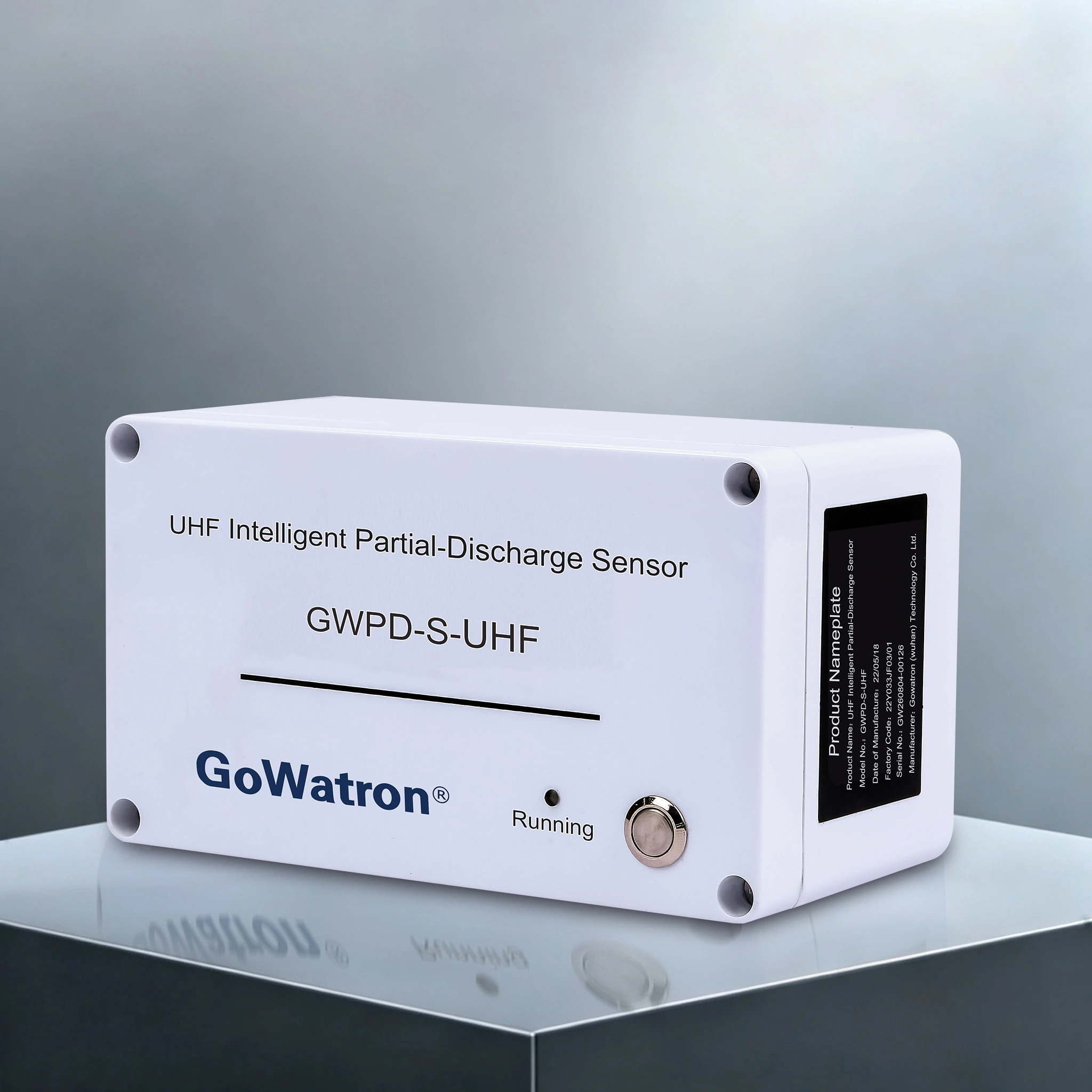
- Product Model: GWPD‑S‑UHF
- Detection Bandwidth: 300 MHz – 3 GHz
- Operating Principle:Captures UHF electromagnetic wave signals generated by partial discharge. It offers extremely high sensitivity to PD activity inside switchgear and GIS equipment, and features excellent rejection of power-frequency interference, effectively filtering out ambient electromagnetic noise.
- Mounting Method:For switchgear, live-line installation is supported via magnetic attachment to the cabinet wall. For GIS and transformer applications, the sensor can be secured using nylon straps, steel wires, or clamps.
- Applicable Scenarios:Suitable for GIS, medium- and high-voltage switchgear, and transformers. Primarily used to detect insulation defects including internal voids, creepage discharge, and floating discharge.
II. AE Sensor (Acoustic Emission)
- Product Model: GWPD‑S‑AE
- Detection Bandwidth: Center frequency at 40 ± 1 kHz
- Operating Principle: Captures ultrasonic vibration signals generated by partial discharge inside high-voltage equipment. The ultrasonic waves produced by PD propagate through metal enclosures, and the sensor acquires these vibrations to identify PD activity.
- Mounting Method: Supports live-line installation with magnetic attachment to the outer surface of equipment enclosures. No drilling or power outage is required, providing a fully non-invasive monitoring solution.
- Applicable Scenarios: Widely applicable to switchgear, transformers, RMUs, and other high-voltage equipment. Particularly effective for detecting corona discharge and external floating discharge.
III. TEV Sensor (Transient Earth Voltage)
- Product Model: GWPD‑S‑TEV
- Detection Bandwidth: 3 – 100 MHz
- Operating Principle: When partial discharge occurs inside the metal enclosure of high-voltage switchgear, transient voltage pulses are generated on the outer surface of the metal shell. The sensor accurately captures these pulse signals to assess PD activity.
- Mounting Method: Supports live-line installation via magnetic attachment to the outer wall of metal-enclosed switchgear. The installation is non-invasive and requires no structural modification to the equipment.
- Applicable Scenarios: Applicable to various metal-enclosed armored switchgear, with ultra-high sensitivity to internal creepage discharge. Not suitable for transformers or open-type electrical equipment, as these do not provide the electromagnetic shielding enclosure necessary for TEV signal propagation.
IV. HFCT Sensor (High-Frequency Current Transformer)
- Product Model: GWPD‑S‑HFCT
- Detection Bandwidth: Broadband high-frequency response; specific bandwidth customizable per site requirements
- Operating Principle:Adopts a split-core Rogowski coil structure that can be clamped onto grounding cables, equipment grounding conductors, or cable bodies. It captures high-frequency pulse current signals generated during partial discharge, enabling accurate identification of PD faults in cables and grounding circuits.
- Mounting Method:The split-core design allows direct clamping onto grounding cables or cable bodies without power outage, ensuring safe and convenient installation.
- Applicable Scenarios:Used for PD monitoring of cable terminations, cable joints, transformer grounding leads, and switchgear grounding circuits. Recognized as the preferred sensor for high-voltage cable PD monitoring.
V. Multi-in-One Composite Sensors
- Multiple detection elements (UHF, AE, TEV, HFCT) are integrated into a single sensor unit to enable simultaneous multi-principle monitoring. This significantly reduces the number of on-site sensor installations and improves monitoring accuracy through multi-signal cross-verification.
- The GWPD‑S‑2IN1 model integrates UHF and AE detection elements, combining internal electromagnetic PD detection with external acoustic vibration monitoring. Highly versatile, it is adaptable to a wide range of application scenarios.
- The GWPD‑S‑3IN1 model integrates UHF, AE, and TEV detection elements, achieving full-coverage PD monitoring for metal-enclosed switchgear and making it suitable for most power distribution scenarios.
- The GWPD‑S‑4IN1 model integrates all four detection principles — UHF, AE, TEV, and HFCT — in a single unit, collecting four types of PD signals simultaneously. It provides comprehensive monitoring of switchgear, equipment bodies, and cable grounding circuits.
VI. General Technical Specifications (Wireless Models)
- All wireless sensor models share the following unified technical specifications:
- Battery Life: 5 to 8+ years
- Power Supply: Built-in 19,000 mAh high-performance lithium-thionyl chloride battery
- Communication Protocol: Wireless LoRaWAN / State Grid-compliant power transmission and transformation protocol (for domestic deployment)
- Transmission Range: Minimum wireless transmission range of 500 meters (both wired and wireless versions are available)
- Data Acquisition Types: PRPS and PRPD phase-resolved patterns, along with characteristic spectrograms
VII. Selection Guidelines
- UHF (GWPD‑S‑UHF): Features strong interference immunity and high PD sensitivity. The switchgear version is magnetically mounted on cabinet walls, while GIS and transformer versions are fixed with straps or clamps. It is optimal for detecting internal insulation defects of GIS, switchgear and transformers.
- AE (GWPD‑S‑AE): Adopts simple magnetic attachment without drilling, enabling non-invasive installation. It is susceptible to ambient acoustic and mechanical vibration noise. Widely applicable to switchgear, transformers and RMUs.
- TEV (GWPD‑S‑TEV): Supports easy magnetic installation and is highly targeted for switchgear scenarios. It is exclusively applicable to metal-enclosed switchgear (cable-termination application research is ongoing). Not suitable for transformers or open-type equipment.
- HFCT (GWPD‑S‑HFCT): Delivers excellent PD detection performance for cables. It needs to be clamped to grounding circuits or cable bodies and is recognized as the preferred sensor for high-voltage cable PD monitoring.
Engineering Best Practice Note: Single-principle sensors have inherent monitoring blind spots and are prone to PD misdetections and missed detections. For critical power monitoring projects, multi-in-one composite sensors are highly recommended. Through cross-validation among multiple detection principles, the probability of false alarms and missed alarms is significantly reduced, ensuring reliable and accurate insulation condition monitoring of power equipment.


