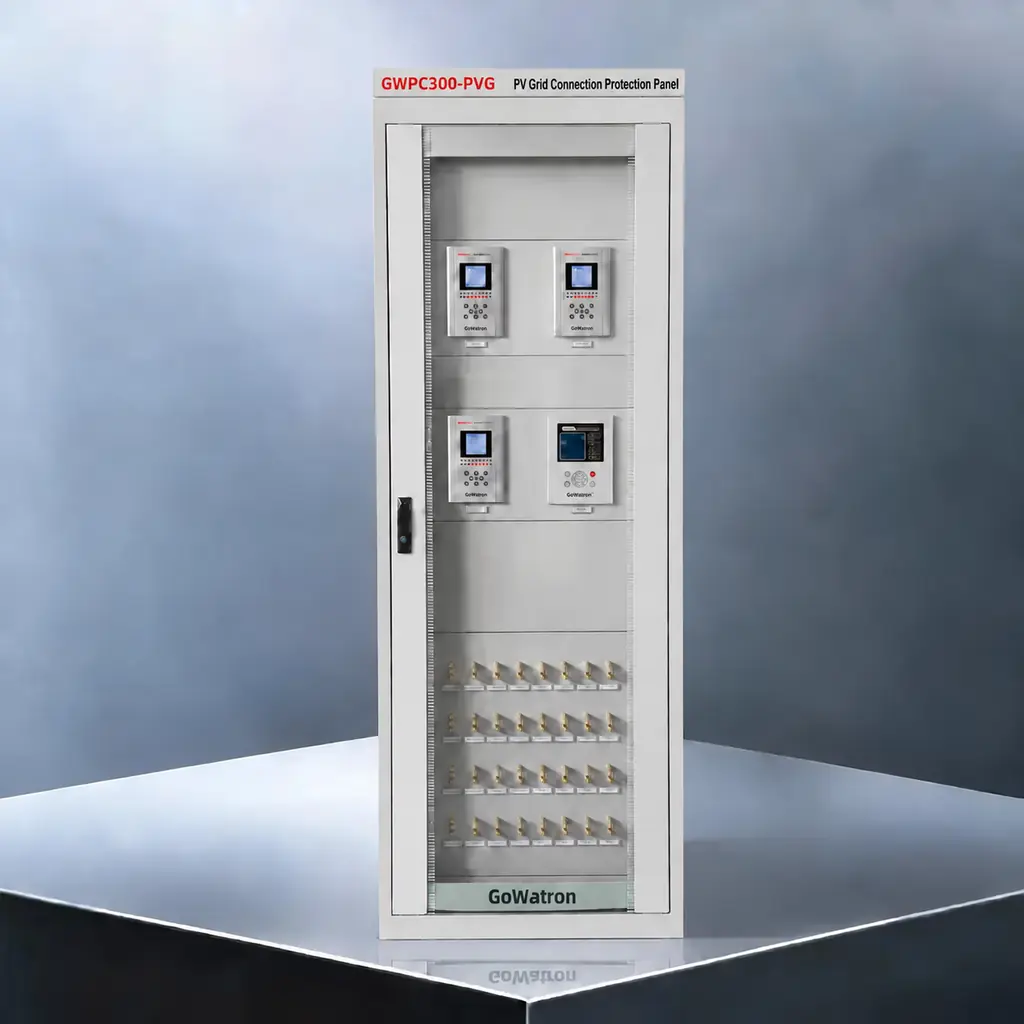
GWPC300-PVG PV Grid Connection Protection Panel
- The GWPC300-PVG PV Grid Connection Protection Panel is an integrated secondary protection and control panel designed specifically for 11 kV / 33 kV /132 kV distributed PV grid connection systems. It integrates four key functions — anti-islanding protection, fault separation (interconnection protection), voltage & frequency emergency control, and power quality monitoring — into a single panel.
- Installed at or near the PV grid connection point, the GWPC300-PVG provides an integrated protection, measurement & control, monitoring, and communication solution between the PV plant and the utility grid. It supports safe grid connection, reliable operation, remote supervision, and plant automation.
- For distributed PV projects requiring grid connection protection + power quality monitoring + communication and data transmission in one panel, the GWPC300-PVG provides a complete integrated secondary-system solution.




1. Product Description
The GWPC300-PVG PV Grid Connection Protection Panel integrates protection, measurement & control, power quality monitoring, and communication functions in a single panel. It is designed primarily for 11 kV / 33 kV / 132 KV distributed PV grid connection systems and is typically installed at or near the point of common coupling (PCC) or grid connection switchgear.
In a distributed PV system, abnormal utility-grid conditions may result in an unintended electrical island if PV generation continues energising a separated section of the network. Such a condition may create risks for maintenance personnel and connected equipment and may interfere with subsequent grid restoration.
In addition, variations in PV generation and utility-grid operating conditions can result in abnormal voltage, frequency, and power quality conditions.
The GWPC300-PVG is designed to provide coordinated monitoring, protection, control, and communication for these operating conditions. It can:
- Detect abnormal grid and PV operating conditions and initiate disconnection when required, according to configured protection settings and applicable grid connection requirements;
- Detect unintended islanding and initiate tripping of the grid connection circuit breaker when the configured anti-islanding criteria are satisfied;
- Perform voltage- and frequency-based emergency control, such as staged load shedding, feeder tripping, or other project-defined control actions;
- Continuously monitor power quality at the point of common coupling (PCC), providing measurement and recorded data for grid compliance assessment, operation, and maintenance;
- Communicate with the PV plant monitoring, SCADA, or station automation system through standard communication interfaces, supporting status indication, measurements, control commands, and parameter or setpoint adjustment where configured.
As part of the communication interface between the PV plant monitoring system and the grid connection equipment, the panel collects and transmits status, measurement, energy, protection, and power quality information. It also receives authorised control and adjustment commands from the supervisory system.
Together with the plant SCADA or monitoring system and other secondary equipment, the GWPC300-PVG supports the implementation of a centralised, remotely supervised, and unattended or minimally attended PV plant automation system.
2. Product Configuration
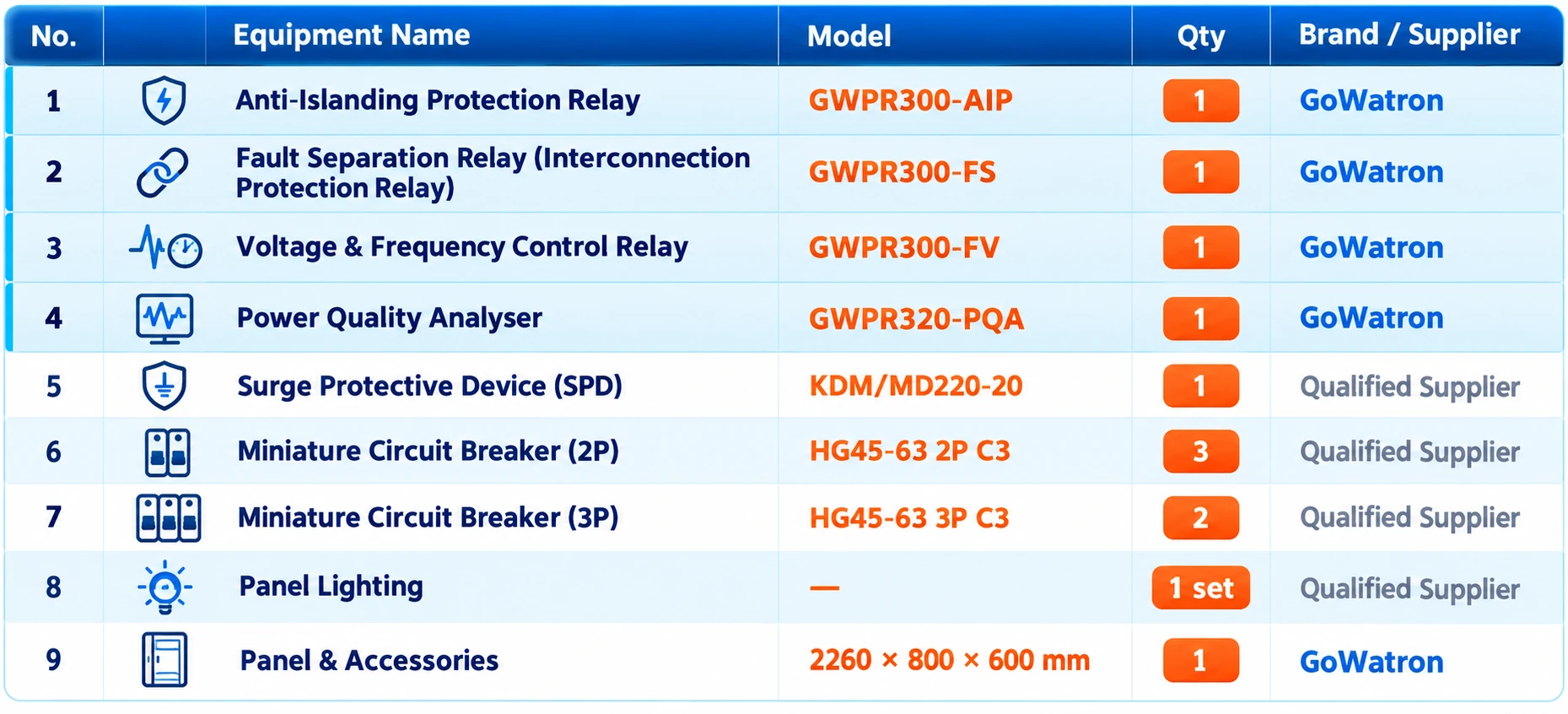
Panel Dimensions: 2260 × 800 × 600 mm (H × W × D), standard floor-standing structure with front and rear doors for convenient wiring, commissioning, inspection, and maintenance.
Configuration Note: The above configuration is a typical reference configuration. Relay functions, auxiliary components, communication protocols, panel dimensions, and quantities can be customised according to the project single-line diagram, utility grid connection requirements, and technical specifications.
3. Product Functions
3.1 Anti-Islanding Protection
- When the utility grid is disconnected because of a fault, maintenance, or another abnormal condition, a distributed PV system may continue energising an electrically separated section of the network. This condition is known as unintentional islanding.
- An unintended island may expose maintenance personnel to an energised circuit, cause abnormal voltage or frequency conditions, interfere with automatic reclosing, and create risks when the utility network is re-energised.
- The GWPR300-AIP Anti-Islanding Protection Relay continuously monitors electrical quantities associated with islanding conditions. When the configured anti-islanding criteria are satisfied, the relay issues a trip command to the relevant grid connection circuit breaker, rapidly separating the PV generation system from the utility network.
- The actual protection criteria, operating thresholds, and time delays are configured according to the applicable grid code, utility requirements, and project design.
3.2 Fault Separation Protection
The GWPR300-FS Fault Separation Relay (Interconnection Protection Relay) monitors abnormal electrical conditions at the PV grid connection point and provides a dedicated separation function when operating conditions exceed the permitted grid connection range.
- Typical monitored conditions may include:
- Over-frequency;
- Under-frequency;
- Over-voltage;
- Under-voltage;
- Zero-sequence over-voltage;
- Other project-defined abnormal grid conditions.
When the configured operating criteria and time delays are satisfied, the relay can initiate tripping of the grid connection circuit breaker to separate the affected PV system from the utility network.
Protection thresholds and operating delays should be coordinated with the applicable grid code, voltage/frequency ride-through requirements, utility protection philosophy, and project-specific protection settings. This coordination helps avoid unnecessary disconnection during conditions for which the PV plant is required to remain connected.
3.3 Voltage & Frequency Emergency Control
The GWPR300-FV Voltage & Frequency Control Relay provides automatic emergency control based on system voltage and frequency conditions.
When the monitored voltage or frequency exceeds the configured limits, the relay can execute staged control actions according to the project control strategy, such as:
- Staged under-frequency load shedding;
- Staged over-frequency control;
- Under-voltage load shedding;
- Over-voltage control;
- Feeder or load tripping;
- Alarm and control signal output;
- Other project-defined emergency control logic.
Multiple stages and time delays can be configured to coordinate different control priorities. This allows designated non-critical circuits or feeders to be disconnected first while maintaining essential loads or equipment in service whenever system operating conditions permit.
The specific control strategy depends on the PV plant topology, connected loads, utility requirements, and overall power system protection and control philosophy.
3.4 Power Quality Monitoring
PV inverters, power electronic equipment, non-linear loads, and variations in generation and network conditions can influence power quality at the point of common coupling.
The GWPR320-PQA Power Quality Analyser continuously monitors electrical and power quality parameters at the PCC. Depending on the project configuration, monitored parameters may include:
- Voltage and current;
- Frequency;
- Active and reactive power;
- Power factor;
- Harmonics;
- Total harmonic distortion (THD);
- Voltage deviation;
- Voltage fluctuation and flicker;
- Three-phase voltage/current unbalance;
- Other power quality parameters required by the project.
The analyser provides continuous measurement, event information, and power quality data for grid compliance assessment, disturbance analysis, operation and maintenance, and power quality improvement.
Power quality monitoring itself does not correct disturbances. Instead, it provides the measurement and analysis data required to identify power quality problems and determine appropriate mitigation measures.
3.5 Communication & Automation
The GWPC300-PVG is equipped with communication interfaces for integration with the PV plant monitoring system, SCADA system, station automation system, or other supervisory systems.
Standard Communication Protocols:
- IEC 60870-5-104: Ethernet-based telecontrol communication for integration with SCADA, plant monitoring, or remote supervisory systems;
- Modbus RTU: Serial communication protocol for integration with compatible industrial monitoring and control equipment.
- Optional Communication Protocols:
- IEC 60870-5-103: Communication with compatible protection and station-level systems;
- IEC 61850: Substation automation communication standard for IEC 61850-based PV substations and smart grid applications.
- Physical Interfaces:
- Ethernet port (standard);
- RS-485 interface (standard);
- IRIG-B time synchronisation interface, 1 channel (standard).
Through these interfaces, the GWPC300-PVG can transmit status indications, electrical measurements, energy data, protection information, alarms, events, and power quality data to the supervisory system.
Where permitted by the system architecture and project configuration, the panel can also receive authorised remote control and parameter/setpoint adjustment commands, supporting remote operation and centralised management of the PV grid connection system.
Together with the PV plant SCADA or monitoring system, communication network, grid connection switchgear, and other secondary equipment, the GWPC300-PVG supports the implementation of a complete PV plant protection, control, monitoring, and automation system.
Communication Option Note: IEC 60870-5-104 and Modbus RTU are provided as standard. IEC 60870-5-103 and IEC 61850 are available as options. Communication protocols and system architecture can be configured according to project requirements. Please specify the required communication protocols when ordering.
4. Application Scenarios
The GWPC300-PVG PV Grid Connection Protection Panel is primarily designed for 11 kV / 33 kV / 132 KV distributed PV grid connection systems and is typically installed at or near the point of common coupling (PCC), grid connection switchgear, secondary equipment room, or control room.
It is suitable for:
- Commercial & industrial rooftop PV plants;
- Ground-mounted distributed PV plants;
- Agrivoltaic power plants;
- Fishery-PV complementary power plants;
- Industrial park distributed PV systems;
- Distributed PV systems with dedicated 11 kV / 33 kV grid connection facilities;
- Other distributed PV power generation and grid connection projects.


