Overcurrent Protection Relay (ANSI 50/51) – Operating Principle, Application & Setting Calculation
Document Type: Technical Articles
Document Published: 2026-08-18
Last Updated: 2026-08-18
Overcurrent Protection (Instantaneous Stage I, Delayed Stage II, Definite-Time Stage III)
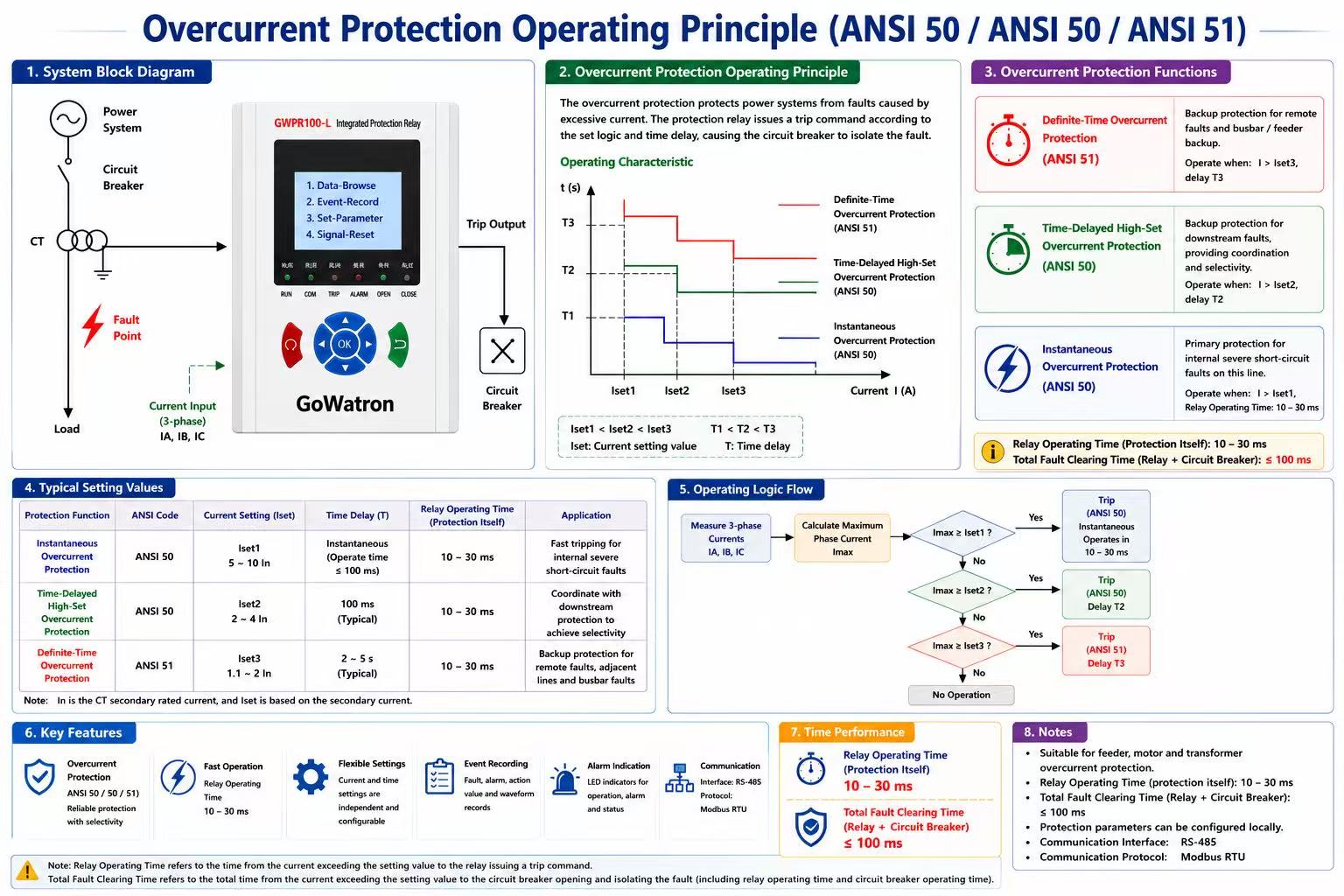
- Overcurrent protection is widely applied in 6.6 kV distribution lines and higher voltage levels. It detects short-circuit faults based on the rise in current under fault conditions. The complete protection scheme is composed of three coordinated stages: instantaneous overcurrent protection (Stage I), delayed high-set overcurrent protection (Stage II), and definite-time overcurrent protection (Stage III). Through the coordination of current settings and time delays, the three stages ensure reliable fault coverage for the entire line and adjacent downstream lines. In international relay protection standards, this graded current protection scheme corresponds to the combination of ANSI device numbers 50 and 51.
Instantaneous Overcurrent Protection (Stage I | ANSI 50 Instantaneous)
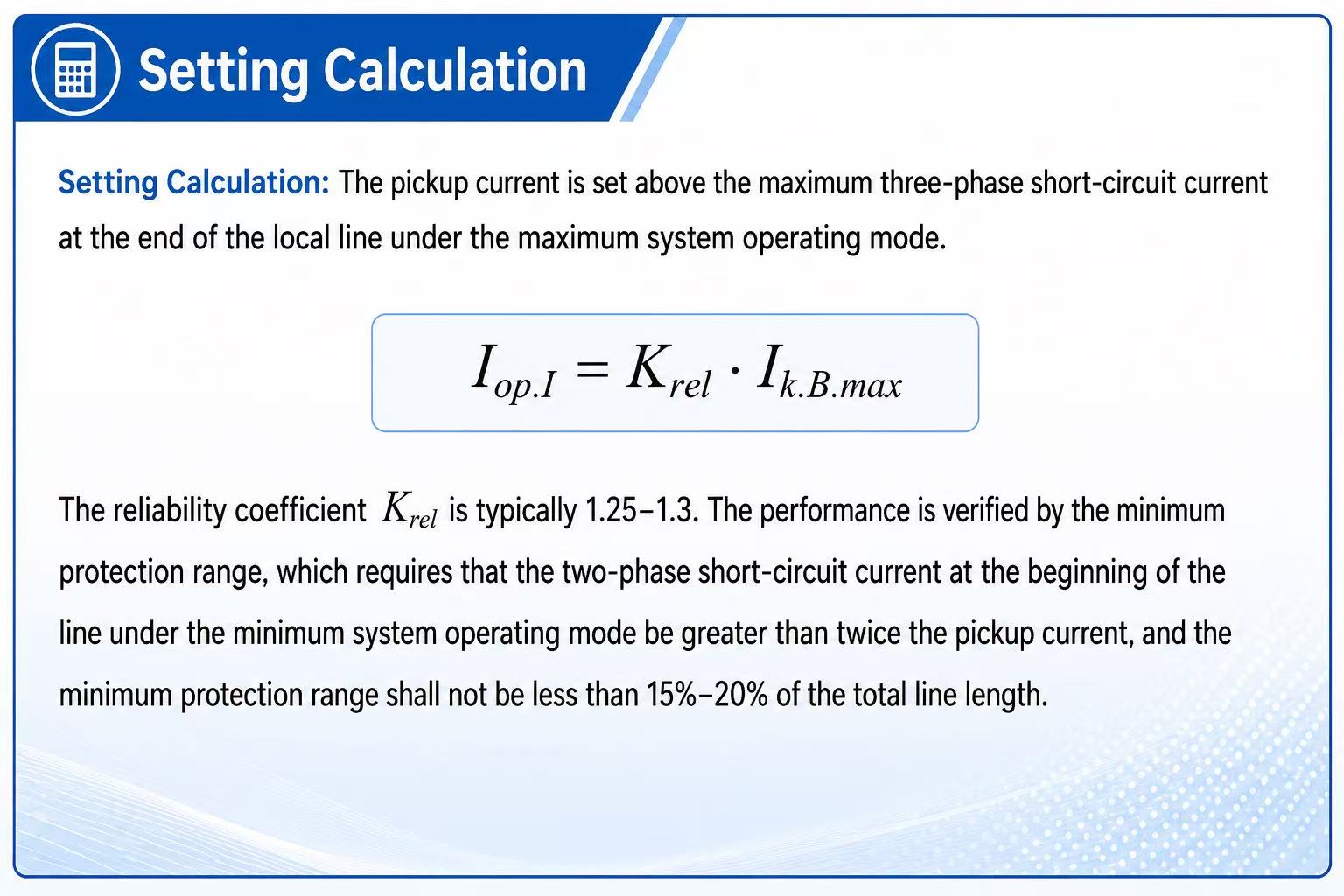
- Operating Principle: Responds only to severe short-circuit faults occurring close to the source end of the line and trips instantaneously (no intentional time delay). To prevent maloperation during faults on downstream busbars, the protection does not cover the entire line length.
- Protection Range: Covers the front section of the line, typically approximately 70%–80% of the total line length. It does not protect the end of the local line nor downstream lines.
- Function: Rapidly clears severe close-in short-circuit faults, reducing the impact and stress of short-circuit currents on primary equipment.
Delayed High-Set Overcurrent Protection (Stage II | ANSI 50 Time Delay)
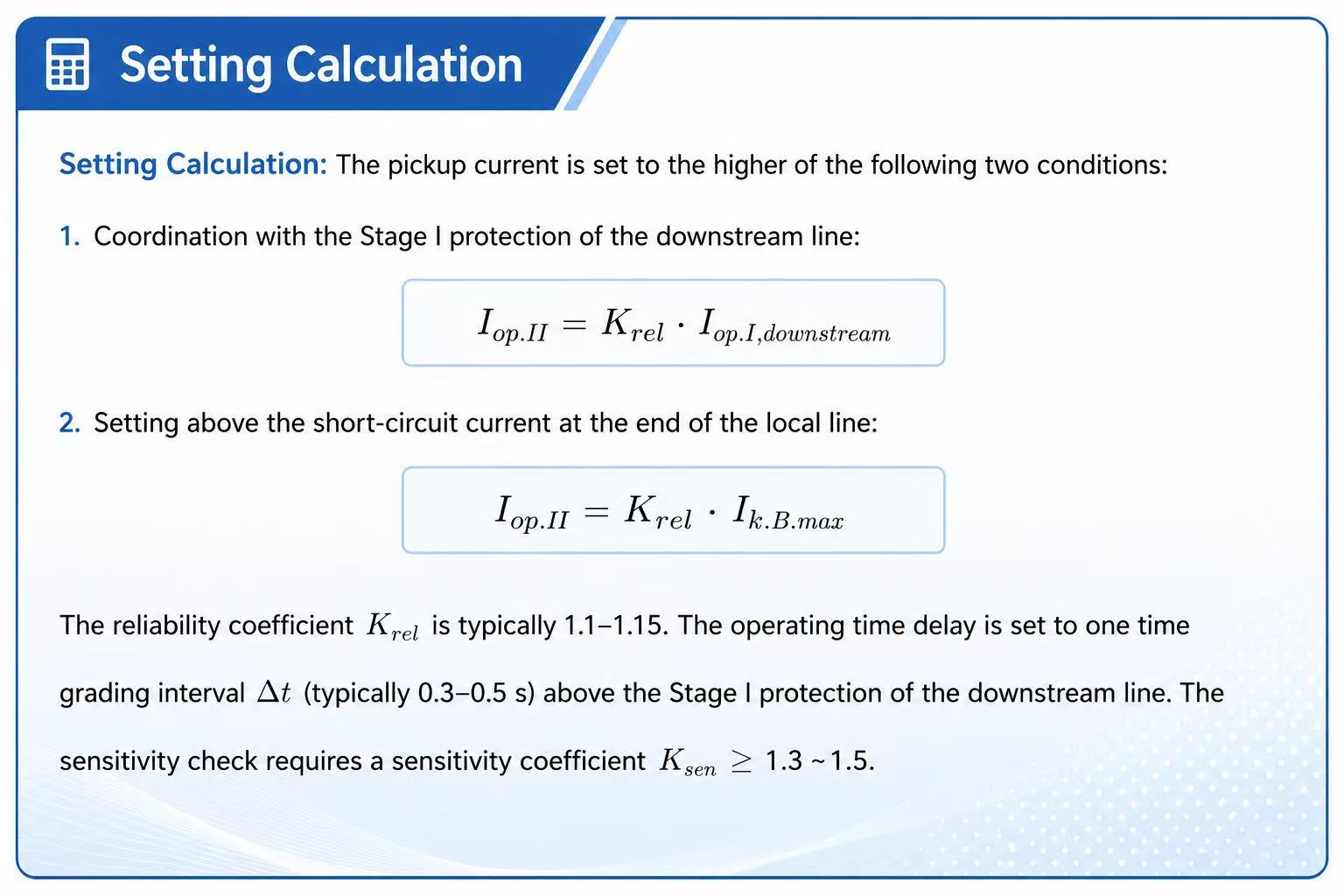
- Operating Principle: Covers short-circuit faults along the entire protected line with a short time delay. The time delay is coordinated with the instantaneous overcurrent protection of downstream feeders to ensure protection selectivity, thereby covering the blind zone of Stage I.
- Protection Range: Covers the full length of the local line and may extend slightly into the Stage I protection zone of the downstream line, but does not cover the entire downstream line.
- Function: Serves as the primary protection for the local line, providing full-line fault coverage, while also acting as backup protection in the event of failure of Stage I protection to operate.
Definite-Time Overcurrent Protection (Stage III | ANSI 51 Definite Time)
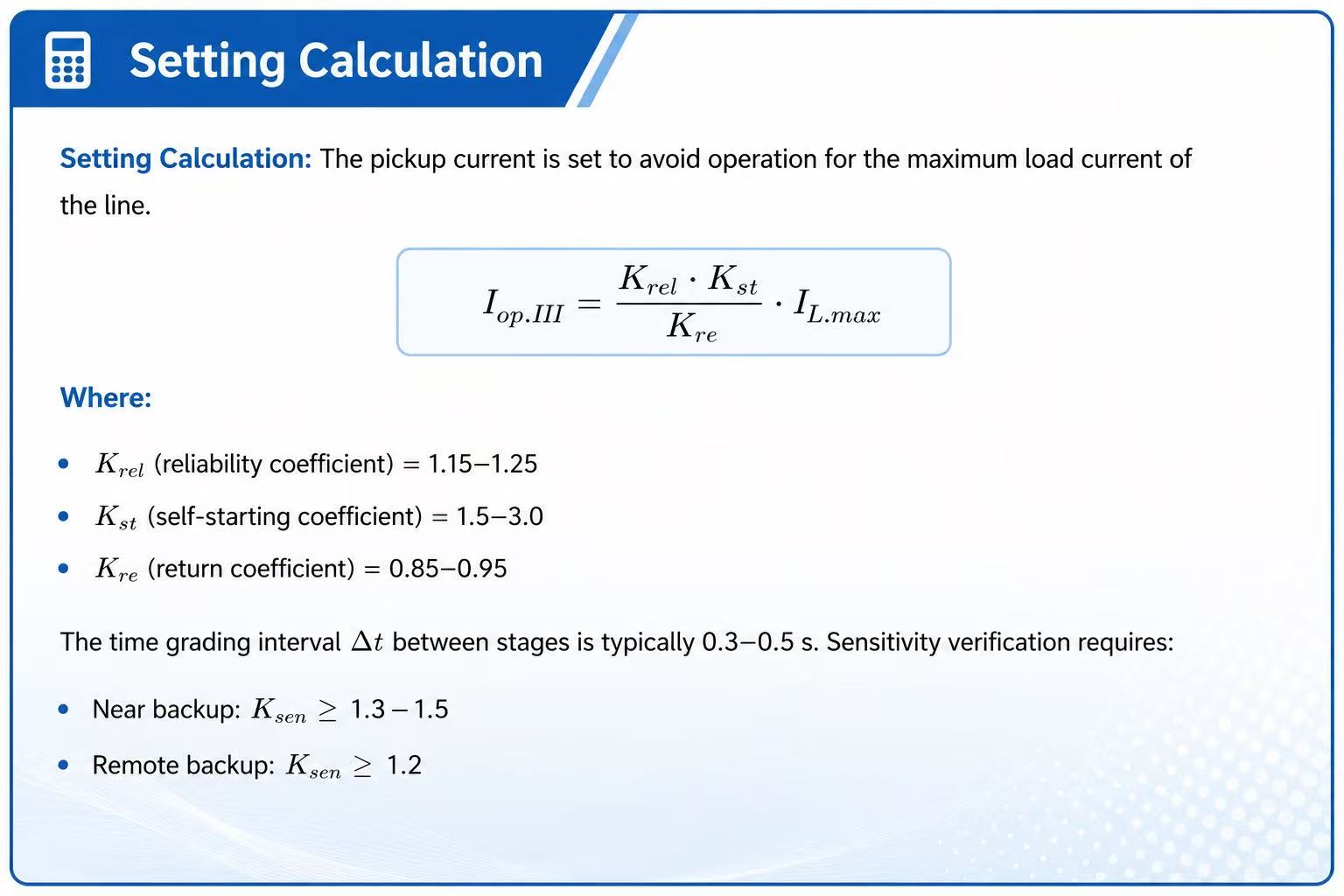
- Operating Principle: The pickup current is set to avoid operation for the maximum load current of the line, resulting in the lowest pickup current among the three stages. It employs a stepped time-grading coordination principle, where time delays increase progressively by one grading interval Δ𝑡 from the load side (downstream) toward the source side (upstream) to prevent unwanted tripping and ensure proper coordination.
- Protection Range: Covers the full length of the local line as well as the entire length of adjacent downstream lines, providing backup protection functions.
- Function: Provides backup protection for the local line and serves as remote backup protection for adjacent downstream lines, in case of primary protection failure, downstream protection device malfunction, or circuit breaker failure.