Hardwired Tripping vs. IEC 61850 GOOSE-Based Tripping: A Technical Comparison
Conclusion First
- Hardwired and GOOSE-based tripping should not be reduced to a simple distinction between “reliable” and “unreliable”. They have different technical characteristics, supervision capabilities and failure modes.
- The principal advantages of hardwired schemes are their visible circuit structure, technological maturity, readily analysable latency and ability to operate independently of the communication network. The principal advantages of GOOSE are online supervision of the communication path, flexible signal exchange, reduced cabling and, in some inter-IED applications, faster signal transfer.
- It should be noted that GOOSE generally replaces blocking, intertripping, initiation and status signals exchanged between protection IEDs. It does not necessarily mean that the final circuit-breaker trip circuit is fully network-based. Even when a trip command is transmitted by GOOSE, hardwired output contacts and a DC trip circuit are normally still required between the receiving IED and the circuit-breaker trip coil.
- Consequently, each solution has its own appropriate applications. Neither has an absolute advantage when considered without reference to a specific protection scheme. Engineering decisions should be based on the complete end-to-end tripping chain rather than on only one section of the signal path.
1. Technical Principles and Architecture
Hardwired trip, blocking or intertripping signals are normally transmitted through the binary inputs and outputs of protection IEDs and multicore control cables. Depending on the application, two principal signal paths are used.
Hardwired signalling between protection IEDs:
Transmitting protection IED output contact closes → control cable → receiving protection IED binary input circuit.
Hardwired tripping directly to the circuit breaker:
Protection IED trip output → interposing trip relay or direct trip output → control cable → circuit-breaker trip coil.
Hardwired circuits transmit binary electrical signals. Whether an interposing relay is required depends on the output-contact rating of the protection IED, the DC system voltage, the circuit-breaker trip-coil current and the project design requirements. Terminals, contacts, cables and DC circuits throughout the signal path can be checked using conventional electrical test methods.
GOOSE-based tripping uses the Layer 2 Ethernet multicast mechanism defined by IEC 61850 to transmit trip, blocking, intertripping, initiation and status information between IEDs as digital messages.
GOOSE combines event-triggered transmission with repeated retransmission. When a data value changes, the updated message is transmitted immediately and then retransmitted several times at short intervals to support fast and reliable delivery. Once the state becomes stable, the retransmission interval progressively increases. The subscriber can use message continuity, the state number, sequence number and Time Allowed to Live (TAL) to detect an abnormal GOOSE subscription.
GOOSE-based tripping commonly uses one of the following network topologies:
- Transmission through Ethernet switches;
- Dedicated point-to-point Ethernet connections between IEDs;
- Two independent communication networks;
- Seamless redundant networks based on PRP or HSR.
A point-to-point connection can reduce risks associated with switch failures and network configuration errors, but provides less flexibility for signal sharing and future expansion. A switched network enables several IEDs to share information but requires appropriate engineering of VLANs, Quality of Service, multicast filtering, network redundancy and switch capacity.
2. Operating-Speed Comparison
Operating speed is one of the most frequently misunderstood aspects of this comparison. Hardwired signalling is often assumed to be inherently faster than GOOSE, but this conclusion does not apply to every architecture.
The total delay of a hardwired inter-IED signal is mainly determined by:
- The operating time of the transmitting IED output contact;
- The operating time of any interposing relay;
- The binary-input filtering and debounce time of the receiving IED;
- The signal propagation time through the control cable.
The propagation time through a control cable is generally negligible. For example, the propagation time through 100 metres of control cable is approximately 0.5 μs, which is much shorter than the operating times of output contacts, interposing relays and binary-input processing.
Hardwired signalling cannot be represented by one universal delay value. If a high-speed output contact is connected directly to a fast binary input, the inter-IED hardwired signal delay may also be only a few milliseconds. If the signal passes through a conventional interposing relay and the receiving IED applies a relatively long debounce time, the total delay may reach tens of milliseconds.
The end-to-end delay of a GOOSE signal is primarily determined by:
- Internal logic processing in the transmitting IED;
- GOOSE message encoding and transmission;
- Network transmission and Ethernet-switch forwarding;
- Message decoding and logic processing in the receiving IED.
In a properly engineered substation LAN, GOOSE used for protection applications is generally designed to provide millisecond-level end-to-end transfer performance. The actual delay depends on IED processing performance, switch forwarding method, number of network levels, message priority, background traffic and network redundancy architecture.
For high-speed protection applications, GOOSE performance should not be assessed only by its average transfer time. Verification should also cover:
- Maximum end-to-end transfer time;
- Latency under high network loading;
- Message loss and consecutive packet-loss conditions;
- Performance during network redundancy events;
- Response to switch or communication-link failures;
- The 99.9th percentile or another appropriately high percentile;
- Internal processing time within the publishing and subscribing IEDs.
VLAN priority and Quality of Service can give GOOSE frames preferential forwarding treatment, but they cannot independently guarantee deterministic latency under all operating conditions. Actual performance must be verified through network-capacity calculations, suitable equipment selection and on-site end-to-end scheme functional testing.
In applications such as reverse interlocking, intertripping and protection initiation between IEDs, GOOSE may eliminate interposing relays and some binary-input filtering stages. It can therefore be faster than a conventional hardwired arrangement. However, where hardwired signals use high-speed outputs and fast binary inputs, or where the protection IED directly energises the circuit-breaker trip circuit, it cannot be assumed that GOOSE will always be faster.
Therefore, GOOSE is not inherently slower than hardwired signalling and may be faster in certain inter-IED architectures. The main characteristic of hardwired signalling is that the components contributing to its delay are relatively easy to identify and analyse. The main characteristic of GOOSE is its fast signal transfer, although its worst-case delay depends on the performance of the IEDs, network and associated configuration.
3. Reliability and Failure Modes
- The principal failure modes of hardwired circuits are concentrated in the physical circuit and include:
- Open-circuit or earth faults in control cables;
- Loss of the DC control supply;
- Cable insulation deterioration;
- Oxidised, damaged or welded output contacts;
- Loose terminals;
- Poor contact at test links or protection links;
- Failure of an interposing relay;
- Open-circuit circuit-breaker trip coils;
- Wiring errors.
In practice, a loose terminal, defective test link or open control cable may prevent the trip command from being transmitted even though the protection function has operated correctly. If the affected circuit is not continuously supervised, such a condition may remain a silent failure until it is discovered during scheduled maintenance, end-to-end scheme functional testing or an actual power-system fault.
However, it is incorrect to state that all hardwired trip circuits lack online supervision. A circuit-breaker trip circuit can be equipped with trip-circuit supervision, commonly referred to as TCS or ANSI device number 74. Depending on the circuit arrangement, TCS can supervise the DC control supply, trip-circuit wiring, certain contacts and the continuity of the circuit-breaker trip coil.
The limitation is that ordinary hardwired interconnection signals between IEDs, certain intermediate contacts, circuits upstream and downstream of test links, and cable sections not included in the TCS scheme may remain unmonitored. A distinction must therefore be made between an ordinary unsupervised hardwired interconnection and a circuit-breaker trip circuit equipped with comprehensive trip-circuit supervision.
The principal failure modes of GOOSE are concentrated in the communication network, IEDs and system configuration and include:
- Fibre-optic or copper Ethernet link failure;
- IED communication-port failure;
- Ethernet-switch failure;
- IED power-supply failure or restart;
- Incorrect VLAN or QoS configuration;
- Incorrect GOOSE publishing or subscription configuration;
- Incorrect APPID, destination MAC address or dataset configuration;
- Network congestion, broadcast storms or multicast storms;
- Message loss, excessive delay or out-of-sequence messages;
- Inconsistency between SCL/SCD file versions;
- Failure of the network-redundancy architecture;
- Unauthorised or illegitimate message injection and other cybersecurity incidents.
These risks can be reduced through appropriate engineering measures. A point-to-point connection can eliminate certain switch-related single points of failure. Two independent networks can improve availability. PRP or HSR can provide seamless network redundancy. VLANs, QoS, multicast filtering and storm control can improve the transmission conditions for critical messages.
An ordinary dual-network arrangement is not equivalent to seamless redundancy. PRP and HSR can provide zero recovery time when correctly supported and configured by the participating equipment. Network recovery mechanisms such as RSTP and MRP normally involve a finite recovery period. Whether that period is acceptable must be verified for the relevant high-speed protection application.
A major advantage of GOOSE is the ability to supervise publishing and subscription status continuously. The receiving IED can use message continuity and TAL to detect an abnormal subscription and initiate a communication alarm or a predefined degraded operating mode.
However, GOOSE supervision primarily covers the publishing, communication and subscription path. It does not automatically supervise:
- The output logic inside the receiving IED;
- The receiving IED’s physical output contact;
- The DC tripping supply;
- The hardwired trip cable;
- The circuit-breaker trip coil;
- The circuit-breaker operating mechanism.
Consequently, even when GOOSE is used between IEDs, the final circuit-breaker trip circuit may still require TCS, circuit-breaker position feedback and end-to-end scheme functional testing.
The response to the loss of a GOOSE subscription cannot universally be configured as “block protection”. Different signals have different implications for protection dependability and security:
- Loss of a blocking signal may cause an unwanted trip;
- Loss of a permissive signal may prevent a required trip;
- Loss of an intertrip signal may prevent the remote circuit breaker from opening;
- Loss of a breaker-failure initiation signal may impair backup fault clearance;
- Loss of circuit-breaker position information may affect autoreclosing or automatic bus transfer logic.
The required response to a communication failure should therefore be determined separately for each protection function. Possible responses include alarming, controlled functional degradation, transfer to a redundant channel, blocking of a particular automation function or adoption of a default state determined by a system-level protection and safety assessment. One universal fail-safe response cannot be applied to every GOOSE signal.
From the perspective of fault-detection speed, GOOSE can rapidly detect failures in the publishing, transmission or subscription path. Whether a hardwired circuit can detect a broken conductor or defective contact depends on the availability and coverage of TCS or another circuit-supervision scheme.
This is the fundamental difference between the two solutions in terms of reliability: GOOSE provides strong communication-path supervision, whereas the supervision coverage of a hardwired circuit depends on its detailed circuit design.
4. Electromagnetic Immunity and Electrical Isolation
Hardwired circuits transmit binary electrical signals through relay contacts and binaryinput circuits. A potentialfree relay contact can provide galvanic isolation between the transmitting and receiving circuits. Immunity can be improved through suitable binaryinput thresholds, screened control cables, interposing isolation relays and appropriate cablerouting practices.
However, hardwired circuits are not inherently immune to electromagnetic interference. They may be affected by:
- Electromagnetic coupling between adjacent cores in multicore cables;
- Differences in earth potential between the ends of long control cables;
- Fast transients produced by primary equipment switching;
- DC system earth faults;
- Incorrect termination of cable screens;
- Parallel routing of power and control cables.
The electromagnetic compatibility of a hardwired circuit therefore depends on cable selection, screen earthing, circuit voltage, binaryinput thresholds and installation quality.
GOOSE transmits digitally encoded messages. Ethernet framechecking mechanisms can detect most random transmission errors, which means a message corrupted by noise is generally discarded rather than interpreted as a valid trip command.
Where fibreoptic media are used, the communication path is nonconductive and is not susceptible to electromagnetic interference or earthpotential differences. This is an important advantage of GOOSE in severe electromagnetic environments. GOOSE can also operate over copper Ethernet, however, so immunity to electromagnetic interference applies specifically to fibreoptic sections of the network.
Digital communication introduces a different class of risk, including message loss, outofsequence delivery, latency variation, configuration errors and unauthorised message injection. Ethernet frame CRC can detect random transmission errors, but it cannot prove that a message originated from an authorised IED or independently prevent forgery, replay or illegitimate injection.
GOOSE cybersecurity therefore requires a combination of measures, including:
- Segregating the protection network from other operational and corporate networks;
- Strictly controlling switch ports and engineering access;
- Applying VLANs, port security and access control;
- Managing SCL/SCD file versions;
- Recording and auditing configuration changes;
- Applying relevant IEC 62351 security mechanisms where required by the project;
- Monitoring important networks for abnormal traffic.
VLANs and Quality of Service are primarily trafficsegregation and prioritymanagement mechanisms. They should not be treated as substitutes for message authentication or comprehensive cybersecurity controls.
5. Operation, Maintenance and Engineering Characteristics
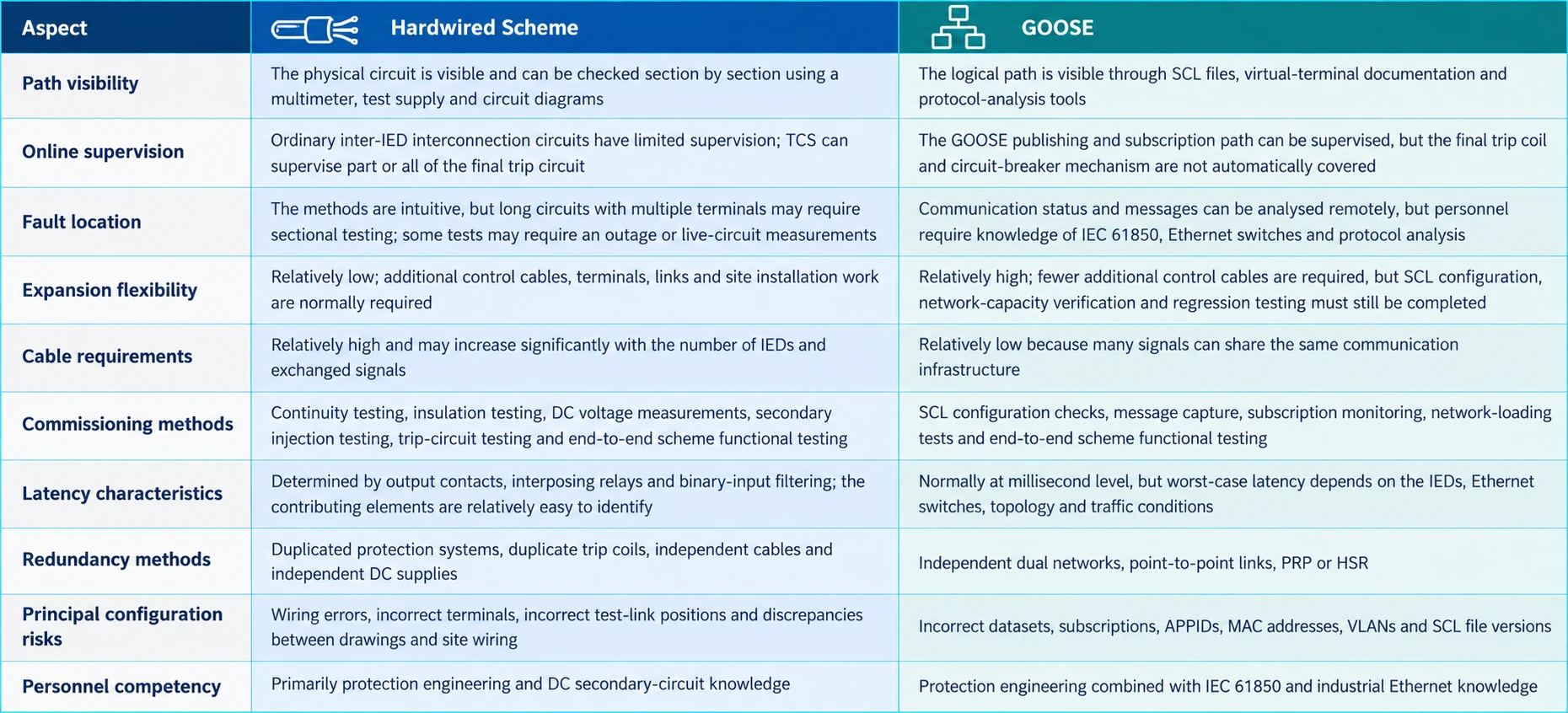
Hardwired maintenance methods are well established. Site personnel can normally locate faults using a multimeter, test supply and secondary circuit diagrams. However, where circuits are long, include many intermediate terminals or lack continuous supervision, locating a fault may require sectionbysection testing and may not necessarily be quicker than diagnosing a GOOSE problem.
GOOSE allows engineers to examine subscription status, communication alarms and message changes remotely, which can help identify whether a failure is associated with the publisher, network or subscriber. However, GOOSE faults can also be difficult to diagnose if SCL file management is inadequate, virtualterminal relationships are poorly documented or maintenance personnel lack sufficient networking knowledge.
Expansion of a hardwired scheme normally requires additional control cables, terminals, test links and site installation work. The workload increases with the number of bays and signals. GOOSE can substantially reduce physical wiring, but an extension involves more than simply changing a configuration file. It may require:
- Modification of the SCL/SCD configuration;
- Verification of publishing datasets and subscription relationships;
- Checks of APPIDs, destination MAC addresses, VLANs and priorities;
- Verification of switch ports and network capacity;
- Configurationversion control;
- Regression testing of affected IEDs;
- Endtoend scheme functional testing;
- Updating network diagrams and virtualterminal documentation.
GOOSE therefore reduces physical installation work but increases the importance of digital configuration, version control and network testing.
6. Neutral Summary
Hardwired and GOOSE-based signalling are two technical solutions intended for different engineering constraints. Each has applications in which it provides distinct value.
The principal value of hardwired signalling is its visible circuit structure, technical maturity and relative independence from the communication network. Its individual sources of delay are generally straightforward to analyse. Common test equipment is widely available, and maintenance personnel do not require advanced network expertise. Through suitable application of trip-circuit supervision, duplicate trip coils, duplicated protection systems and independent DC supplies, a highly dependable tripping system can be achieved.
Its principal disadvantages are the large number of control cables, terminals and test links; the physical installation work required for extensions; and the possibility of silent failures in unsupervised inter-IED interconnection circuits. Large quantities of physical wiring can also increase the risk of human error during design, installation and maintenance.
The principal value of GOOSE is rapid signal transfer between IEDs, continuous supervision of the publishing and subscription path, reduced wiring and flexible sharing of trip, blocking, intertripping, initiation and status information. Extensions normally require fewer additional control cables, and fibre-optic communication provides effective electrical isolation in severe electromagnetic environments.
Its principal disadvantages are that system performance depends on correct IED, switch, topology and configuration design. It introduces new failure modes associated with communication ports, Ethernet switches, SCL configuration, abnormal traffic and cybersecurity. It also requires maintenance personnel to possess IEC 61850 and industrial Ethernet expertise. Critical protection applications require appropriate network redundancy, QoS, multicast management, configuration control and end-to-end scheme functional testing.
In terms of operating speed, GOOSE is not inherently slower than hardwired signalling. For reverse interlocking, intertripping and inter-IED initiation signals, it may be faster because it can eliminate interposing relays and some binary-input filtering stages. Where a hardwired circuit uses high-speed outputs, fast binary inputs or a direct trip output, however, GOOSE cannot automatically be assumed to be faster.
In terms of reliability, the correct comparison is not between a GOOSE communication path and one section of control cable. The entire end-to-end chain from the protection logic output to final circuit-breaker operation should be assessed, including:
- Protection IED internal logic;
- Output or communication interfaces;
- Control cable or Ethernet network;
- Receiving IED;
- Trip output contacts;
- DC tripping supply;
- Circuit-breaker trip coil;
- Circuit-breaker operating mechanism;
- Online supervision and alarm coverage;
- Single points of failure and backup measures.
In important substations, hardwired and GOOSE-based signalling can also be used together. GOOSE may be used for blocking, intertripping, initiation and status sharing between IEDs, while the final circuit-breaker trip output remains hardwired. Critical protection schemes may additionally employ duplicated protection systems, independent communication networks, PRP or HSR, independent DC supplies and duplicate trip coils.
The choice between the two solutions should therefore be based on the project’s reliability requirements, the importance of the protection function, the complete network architecture, maintenance capability, cybersecurity requirements and future expansion plans. Neither solution should be labelled categorically as “more reliable”, “more advanced” or “unacceptable” without a system-level engineering assessment.


