

GWWT-S-P Series Passive Wireless Temperature Sensors
Product Desc
- GoWatron GWWT-S-P Series Passive Wireless Temperature Sensors monitor the temperature of current-carrying connections in high- and low-voltage switchgear, ring main units, compact substations and transformer installations. They help maintenance personnel detect abnormal heating at busbars, cable terminations and electrical contacts. Powered via current-transformer (CT) energy harvesting, the sensors require no batteries or external power supply and transmit temperature data wirelessly to a compatible receiver. They are suitable for online monitoring projects where reduced wiring and battery maintenance are priorities.
- The series has a temperature measurement range of −40 to +200 °C and an accuracy of ±0.5 °C. Standard, miniature, outdoor miniature, strap-mounted and infrared versions are available to suit different measurement locations, installation spaces and site conditions. When used with compatible receivers and monitoring software, the sensors support centralised temperature display, trend monitoring and overtemperature alarms, providing data for routine inspections, condition-based maintenance and the identification of developing faults.




Battery-Free
CT-powered

High Accuracy
±0.5 °C

Wireless Options
2.4 GHz / 433 MHz / LoRa

Adjustable Interval
1 s–1 min

Easy Mounting
Strap-mounted

Fast Delivery
Global Shipping

Warranty
2 Year Warranty
1. Product Description
- GoWatron GWWT-S-P Series Passive Wireless Temperature Sensors are designed for online temperature monitoring of critical electrical connections. Loose connections, poor contact or increased loading can cause localised heating during operation. Sensors installed at suitable locations provide operating temperature data to help maintenance personnel identify abnormal hot spots.
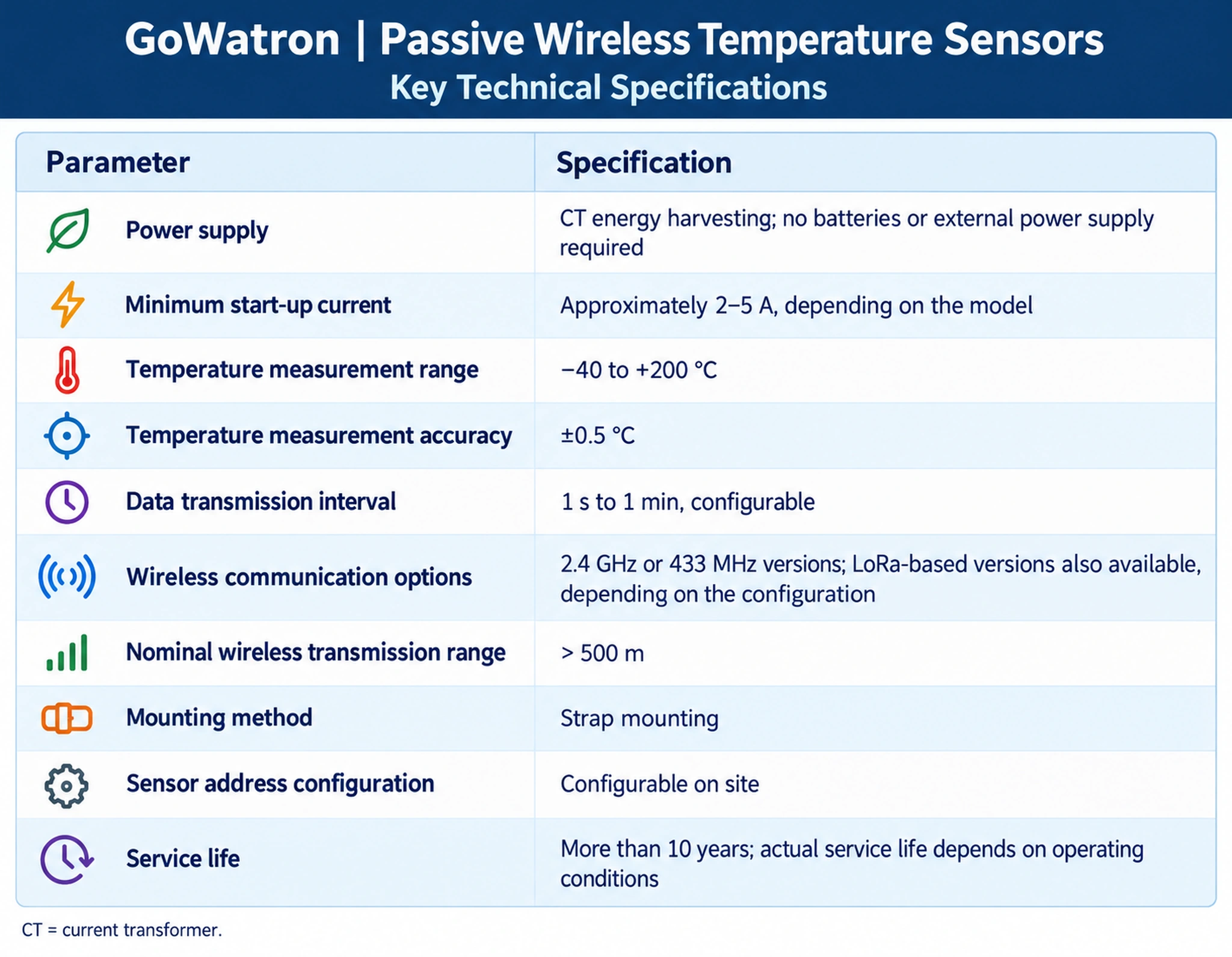
- The sensors use CT energy harvesting to power their temperature measurement and wireless communication circuits. The minimum start-up current is approximately 2–5 A, depending on the model and operating conditions. Battery replacement is unnecessary, reducing maintenance requirements at locations inside enclosed switchgear or where access is difficult.
- The series uses strap mounting and supports on-site sensor address configuration, allowing multiple measurement points to be identified and associated with compatible receivers. Available wireless configurations include versions operating at 2.4 GHz or 433 MHz, as well as versions using LoRa modulation. The selected wireless configuration must be matched to the receiver.
Product Selection
Key Technical Specifications
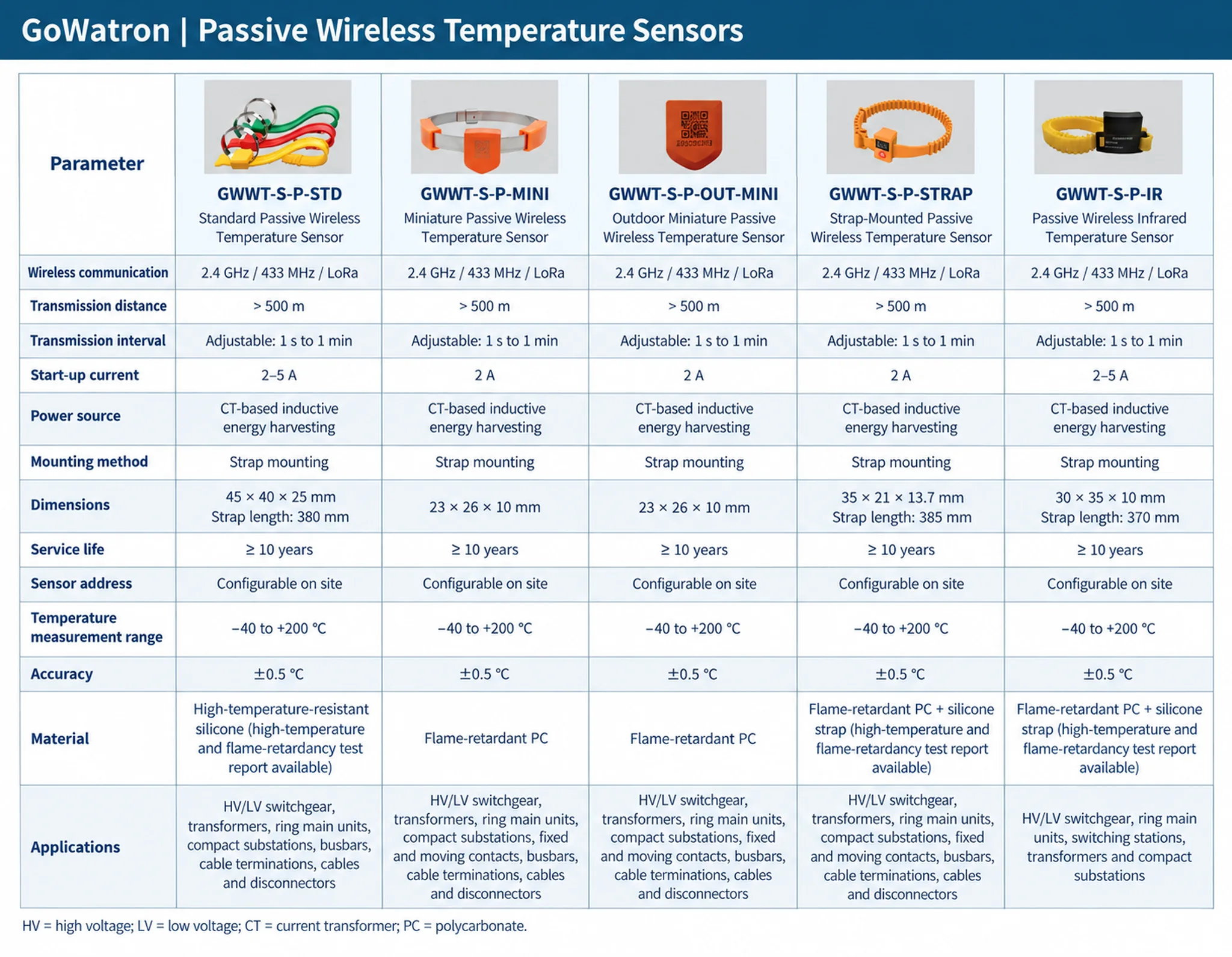
The GWWT-S-P-STD standard model uses high-temperature-resistant silicone material. A corresponding high-temperature and flame-retardancy test report is available. Its specified CT energy-harvesting current range is 2 A to 5,000 A. The sensor body measures 45 × 40 × 25 mm, and the total strap length is 380 mm.
Actual wireless transmission range depends on metal enclosure shielding, installation position and the local radio environment. Since the sensors rely on the monitored circuit for energy, continuous measurement and data transmission cannot be guaranteed when the circuit is de-energised or the current falls below the energy-harvesting requirement.
2. Main Functions
Battery-Free Operation Through CT Energy Harvesting
- CT energy harvesting eliminates the need for batteries and external power wiring. When the circuit current meets the energy-harvesting requirement, the sensor measures temperature and transmits data wirelessly for ongoing online monitoring.
Wide Temperature Measurement Range
- The sensors measure temperatures from −40 to +200 °C with an accuracy of ±0.5 °C, providing data for monitoring temperature changes and detecting abnormal localised heating at critical electrical connections.
Wireless Data Transmission
- Temperature data is transmitted wirelessly to compatible receivers, reducing signal wiring between sensors and receivers. The wireless configuration can be selected to suit the project, while receiver placement should take account of site conditions.
Configurable Data Transmission Interval
- The data transmission interval can be set from 1 s to 1 min to suit the required data update rate.
Measurement Point Identification and Centralised Monitoring
- On-site sensor address configuration allows measurement points in different switchgear panels, circuits and locations to be identified. Compatible receivers and monitoring software can display temperatures centrally, record temperature trends and generate overtemperature alarms.
Multiple Designs for Different Installation Locations
- Different sensor sizes and mounting designs are available for busbars, cable terminations, electrical contacts and disconnector connections. The miniature sensor body measures 23 × 26 × 10 mm, making it suitable for locations with limited installation space.
3. Applications
High- and Low-Voltage Switchgear
- The sensors monitor copper busbar joints, cable terminations and other suitable current-carrying connections inside high- and low-voltage switchgear. Operating temperature data helps maintenance personnel detect abnormal heating associated with poor contact, loose connections or increased loading.
Transformers and Compact Substations
- The sensors monitor external transformer cable terminations, copper busbar connections and critical current-carrying connections within the high- and low-voltage equipment of compact substations. Wireless transmission of temperature data enables centralised monitoring of multiple measurement points, supporting inspections and condition-based maintenance.
Ring Main Units
- The sensors monitor cable terminations, conductor connections and other suitable current-carrying locations inside ring main units. Compact models can be selected according to the available installation space and used with compatible receivers for centralised monitoring of multiple measurement points.
Copper Busbars, Cable Terminations and Cables
- The sensors monitor copper busbar joints, cable terminations and cable connections to help identify abnormal localised heating. For cable monitoring, the installation location should reflect the measurement objective. Cable surface temperature must be distinguished from the temperature of the internal conductor.
Disconnectors
- The sensors monitor suitable current-carrying connections on disconnectors, helping identify localised heating caused by increased contact resistance or poor connections. Installation must maintain the required electrical clearances and avoid interfering with disconnector operation.
Boilers and High-Temperature Equipment
- For temperature monitoring associated with boilers and high-temperature equipment, model suitability must be assessed with respect to the measurement location, available energy source and installation environment. The target temperature must remain within −40 to +200 °C, and the sensor body must operate within its specified ambient temperature limits. Models in this series that use CT energy harvesting also require a suitable current-carrying circuit at the installation location.


