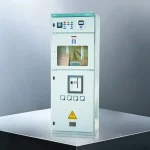
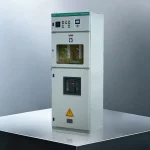
Low-Voltage Grid-Connected Photovoltaic Switchgear (GGD)
The GGD low-voltage grid-connected photovoltaic switchgear is a modular fixed-type low-voltage complete switchgear and controlgear assembly. It is designed and manufactured in strict compliance with GB/T 7251 series national standards for low-voltage switchgear and controlgear assemblies, IEC 61439 international standards, and NB/T 32004 technical specifications for photovoltaic grid-connected systems. Suitable for low-voltage distributed photovoltaic power generation systems with a rated operating voltage of AC 400V/380V and a rated frequency of 50Hz, the equipment serves as the core grid-connection interface device positioned at the Point of Common Coupling (PCC) between photovoltaic power stations, public power grids, and users’ internal distribution networks. The equipment adapts to photovoltaic systems with installed capacities ranging from 200kWp to 2000kWp and above, and is widely applied in new energy scenarios including industrial and commercial rooftop distributed PV systems, village-level centralized PV power stations, and solar-water complementary power plants.
Installed in series between the AC output side of inverters and the grid incoming line, the equipment integrates core functions including grid-connected power feeding, electrical energy metering, fault protection, safety disconnection, and grid adaptability regulation. Under normal operating conditions, the equipment stably delivers clean power. In the event of grid-side or equipment-side abnormalities or faults, the equipment performs rapid and reliable disconnection to isolate fault points effectively, ensuring the operational safety and power supply reliability of both PV power generation systems and public distribution networks.




Product Introduction
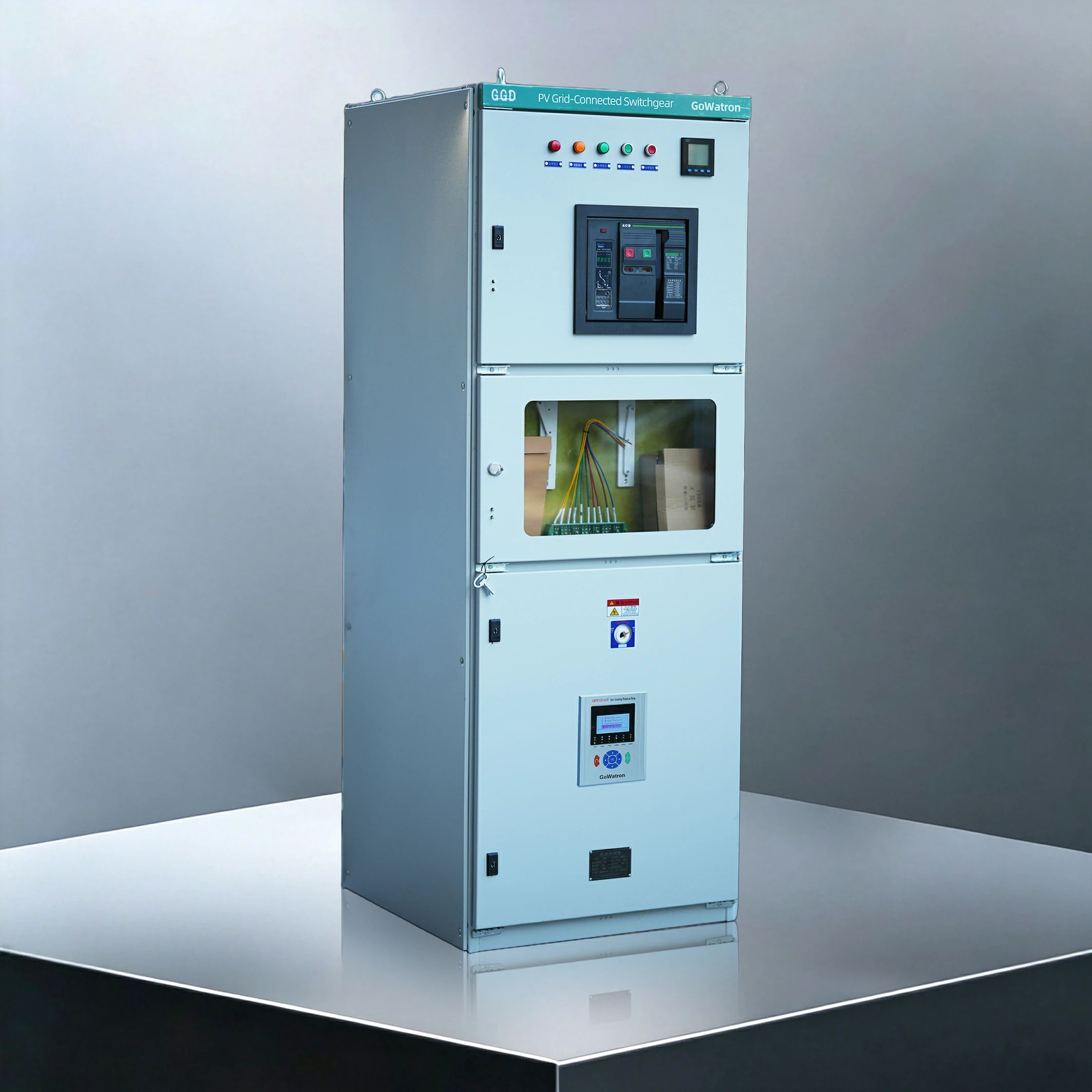
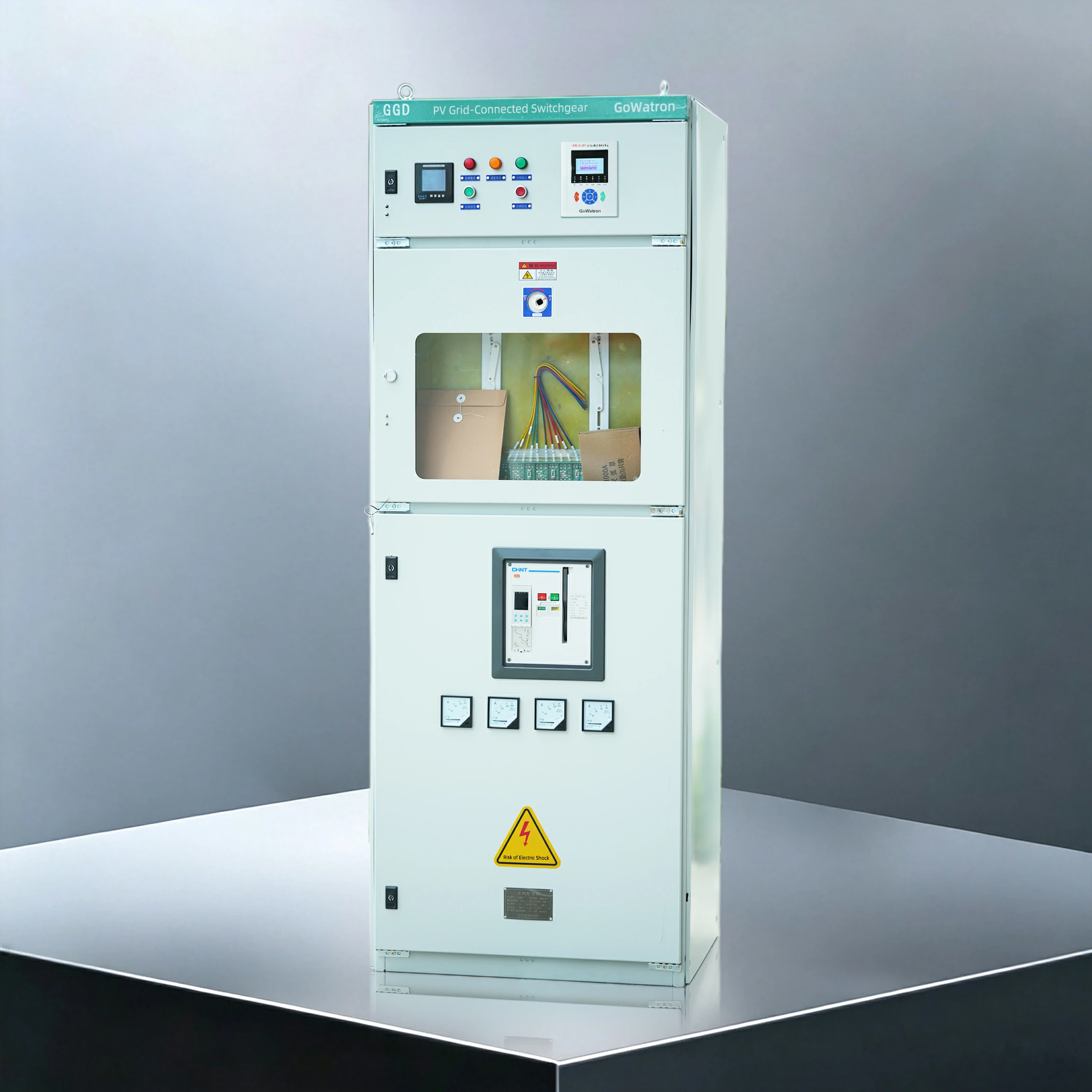
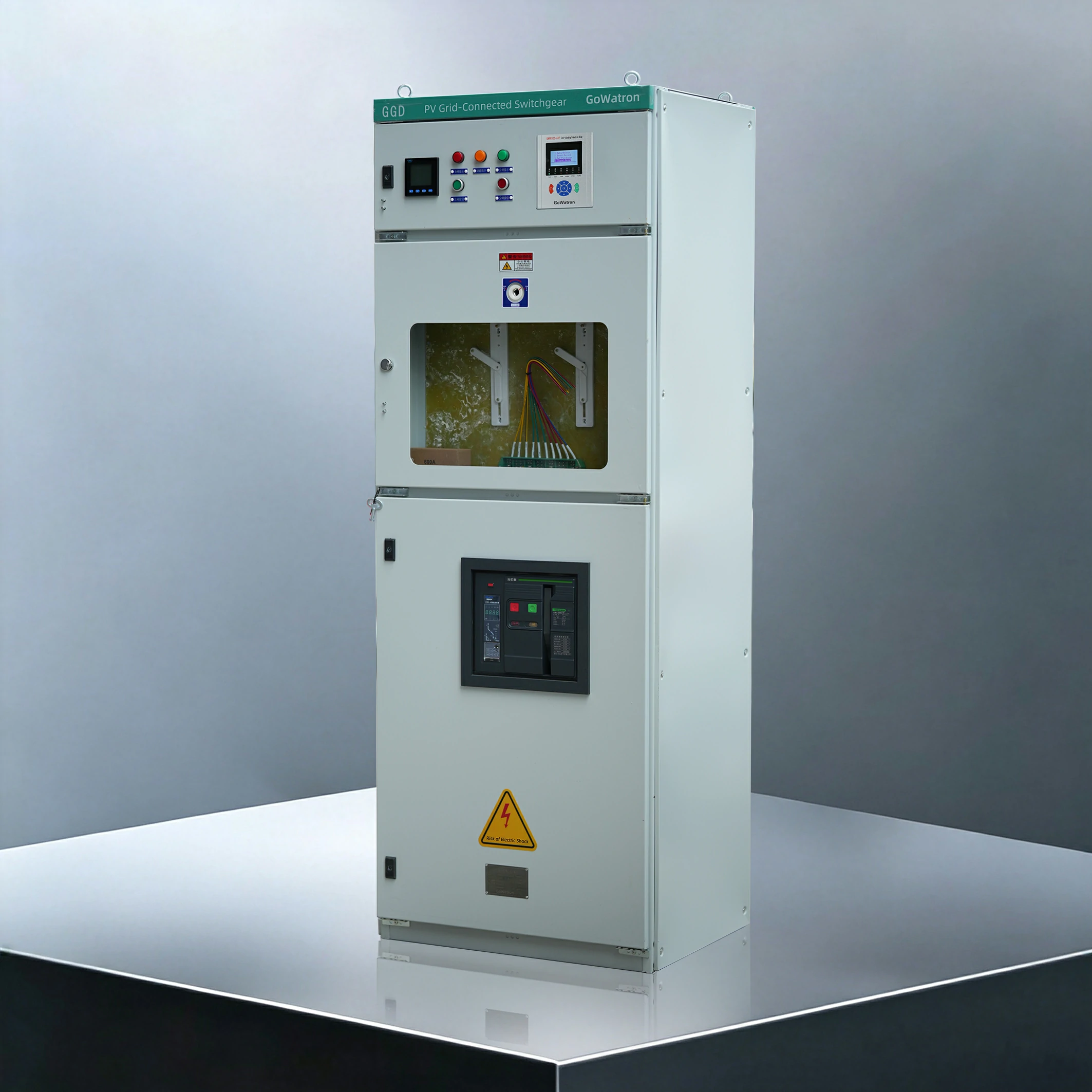
This product adopts a standard GGD fixed low-voltage switchgear framework with cold-formed steel bolted assembly construction. It features high overall rigidity, structural stability, outstanding vibration and impact resistance, and superior internal arc fault withstand performance, fully accommodating the frequent grid switching and dynamic load characteristics of PV systems for long-term stable operation. Cabinet dimensions and protection grades are configurable; the indoor version meets general distribution protection requirements, while the upgraded outdoor version provides enhanced rainproof and dustproof performance for harsh environments.
The cabinet adopts partition-based enclosed structure, independently dividing the incoming busbar compartment, main switching device compartment, and secondary control & metering compartment. Complete physical isolation between primary high-power circuits and secondary low-power measurement and control circuits effectively suppresses electromagnetic coupling interference and improves metering accuracy and operational stability. The independent sealed metering compartment fully complies with utility anti-theft and lead seal specifications, meeting official grid-acceptance criteria.
The main circuit core device is an Air Circuit Breaker (ACB) equipped with a microprocessor-based Electronic Trip Unit (ETU). Differing from traditional thermal-magnetic trip mechanisms, the ETU provides precise three-stage selective protection (L-S-I) plus optional earth fault protection (G), realizing full-current graded protection and accurate coordination with upstream and downstream distribution devices. This effectively prevents stage-skipping tripping and large-area power outages. The breaker integrates electrical and mechanical dual interlocks as well as an electric operating mechanism, supporting local and remote control for intelligent centralized power station management.
The front cabinet door is equipped with a high-grade transparent observation window. Operators can directly access real-time data from the ETU LCD HMI without opening live doors, including three-phase current, line voltage, active/reactive power, accumulated energy, thermal capacity, and fault codes. This facilitates routine inspection, condition evaluation, and rapid fault diagnosis.
The whole equipment is designed, manufactured and type-tested in accordance with national low-voltage switchgear standards and has obtained CCC certification for stable and compliant quality. Integrated professional PV grid-connected modules support anti-islanding protection, grid anomaly adaptation, and LVRT capability. Built-in Surge Protective Devices (SPD) effectively resist voltage fluctuation, frequency deviation, lightning surges and switching overvoltages, fully satisfying distributed PV grid-connected technical requirements.
Product Parameters and Selection Specifications
Selection of GGD low-voltage PV grid-connected switchgear requires comprehensive verification of rated insulation level, operating current, prospective short-circuit current at the Point of Common Coupling (PCC), overvoltage category, altitude and ambient temperature. All selections comply with low-voltage safety codes and PV grid-access standards to ensure equipment compatibility, operational safety and grid adaptability.
Main Technical Parameters
| Parameter Item | Technical Index and Requirement |
| Rated Operating Voltage (Ue) | Main circuit: AC 400V/380V; Control auxiliary circuit: AC 220V |
| Rated Insulation Voltage (Ui) | AC 690V/800V |
| Rated Impulse Withstand Voltage (Uimp) | ≥8kV (Overvoltage Category IV) |
| Rated Frequency (fn) | 50Hz |
| Main Busbar Rated Current (In) | 630A ~ 4000A (customized according to actual system load) |
| Rated Ultimate Short-Circuit Breaking Capacity (Icu) | ≥35kA (RMS), selected with 1.25× safety margin based on maximum PCC short-circuit current |
| Rated Service Short-Circuit Breaking Capacity (Ics) | 100% of Icu |
| Rated Short-Time Withstand Current (Icw, 1s) | ≥35kA (RMS) |
| Degree of Protection (IP Code) | Indoor standard type; Outdoor rainproof & dustproof type (optional by environment) |
| Core Grid-Connected Functions | Three-stage current protection (L-S-I), earth fault protection (G), islanding protection, OV/UV protection, OF/UF protection, LVRT capability, remote switching control, fault recording & remote transmission |
Selection Reference Specifications
Circuit Breaker Current Rating Selection
The ACB frame rated current shall be higher than the system maximum continuous operating current. Generally, the rating is selected at 1.2~1.25 times the total inverter rated output current and verified to fully cover system peak loads to avoid long-term overload and thermal aging risks. Typical matching: 200kWp PV system equipped with 500A ACB; 400kWp with 1000A ACB; 800kWp and above large-capacity systems with 2000A or higher ACB. The breaker short-circuit breaking capacity must exceed the prospective three-phase short-circuit current at the PCC to ensure reliable fault isolation.
Derating Correction for Environmental Operating Conditions
Standard operating conditions: altitude ≤2000m, ambient temperature -5℃~+40℃. For altitudes above 2000m, decreased air dielectric strength and degraded heat dissipation require comprehensive derating of breaker insulation, current-carrying capacity and busbar rating. For sustained ambient temperatures above 40℃, conductor current attenuation requires temperature derating verification. Non-magnetic stainless steel cabinets, optimized busbar layout or forced cooling can be adopted to maintain rated performance under non-standard conditions.
Electronic Trip Unit Function Selection
ETU with Zone Selective Interlocking (ZSI) is recommended for precise upstream and downstream protection coordination, ensuring local fault clearing and eliminating stage-skipping tripping to improve overall station reliability. The programmable ETU supports LVRT logic invocation, grid adaptive strategies, fault event recording and signal remote transmission, fully complying with latest grid codes for intelligent grid connection and unattended O&M.
Core Product Advantages
Complete Compliance with High Acceptance Rate
The equipment is designed, manufactured, and type-tested in full compliance with applicable national standards, industry specifications, and IEC international standards. All series have obtained CCC National Compulsory Product Certification, fully meeting the acceptance requirements for distributed photovoltaic grid connection. The product successfully passes grid-connection inspections, project completion assessments, and third-party verification conducted by local utility organizations.
Comprehensive Protection with Strong Grid Adaptability
The main circuit is equipped with standardized three-stage selective protection: long-time delay overload protection (L), short-time delay short-circuit protection (S), and instantaneous short-circuit protection (I), with optional earth fault protection (G). Integrated PV-exclusive grid-connected functions include islanding protection, overvoltage/undervoltage protection, overfrequency/underfrequency protection, and Low Voltage Ride Through (LVRT) capability. The equipment adapts to stringent grid requirements such as fault ride-through and grid disturbance self-adaptation, effectively eliminating protection refusal, maloperation, and stage-skipping tripping caused by protection coordination mismatch.
Robust Cabinet Construction with Anti-Interference and Anti-Theft Compliance
The cabinet adopts a standard cold-formed steel bolted assembly structure, delivering high mechanical strength, excellent dynamic and thermal stability, and superior internal arc fault withstand capability to resist system short-circuit impacts. Internal metal partition design achieves complete physical isolation between primary power circuits and secondary control & metering circuits, significantly suppressing electromagnetic interference. The independent enclosed metering compartment fully complies with power industry anti-theft and lead seal management specifications.
Intelligent and Efficient O&M with User-Friendly HMI
The cabinet door is fitted with a high-protection-grade transparent observation window, enabling real-time full parameter monitoring without door opening. The main Air Circuit Breaker (ACB) is equipped with an electric operating mechanism, supporting local manual operation and remote electrical closing/opening. Programmable logic ports enable remote signal transmission, real-time status monitoring, and accurate fault tracing, realizing intelligent operation and maintenance and substantially reducing lifecycle maintenance costs.
Wide Scenario Adaptability and High Customization Flexibility
Equipment rated current, protection grade, functional modules, and cabinet dimensions are fully customizable according to project capacity and site conditions. The product adapts to PV systems from 200kWp to megawatt level, covering standard indoor environments, outdoor rainproof/dustproof sites, as well as high-temperature, low-temperature and high-altitude working conditions.
Installation and Operation Precautions
Installation Environment Requirements
The equipment shall be installed in dry, ventilated locations free of corrosive gas, combustible dust, severe vibration and impact. Outdoor installation requires full rain, snow and waterlogging protection with sealed cable entry points. Indoor installation shall reserve sufficient heat dissipation and maintenance clearance complying with low-voltage distribution codes. Operation under extreme high temperature, high humidity, strong corrosion or high altitude without formal derating is prohibited.
Construction and Wiring Specifications
Primary busbars and power cables shall match rated current specifications, with all bolts torqued to standard values to prevent loose contact and overheating. Secondary control and metering wiring shall be neat, clearly numbered and firmly bundled, with single-point shielding grounding to avoid circulating current interference. PV inverter-side and grid-side circuits must be strictly distinguished; reverse or wrong connection is forbidden. After installation, insulation test, circuit verification, phase sequence check and continuity test shall be completed before commissioning.
Grid-Connected Operation Preconditions
Before commissioning, all protection parameters shall be set according to official grid dispatching setting sheets, including overcurrent, short-circuit, voltage/frequency limit and islanding thresholds. ETU logic, mechanical/electrical interlocks, remote communication and remote control functions shall be fully debugged. Equipment failing handover test, parameter verification or insulation test is prohibited from grid connection. Grid connection sequence: inverter-side closure first, then grid-side closure. Grid disconnection sequence: grid-side opening first, then inverter-side opening.
Safe Operation Specifications
All operation and maintenance work must be performed by certified electrical personnel following standard safety procedures: power cut, voltage verification, earthing, warning signage and lockout. Door opening and live part contact during energized operation are prohibited. Unauthorized parameter modification, interlock removal, or metering seal tampering is forbidden. Forced closing after fault tripping is not permitted; faults must be fully eliminated and verified before re-operation.
Lightning Protection and Grounding Requirements
Cabinet frame, main grounding busbar, secondary shielding layers and SPD terminals shall be reliably connected to the station grounding system with qualified grounding resistance. SPD operating status shall be inspected regularly, and faulty modules replaced timely to prevent lightning and switching overvoltage damage, ensuring stable grid-connected system operation.
Daily Operation, Maintenance, and Servicing
Daily Inspection
O&M personnel shall monitor real-time voltage, current, power and temperature via the observation window, and inspect for abnormal noise, odor, local overheating and fault alarms. Regular verification of metering data and grid status ensures stable continuous power delivery.
Periodic Maintenance
Annual power-off preventive maintenance includes primary circuit bolt tightening, cabinet dust cleaning, mechanism flexibility inspection, interlock reliability verification, ETU protection accuracy testing, and communication function confirmation. Maintenance cycles shall be shortened for high-temperature, high-humidity and dusty outdoor environments.
Fault Maintenance
Upon overload, short circuit, voltage anomaly or islanding tripping, the ETU and grid protection device automatically record fault parameters and codes. O&M staff can retrieve fault logs via local HMI or background system to locate faults on the inverter side, line side or grid side. Grid connection can only be resumed after complete fault elimination and re-verification.


