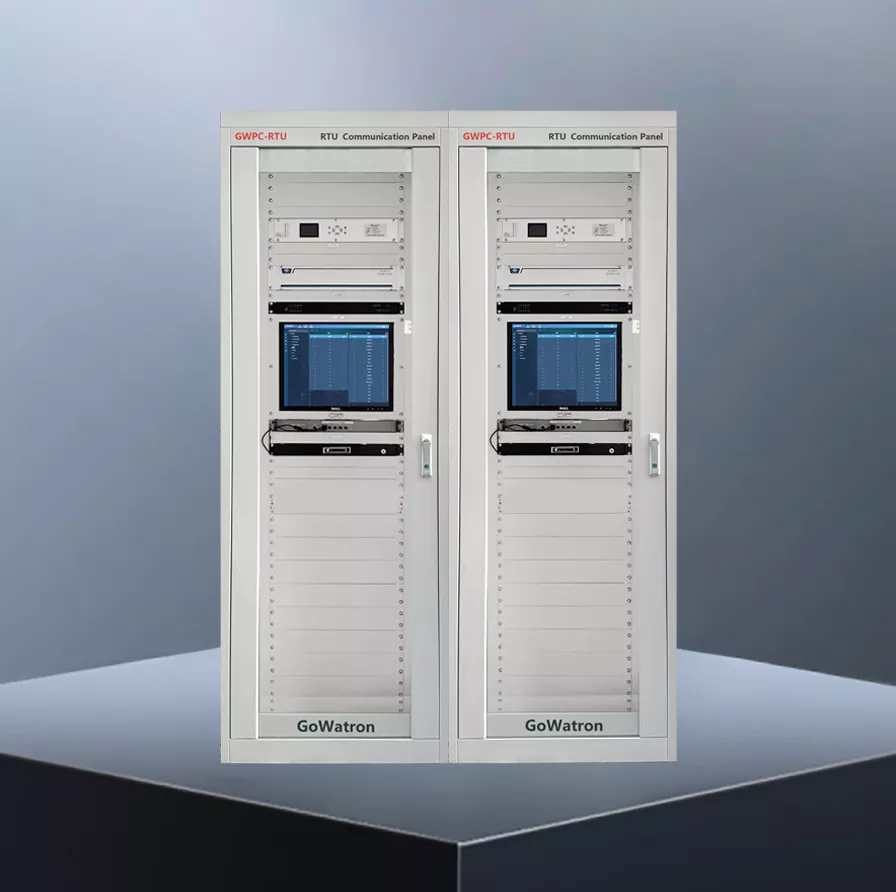
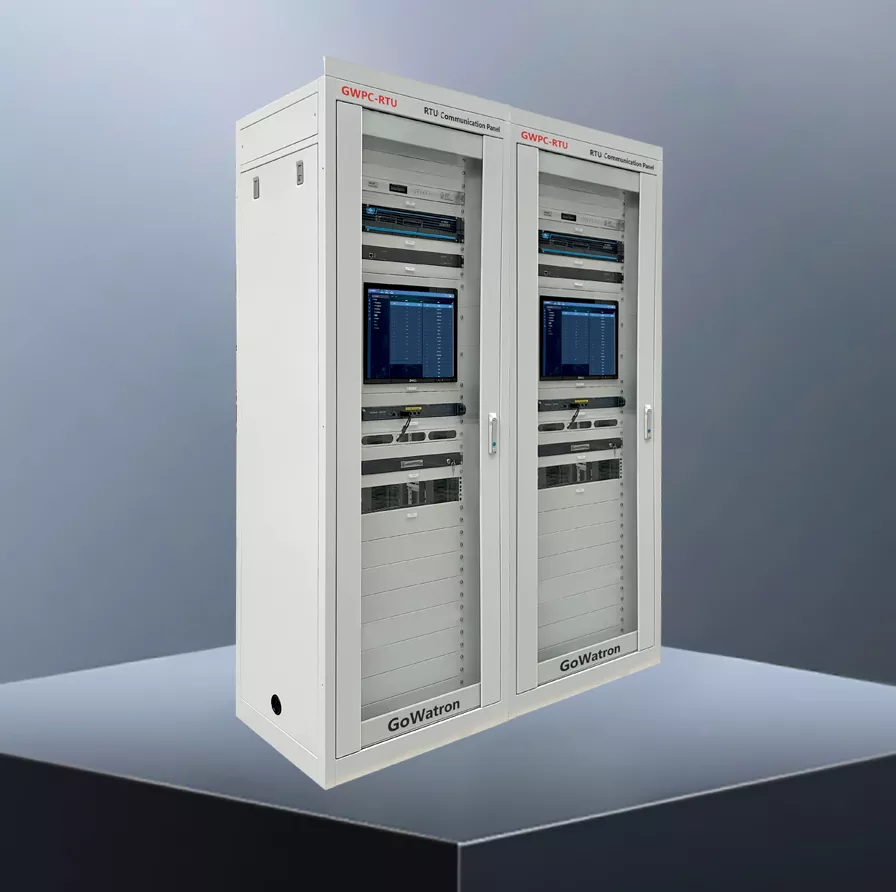
GWPC-RTU RTU Communication Panel
The GWPC-RTU RTU Communication Panel is primarily used in photovoltaic power plants, substations, distribution systems, power generation facilities, and other power automation applications for communication protocol conversion and data transmission between intelligent electronic devices (IEDs) and supervisory control systems.
Main Functions
Protocol Conversion;Supports protocol conversion and interoperability among various communication protocols, including:
- Modbus/IEC 60870-5-103/IEC 60870-5-104/TCP-IP/DNP3/IEC 61850
Data Transmission and Monitoring
- Data Upload: Telemetry, status indications, alarms, and event information are transmitted in real time to centralized control centers, SCADA systems, or utility dispatching centers through fiber-optic networks, dedicated communication networks, or wireless communication channels.
- Remote Monitoring and Control:Supports remote monitoring, supervisory control, and operational management of plant and substation equipment from dispatching centers, ensuring the safe and reliable operation of the power system.




Product Introduction
The GWPC-RTU RTU Communication Panel collects operational data from digital protection relays, multifunction power meters, and other intelligent electronic devices (IEDs) within the substation or power plant. It converts the acquired data into the communication protocols required by local monitoring systems and utility dispatch centers, and transmits critical information to centralized control centers, SCADA systems, or grid dispatching systems for real-time monitoring and supervisory control.
Product Composition
1. Remote Terminal Unit (RTU)
Functions:
- Collects real-time operational data and status information from substation and plant equipment.
- Processes, stores, and transmits data to supervisory and dispatching systems.
- Receives remote control commands from SCADA systems and dispatch centers
- Supports telemetry, status monitoring, remote control, and remote setpoint adjustment functions.
Typical Connected Devices:
- Protection Relays
- Power Meters
- DC Power Supply Systems
- UPS Systems
- Environmental Monitoring Devices
2. Communication Gateway
Functions:
- Serves as the communication hub for intelligent electronic devices (IEDs) within the station.
- Aggregates data from multiple field devices.
- Transfers collected information to RTUs, SCADA systems, and dispatching centers.
- Reduces communication workload between field devices and supervisory systems.
Supported Protocols:
- Modbus RTU
- Modbus TCP
- IEC 60870-5-103
- IEC 61850
- DNP3
3. Protocol Converter
Functions:
- Performs communication protocol conversion between different devices and systems.
- Resolves interoperability issues among equipment from different manufacturers.
- Converts field data into protocols required by SCADA and dispatching systems.
Typical Conversions:
- Modbus to IEC 60870-5-104
- IEC 60870-5-103 to IEC 60870-5-104
- IEC 61850 to IEC 60870-5-104
- Modbus RTU to Modbus TCP
4. Channel Switching Device
Functions:
- Provides automatic switching between primary and backup communication channels.
- Enhances communication system reliability and redundancy.
- Maintains uninterrupted communication during channel failures.
Typical Applications:
- Fiber-optic and 4G/5G network switching
- Primary and backup utility communication networks
- Dual dispatch center communication channels
5. Time Synchronization Device
Functions:
- Provides a unified and accurate time reference for all connected equipment.
- Ensures consistent time stamps for event recording and fault analysis.
- Meets utility requirements for precise time synchronization.
Supported Synchronization Methods:
- GPS
- BeiDou (BDS)
- NTP
- SNTP
- IRIG-B
- IEEE 1588 Precision Time Protocol (PTP)
Typical Connected Devices:
- Protection Relays
- Fault Recorders
- RTUs
- SCADA Systems
6. Industrial Ethernet Switch
Functions:
- Establishes the station communication network infrastructure.
- Enables data exchange among intelligent electronic devices.
- Supports network redundancy and traffic management.
Key Features:
- Industrial-grade design
- VLAN support
- RSTP/MSTP ring network redundancy
- IEC 61850-compliant communication
7. Fiber Optic Converter
Functions:
- Converts optical signals to electrical signals and vice versa.
- Extends communication transmission distance.
- Improves immunity to electromagnetic interference.
Typical Applications:
- Fiber optic to Ethernet conversion
- RS-485 to fiber optic conversion
- Utility communication network interfaces
8. Auxiliary Equipment and Enclosure Cabinet
Main Components:
- Power Supply Modules
- Terminal Blocks
- Miniature Circuit Breakers (MCBs)
- Fuses
- Surge Protection Devices (SPDs)
- Cable Accessories
- Cabinet Lighting
- Cooling Fans and Temperature Controllers
Cabinet Specifications:
- Dimensions: 2200 × 800 × 600 mm
- Protection Rating: IP30 to IP54 (optional)
- Floor-mounted installation
Overall Function
The GWPC-RTU RTU Communication Panel serves as the communication and data integration center of a power automation system. It collects, aggregates, converts, and transmits data from Protection Relays, Power Meters, DC Power Supply Systems, and other intelligent devices, enabling reliable communication with SCADA systems, centralized control centers, Energy Management Systems (EMS), and utility dispatching centers for real-time monitoring, control, and grid operation management.
Typical Applications
- Photovoltaic Power Plants: The GWPC-RTU RTU Communication Panel is widely used in utility-scale photovoltaic power plants, distributed solar power plants, and PV substations, enabling communication and data exchange between field equipment, SCADA systems, centralized control centers, and utility dispatching centers.
- Substations: The GWPC-RTU RTU Communication Panel is used in substations of various voltage levels to integrate Protection Relays, Power Meters, monitoring devices, and auxiliary systems, providing data collection, protocol conversion, and communication with utility dispatching automation systems.
- Thermal Power Plants: The GWPC-RTU RTU Communication Panel supports communication between generator protection systems, auxiliary power systems, substations, plant monitoring systems, and utility dispatching centers.
- Hydroelectric Power Stations: The GWPC-RTU RTU Communication Panel facilitates communication and data exchange among generating units, substations, plant monitoring systems, centralized control centers, and utility dispatching systems.
- Wind Farms: The GWPC-RTU RTU Communication Panel integrates wind turbine generators, substation equipment, Protection Relays, and monitoring systems, enabling reliable communication with SCADA platforms and grid dispatching centers.
- Battery Energy Storage Systems (BESS): The GWPC-RTU RTU Communication Panel provides communication and data integration between power conversion systems (PCS), battery management systems (BMS), Protection Relays, and supervisory systems.
- Industrial Power Distribution Systems: The GWPC-RTU RTU Communication Panel supports communication and data integration for power distribution equipment, Protection Relays, and power monitoring systems in industries such as oil and gas, petrochemical, metallurgy, mining, transportation, and data centers.
- Smart Grid and Distribution Automation Systems: The GWPC-RTU RTU Communication Panel serves as a communication and data integration platform, enabling seamless interoperability among intelligent electronic devices, supervisory systems, and utility dispatching networks.


